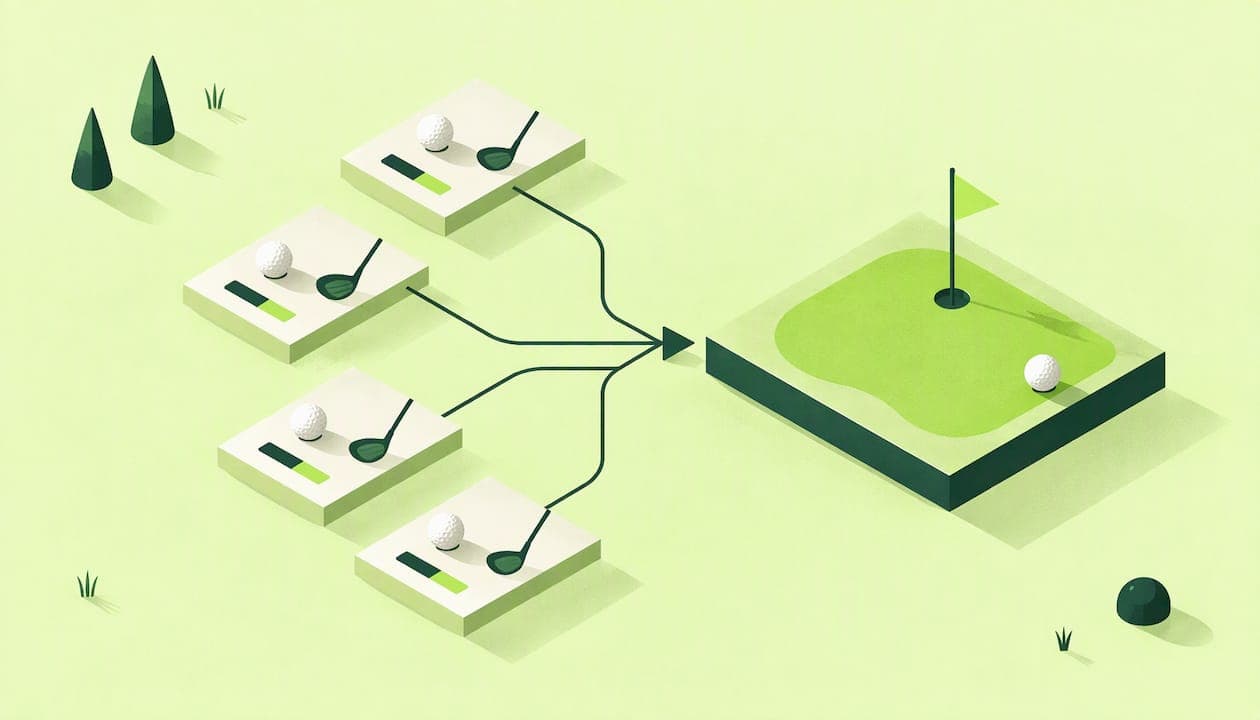
To calculate a team handicap, start with each player's unrounded Course Handicap. Multiply each one by the allowance for their position (lowest to highest) in your format. Add the results together, then round once, at the very end. For a 4-player scramble, the USGA recommends 25%, 20%, 15% and 10%. That's the whole method. The rest of this guide shows you each step with real numbers.
TL;DR
- Convert every Handicap Index to a Course Handicap for the tees you're playing, and keep the decimals.
- Apply the format's allowance to each player, add the pieces, and round only the final total.
- Scramble allowances: 2 players 35% / 15%, 3 players 30% / 20% / 10%, 4 players 25% / 20% / 15% / 10%.
- Write the allowance in your tournament rules before anyone tees off.
- Chase Birdies handles the scoring for $1 per player, so you can spend your time on the event instead of the spreadsheet.
Table of Contents
- Step 1: Get each player's Course Handicap
- Step 2: Pick the handicap allowance for your format
- Step 3: Scramble team handicap formulas
- Worked example: 4-player scramble
- Worked example: 2-player scramble
- Worked example: 3-player scramble
- Team formats where players play their own ball
- Common mistakes that throw off team handicaps
- How to run it on tournament day
- Our take on team handicaps
- Put your team handicaps to work with Chase Birdies
- FAQ
- Sources
Step 1: Get each player's Course Handicap
A team handicap is built from individual numbers. Before you can blend anything, every player needs a Course Handicap for the tees they'll play.
The USGA gives the formula as Handicap Index x (Slope Rating / 113) + (Course Rating – par). You'll find the Slope Rating, Course Rating and par on the scorecard or the course website for each set of tees.
The USGA also notes the result is only rounded to a whole number when applying net double bogey adjustments. Otherwise the unrounded result is kept and used to work out the Playing Handicap. That detail matters for teams, as you'll see below.
A quick Course Handicap example
Say a player has a Handicap Index of 14.2. The tees you're using have a Slope Rating of 128, a Course Rating of 71.4 and a par of 72.
- 14.2 x (128 / 113) = 16.085
- Course Rating minus par: 71.4 – 72 = –0.6
- 16.085 + (–0.6) = 15.485
That player's unrounded Course Handicap is 15.485. For an individual stroke play round, you'd round it to 15. For a team, keep 15.485 for now.
If your players use different tees, calculate each Course Handicap from their own tees. Don't just reuse one number for the whole group.
Step 2: Pick the handicap allowance for your format
A handicap allowance is the percentage of a Course Handicap you use for a given format. The USGA says its recommended allowances in team formats are designed to give each team the same chance of winning.
This is the part new organizers often miss. Playing Handicap is Course Handicap multiplied by the allowance. In a team event, the allowance changes by format and, in a scramble, by player position.
For events run as organized competitions, the Committee (that's you) should specify the handicap allowance in the Terms of the Competition. Put it in your event rules or sign-up page so nobody argues about it on the 18th green.
For format-by-format detail, our guide to golf team formats and handicap math is a good companion to this page.
Step 3: Scramble team handicap formulas
Scrambles are the most common reason organizers search for team handicap formulas. Everyone hits, the team picks the best shot, and everyone plays from there. One ball, so one team handicap.
The USGA's scramble allowances depend on team size. Rank your players from lowest to highest Course Handicap, then use this table.
| Team size | Lowest handicap | 2nd lowest | 3rd lowest | Highest |
|---|---|---|---|---|
| 2 players | 35% | n/a | n/a | 15% |
| 3 players | 30% | 20% | n/a | 10% |
| 4 players | 25% | 20% | 15% | 10% |
Notice the lowest handicap gets the biggest percentage. In a scramble, the better player's ability does the most to drive the team's score, so their number carries the most weight.
The rounding rule: round last
The USGA's guidance for team events where players don't play their own ball all the way through a hole is clear. Apply the allowances to each player's unrounded Course Handicap. Then combine them and round as the final step to get the team Playing Handicap.

Rounding each player first is a common shortcut, and it can shift the team by a stroke. Keep the decimals until the end.
Worked example: 4-player scramble
Here's the USGA's own scramble example. A team's unrounded Course Handicaps are 10.335, 15.353, 28.255 and 37.574. Using the 25/20/15/10 allowances, the team Playing Handicap comes out at 14.
Here's the math, step by step:
| Player (low to high) | Unrounded Course Handicap | Allowance | Contribution |
|---|---|---|---|
| 1 | 10.335 | 25% | 2.584 |
| 2 | 15.353 | 20% | 3.071 |
| 3 | 28.255 | 15% | 4.238 |
| 4 | 37.574 | 10% | 3.757 |
| Total | 13.650 |
13.650 rounds to 14. That's the team handicap. On a par 72, a gross team score of 70 becomes a net 56.
Worked example: 2-player scramble
This one uses made-up numbers to show the pattern. Player A has an unrounded Course Handicap of 8.4 and Player B has 20.6.
- Player A: 8.4 x 35% = 2.94
- Player B: 20.6 x 15% = 3.09
- Total: 6.03, which rounds to a team handicap of 6
Worked example: 3-player scramble
Again, these numbers are for illustration. The players' unrounded Course Handicaps are 6.2, 14.8 and 22.4.
- Lowest: 6.2 x 30% = 1.86
- Middle: 14.8 x 20% = 2.96
- Highest: 22.4 x 10% = 2.24
- Total: 7.06, which rounds to a team handicap of 7
For more scramble-specific guidance, see our scramble handicap rules and the 25/20/15/10 scoring math for tournament directors.
Team formats where players play their own ball
Not every team event uses one team handicap. In formats like best ball or four-ball, each player plays their own ball and usually keeps an individual Playing Handicap. The team score is then built from the individual net scores.
In those formats, the allowance is applied to each player separately. Your Terms of the Competition should say which percentage you use.
Match play team events
In team match play, the USGA says the player with the lowest Playing Handicap typically plays off zero. Everyone else receives the difference between their own Playing Handicap and the lowest one.
For Foursomes match play (alternate shot), the recommended allowance is 50% of the difference between the aggregate of each team's combined Course Handicaps. The side with the higher combined number gets those strokes.
We cover match play in more depth in our guide to match play handicaps for organizers, and compare the two best-ball styles in best ball vs four ball. If you're running alternate shot with a blended handicap, see our page on greensomes rules.
Common mistakes that throw off team handicaps
Most errors are small. They add up when 20 teams are chasing a prize.
- Rounding too early. Round each player and you may be off by a stroke. Keep decimals until the final sum.
- Mixing up the order. The biggest percentage goes to the lowest handicap, not the highest.
- Using one set of tees for everyone. If players are on different tees, each Course Handicap must come from their own tees.
- Forgetting to publish the rule. The USGA expects the Committee to state the allowance. Say it in your sign-up page and in your pre-round announcement.
- Using the wrong team size. A threesome in a four-player event needs the 3-player percentages, not the 4-player ones with a blank row.
How to run it on tournament day
You have two options. You can build a spreadsheet, check every formula and hope it holds when 80 players arrive. Or you can set the numbers once, publish the rules and let scoring take care of itself.
- Collect Handicap Indexes early. Ask for them at sign-up, along with the tees each player will use.
- Calculate Course Handicaps. Use the formula above, or a course handicap table or app.
- Rank and apply allowances. Sort each team low to high and apply your format's percentages.
- Round once. Write the team handicap next to each team name.
- Post the rules. Share the format, the allowance and any tie-break rule with every team.
- Score live. Let players or scorers enter hole-by-hole scores, so standings update as groups finish.
If you want a broader view of how to handle handicaps across a whole field, read our guide on golf tournament handicaps you can automate. Fair groupings help too, and our tournament pairings guide shows how to build them.
Our take on team handicaps
Most first-time organizers don't struggle with golf. They struggle with the paperwork around it. The handicap math is learnable in one sitting, and we think the best thing you can do is write it down once, apply it the same way to every team, and then stop fiddling with it.
That's why we built Chase Birdies for individual organizers, small clubs and fundraisers, rather than for big facilities. You set up your event in minutes, choose your format, and players or scorers enter scores hole by hole from any device. There's no subscription and no app download, and leaderboards update as scores come in.
Our pricing is $1 per player, billed once for the tournament. A 100-player charity scramble has no monthly fee waiting for you afterward. We designed it that way so a volunteer committee can run a smooth event without a budget meeting.
Jon
Put your team handicaps to work with Chase Birdies
Once your team handicaps are set, you need a place to score them. Chase Birdies is a web-based platform for live golf tournament scoring. It supports scramble, shamble, scotch, best ball, stroke play and match play. Leaderboards can be public or PIN-protected.
It costs $1 per player per tournament, with no subscription. Check the details on our pricing page, or see how hole-by-hole scoring and the live leaderboard work.

You can also browse examples on the live leaderboards page to see what your players and spectators will see.
FAQ
What's the difference between a Course Handicap and a Playing Handicap?
A Course Handicap converts a Handicap Index into strokes for a specific set of tees. A Playing Handicap is the Course Handicap multiplied by the handicap allowance for your format. In a team event, the Playing Handicap is what you actually use to calculate net scores.
Do I round before or after applying the allowance?
Round after. For team formats where players don't play their own ball the whole way, the USGA says to apply allowances to unrounded Course Handicaps, add them up, and round as the last step. Rounding early can move your team handicap by a stroke.
What are the scramble handicap percentages?
For 2-player teams, use 35% of the lowest handicap and 15% of the highest. For 3-player teams, use 30%, 20% and 10%. For 4-player teams, use 25%, 20%, 15% and 10%, from lowest to highest.
Do I have to use the USGA allowances?
The USGA allowances are recommendations designed to make team formats fair. As the organizer, you can set your own, but you should state them in the Terms of the Competition before play starts. Whatever you choose, apply it equally to every team.
Can I use these numbers for a charity event with casual golfers?
Yes. Ask players for their Handicap Index if they have one, and decide in advance what you'll do for those who don't. Many organizers set an agreed estimate, then apply the same scramble percentages to everyone.
Sources
- USGA: Calculate Course Handicap and Playing Handicap FAQs
- USGA Rules of Handicapping: Other Formats of Play
- USGA Rules of Handicapping: Scramble
- USGA Rules of Handicapping: Appendix C, Handicap Allowances