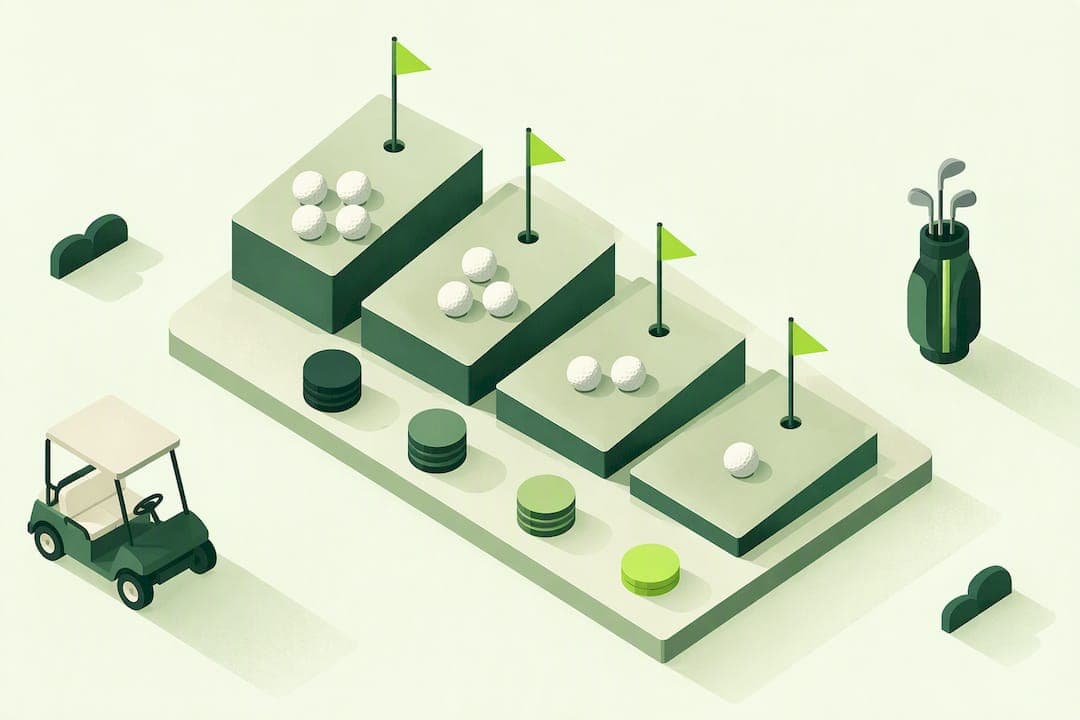
In a scramble, the team records the fewest strokes taken from the chosen shot sequence to hole out. For net scoring, most organizers apply the USGA's recommended team allowances: 25/20/15/10 for a four-player team. We'll walk through the math below, plus the in-play marking and placement rules that keep your event fair and fast.
TL;DR:
- After the team selects a shot, mark its position; players place within one club length, no nearer the hole, and preserve the same lie.
- On greens, players place within one putter head length; selected bunker shots must remain in bunkers, while penalty areas follow normal relief rules.
- For teams of three, use 30/20/10%; for teams of two, use 35/15%; apply each rate to that player’s course handicap, then total and round.
- Have two carts compare hole scores or check them at the turn, then require an official scorer to approve the card before submission.
- Mixed teams with handicaps from 10 to 20 often score in the low 60s on par 72 courses; two player teams usually score higher.
Table of Contents
- How a scramble team plays each hole, step by step
- Recording and submitting hole scores: scorecard protocol
- Team handicap math: USGA allowances and worked examples
- Common local rules and variants organizers should know
- Typical scramble scores and what counts as strong play
- Organizer checklist: what to publish on your rule sheet
- What I've learned running scrambles for years
- How Chase Birdies makes scramble scoring simple
- FAQ
- Sources
How a scramble team plays each hole, step by step
A scramble sounds simple until twelve teams hit the first tee at once. Keeping everyone on the same page starts with a consistent routine for every hole.
- Every player tees off. All four (or three, or two) players hit a drive from the tee box, no exceptions, even if the team already has a strong shot in hand.
- The team picks the best shot. Players agree on which drive to play and mark that spot with a coin or tee peg before anyone moves their ball.
- Everyone plays from the marked spot. Players place their ball within one club length of the mark, no closer to the hole, and the ball must stay in the same type of lie (fairway stays fairway, rough stays rough).
- Bunkers and penalty areas get special handling. A ball marked in a bunker must be placed in the bunker; a ball in a penalty area follows the usual relief options for that area, not the one-club-length rule.
- On the green, mark with putter-head length. This tighter radius keeps teams from gaining an unfair advantage. Give every player a real chance to putt, even once the team has a safe two-putt in hand.
- Count strokes for the chosen ball only, from the selected drive through the holed putt. That total is the team's score for the hole.
A quick etiquette note: mark clearly and move fast. Scrambles already involve four tee shots per hole, so marking your ball correctly and replacing it without delay matters more here than in stroke play.
Recording and submitting hole scores: scorecard protocol
Only one score goes in each hole's box: the team's final stroke count, written under the group's listed names. Most tournaments follow a straightforward protocol borrowed from common scramble tournament rule sheets:
- Each cart or group keeps its own running scorecard throughout the round.
- Two carts compare scores hole by hole or at the turn to catch mistakes early.
- A designated official scorer signs off on the final card before it's turned in.
- Teams share responsibility for accuracy, so a wrong number caught after submission can be hard to fix.
Most club scrambles are not posted for individual handicap indexes, since the format blends scores across players. If your event does require posting, tell players in advance how to calculate an acceptable score, typically using a most-likely-score method for any hole they didn't finish.
Team handicap math: USGA allowances and worked examples
Once you've got the gross score, applying a team handicap turns it into a net result everyone can compare fairly. The USGA's Appendix C lays out recommended percentages by team size, applied to each player's course handicap, then summed and rounded to a whole number.
Statistic: The USGA recommends scramble allowances of 25/20/15/10 for four-player teams, 30/20/10 for three-player teams, and 35/15 for two-player teams, with each percentage applied to that player's own course handicap before the figures are added together.

The total is 10.2, which rounds to a team playing handicap of 10. Subtract that from the team's gross score to get net.
Committees can choose different allowances to fit an unusually skewed field or a charity event with mixed skill levels, but whatever formula you pick should be published on the rule sheet before play begins.
Common local rules and variants organizers should know
Most scrambles add at least one house rule on top of the basics, and spelling these out ahead of time prevents disputes mid-round.
- Texas scramble requires each player's drive to be used a minimum number of times, often four, tracked directly on the scorecard so one strong driver can't carry the whole team.
- Drive minimums are common for both four- and three-player teams; some events exclude par-3 holes from the count since there's no true "drive" involved.
- Florida scramble adds a twist: whoever's shot gets selected sits out the next shot, which changes who's playing from where as the hole progresses.
- Max-score or pick-up rules cap a hole at bogey or double bogey to keep pace of play moving, though this affects how (or whether) scores get posted afterward.
Typical scramble scores and what counts as strong play
Scrambles produce lower scores than stroke play because the team always builds on its best shot, so set expectations and prizes accordingly. A mixed four-player team with handicaps in the 10 to 20 range often lands in the low-to-mid 60s gross on a par-72 course, while stronger teams can push into the mid-to-high 50s. Two-player teams, with fewer shots to choose from each time, tend to post higher scores than four-player teams of similar ability. Knowing this range ahead of time helps you set a realistic cutoff for prizes and plan for ties, since several teams often finish within a stroke or two of each other.

Organizer checklist: what to publish on your rule sheet
A short, specific rule sheet prevents most scramble disputes before they start.
- State your handicap formula. Name the exact percentages you're using and how you'll round the final number.
- Spell out placement rules. Cover club-length placement off the fairway, putter-head length on greens, and bunker or penalty-area handling.
- Set drive-usage minimums. Say how many drives each player must contribute and how you'll track compliance.
- Define scorecard procedures. Require cart comparisons, name an official scorer, and state the penalty for a missing or incorrect card.
- Clarify posting policy. Tell players whether scores count toward handicap indexes and, if so, how to post an acceptable individual score.
Pro Tip: Print the rule sheet on the back of the scorecard so no team can claim they never saw it.
What I've learned running scrambles for years
Keep the rule sheet short enough that players actually read it. Publish your handicap formula in plain numbers, not a vague reference to "USGA guidelines," so nobody argues about math after the round. Assign one official scorer per team and require two carts to compare cards before anyone signs off. Live, hole-by-hole scoring also catches a wrong number while there's still time to fix it, instead of after the trophies are handed out.
— Jon
How Chase Birdies makes scramble scoring simple
We built Chase Birdies for organizers who need scramble scoring without the headaches: hole-by-hole entry means a wrong drive count or a mismarked hole score gets caught in real time, not after the round. Editable scorecards let you fix mistakes on the spot, and our platform supports scramble setup alongside shamble, best ball, and stroke play, so you're not learning a new system for every event.

Pricing stays simple too: $1 per player, no subscription, no hidden fees, which works well for small clubs and fundraisers that only run one or two events a year. Set up your scramble and start tracking live scores at Chasebirdies.
FAQ
What are the rules for playing a scramble in golf?
Every player tees off, the team picks the best shot, and everyone plays their next shot from within one club length of that spot (no closer to the hole). This repeats until the ball is holed, and the team records one score per hole based on the chosen ball.
How does scramble format compare to best ball?
In a scramble, the whole team plays from one selected ball each shot, while in best ball, each player plays their own ball throughout and the team keeps the lowest individual score on the hole. Scramble scores tend to run much lower since the team always builds on its best position.
How is a Texas scramble scored?
A Texas scramble follows standard scramble scoring, recording the team's lowest-stroke result each hole, but it adds a requirement that each player's drive gets used a set minimum number of times, often four. Scorecards typically track which player's drive was selected to confirm the minimum is met.
What's considered a good scramble score?
A strong four-player team on a par-72 course often finishes in the mid-to-high 50s gross, while a typical mixed-handicap team lands in the low-to-mid 60s. Two-player teams usually post higher scores since there are fewer shot options to choose from on each attempt.
Sources
For the handicap math covered above, the USGA's Appendix C lays out the recommended allowances in full. Representative club rule sheets, like the NIHGA scramble appendix and a sample 4-player scramble rule page, show how these rules get applied at the event level.