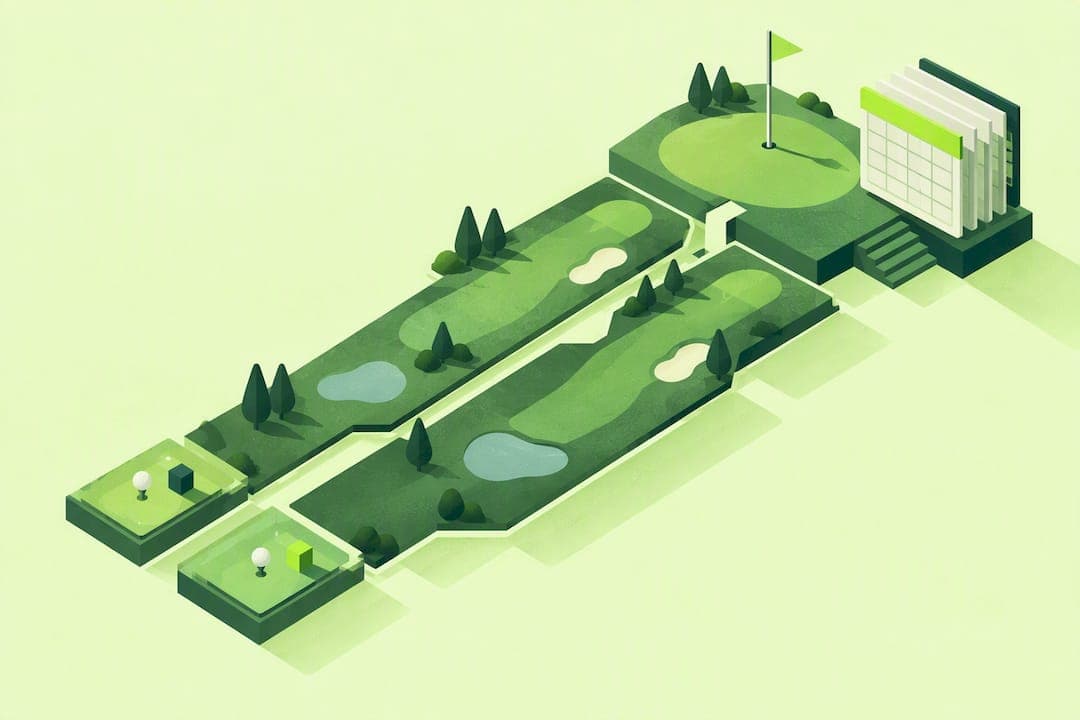
Greensomes is a two-player team format where both partners tee off, the team picks the better drive, and the partner whose ball wasn't chosen hits the second shot. From there, teammates alternate shots until the ball is holed. You can play it as stroke play, match play, or Stableford, and the World Handicap System recommends a team allowance of 60% of the lower Course Handicap plus 40% of the higher.
TL;DR:
- Greensomes handicaps are calculated by taking 60% of the lower player's Course Handicap and 40% of the higher's, then rounding according to local rules.
- The format involves both players teeing off, choosing the better drive, then alternating shots with the partner whose drive was not selected, continuing until the hole is finished.
- It can be scored as stroke play, match play, or Stableford, with the handicap allowance applied consistently across formats.
- Speeding up play involves selecting the better drive based on lie and hazard risk, announcing the choice immediately, and having a designated scorekeeper.
- Event organizers should specify local rules and handicap application procedures beforehand and can use scoring apps to streamline live score entry and leaderboards.
Table of Contents
- How Do You Play a Greensomes Hole?
- What Scoring Formats Work With Greensomes?
- How Do You Calculate a Greensomes Handicap?
- What Greensomes Variations Should You Know?
- How Do You Choose the Better Drive and Speed Up Play?
- What Should Tournament Committees Decide in Advance?
- A Format That Rewards Teamwork Over Talent
- Run Your Greensomes Event Without the Spreadsheet Headaches
- Where to Confirm the Official Rules
- Sources
- FAQ
How Do You Play a Greensomes Hole?
Every hole follows the same basic rhythm, and once you've played it once, it clicks fast.
- Both teammates tee off. You and your partner each hit a drive from the tee, so two balls are briefly in play at the same time.
- The team picks the better ball. Walk up, look at both lies, and agree on which drive gives you the best shot at the green or fairway.
- The non-selected player hits the second shot. This is the rule that trips up first-timers: whoever's drive was NOT chosen plays next, not the person who just hit the good drive.
- Alternate shots the rest of the way. After that second shot, you and your partner take turns hitting the ball until it's in the hole. No skipping turns, even on the green.
- Record one team score per hole. Only one number goes on the card, since Greensomes produces a single ball in play from the second shot onward.
Golf Monthly's breakdown of the format confirms this exact sequence: both players tee off, the team selects the preferred drive, and the partner whose shot wasn't picked plays second, with alternate shots continuing to the hole. That second-shot rule is really the whole format in one sentence. Everything else, scoring, handicaps, variations, builds on top of it.
Pro Tip: Mark your scorecard with a quick note on whose drive got picked each hole. It sounds unnecessary until hole 14, when you and your partner are arguing about who's "due" to hit the harder second shot.
What Scoring Formats Work With Greensomes?
Greensomes isn't locked into one scoring style. Committees run it three main ways, and each one changes how you fill out the card.
- Stroke play (medal): You record one gross score per hole for the team, then subtract the team's handicap allowance to get a net score for the round. This is the most common format for club events and outings.
- Match play: Instead of counting total strokes, you compare your team's score to your opponents' on each hole. Lowest net score wins the hole; ties are halved, just like standard match play scoring.
- Stableford: Your team's net score on each hole converts to points, typically 2 for par, 3 for birdie, and so on, with the highest point total winning.
Handicap allowance gets applied the same way across all three: you compute the team's combined Course Handicap once before the round, then use it to adjust either the total score (stroke play), the hole result (match play), or the points conversion (Stableford). Other explainers note this is one of the clearer distinctions from Foursomes, where the handicap math works differently.
How Do You Calculate a Greensomes Handicap?
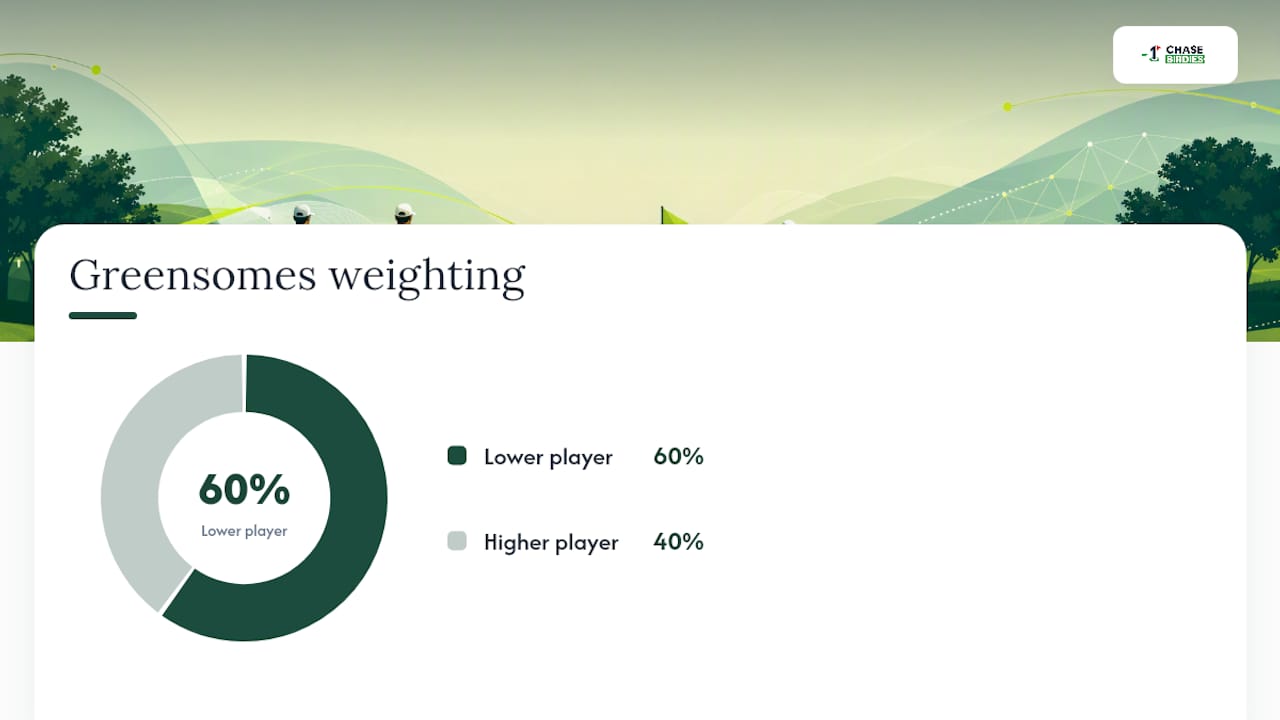
The formula the World Handicap System recommends for Greensomes is 60% of the lower player's Course Handicap plus 40% of the higher player's Course Handicap. That weighting rewards the stronger player slightly less than a straight average would, since Greensomes already gives teams two tee shots to work with.
Here's the math in practice:
- Find each player's Course Handicap. Say Player A carries a Course Handicap of 8, and Player B carries 18.
- Apply the 60/40 split. Multiply the lower handicap (8) by 0.6, giving 4.8. Multiply the higher handicap (18) by 0.4, giving 7.2.
- Add the two figures together. 4.8 + 7.2 = 12. That's the team's combined handicap allowance.
- Round according to your club's policy. Some clubs round to the nearest whole number before assigning strokes to holes; others keep the exact figure and only round when distributing stroke indexes. Check the event sheet before you tee off.
So if your team shoots a gross score for the round, subtracting the stroke allowance gives a net score adjusted accordingly. That's the number that goes up against the field in stroke play, or gets used to determine points in Stableford.
What Greensomes Variations Should You Know?
A few close cousins of Greensomes show up often enough that you should know the differences before you sign a scorecard.
- Pinehurst (also called Canadian): Both players tee off, and both players then hit a second shot with the other's ball before the team picks the better result. It's Greensomes with an extra decision point built in.
- Chinese, or St Andrews variant: The order of who plays the second shot is set in advance by hole number (odds and evens), rather than by which drive gets chosen. This removes any debate about strategy on the tee.
- Gruesomes: The twist here is that the opposing team, not your own, picks which of your two drives you have to play. It's a lighthearted variant common in casual outings.
Each variant changes the decision-making sequence enough that handicap application and fairness shift slightly too. Publish the exact variant name in your event details so nobody's surprised on the first tee.
How Do You Choose the Better Drive and Speed Up Play?
Picking the "better" drive isn't just about who hit it farther. Angle into the green, lie in the fairway or rough, and any hazards in the layup zone all matter more than raw distance on plenty of holes.
- Weigh angle over length. A shorter drive in the fairway with a clean look at the pin usually beats a longer one blocked by a tree.
- Set your tee order on risk holes. On a tight par 4, let your steadier ball striker go first so your partner can react to what's already in play.
- Use a spotter. Have one player watch the ball flight while the other tees off, especially on blind or narrow holes, to keep pace of play moving.
- Announce the pick and move on. Say out loud which drive you're using, mark it, and pick up the other ball right away instead of debating over it.
Pro Tip: Assign one player as scorekeeper for the whole round. Switching who tracks strokes hole to hole is a common way disputes creep in in Greensomes.
What Should Tournament Committees Decide in Advance?
Committees running Greensomes events need a short list of local rules published before the first tee time, so players know exactly what to expect.
- Set a minimum number of tee shots per player, if you want one. Some events require each partner to hit a set number of drives so one player doesn't dominate the tee box; Golf Monthly notes this is a common local rule worth stating clearly.
- Reserve committee discretion for edge cases. The R&A's own guidance treats Greensomes as a recognized variation of Foursomes and leaves committees to rule on anything the standard Rules of Golf don't directly cover.
- Define tie-break procedures ahead of time. Decide whether ties get settled by countback, sudden death, or a shared placing, and post it with the scorecard.
- State the scoring format and handicap method on the event sheet. Players should know before they arrive whether it's stroke play, match play, or Stableford, and exactly how the 60/40 allowance gets applied.
A Format That Rewards Teamwork Over Talent
Greensomes works because it gives every player a reason to show up and swing away. Both partners hit a tee shot on every hole, so nobody's standing around watching a stronger player carry the group. That's part of why it holds up so well for mixed-ability outings and charity scrambles, groups where skill levels vary widely but everyone still wants a moment that matters.
The format's popularity for club and fundraiser events tracks with something organizers learn fast: the rules are simple enough to explain in thirty seconds, but the strategy still rewards good decisions. Get your scoring tool sorted before the round starts. It saves you from doing handicap math by hand between holes.
— Jon
Run Your Greensomes Event Without the Spreadsheet Headaches
Once you've got the format and handicap math down, the last thing you want is a paper scorecard system falling apart on hole 12. Chase Birdies gives organizers a straightforward alternative to tracking Greensomes scores by hand or juggling spreadsheets between groups.

The platform supports hole-by-hole score entry for any format on your event sheet, including Greensomes, so players or scorers can log each team's result the moment it happens. Standings update instantly on a mobile-friendly leaderboard that anyone in the field can check from their phone, no app download required. Chase Birdies charges a flat fee per player, per event, with no subscription or hidden add-ons, which keeps it accessible for small clubs, charity outings, and casual weekend groups running Greensomes alongside other tournament formats. Check the pricing page and set up your next event in a few minutes.
Where to Confirm the Official Rules
For the handicap formula itself, go straight to the USGA's Appendix C on handicap allowances. For committee guidance and official recognition of the format, see the R&A's page on other forms of play. For practical walkthroughs, Golf Monthly and CaddieHQ both offer solid, plain-language explainers.
Sources
- USGA — Handicap allowances (Appendix C)
- R&A — Other forms of play (Greensomes)
- What Is Greensomes? | Golf Monthly
- What Is Greensomes in Golf? | CaddieHQ
FAQ
How do you work out handicaps for Greensomes?
Take 60% of the lower player's Course Handicap and add it to 40% of the higher player's Course Handicap. That WHS formula gives you the team's combined allowance for the round, which you subtract from the gross score to get net.
Is Greensomes medal or Stableford?
Greensomes can be played as either, along with match play. It's a format that describes how teams hit the ball, not a fixed scoring method, so any club or committee can pair it with stroke play, match play, or Stableford depending on the event.
Do both players tee off in Greensomes?
Yes, both teammates hit a drive on every hole before the team picks the better of the two. That's the feature that separates Greensomes from Foursomes, where partners alternate every shot including the tee shot.
What is a good Greensomes score?
It depends entirely on the team's combined handicap and the course's difficulty, since net score is what matters for comparing against the field. A team’s net score depends on their combined handicap allowance and gross score, which determines how well they perform relative to the field.
Can I use a scoring app to run a Greensomes event?
Yes. Chase Birdies supports hole-by-hole entry for Greensomes and other team formats, with live leaderboards that update as scores come in, with pricing details available on their website.