
Use the World Handicap System and USGA Rules of Handicapping as your foundation, then apply a format-specific allowance from Appendix C, such as 95% for individual net stroke play or 85% for four-ball. Lower percentages fit team formats like scrambles, where partners can cover for each other's weak holes. Whatever you pick, write it into your Terms of Competition before the first tee time so every player knows the math before they sign a scorecard.
TL;DR:
- Using a 95% allowance for individual stroke play ensures fair competition, while team formats like four-ball typically require allowance reductions to 85% or lower.
- Confirm players’ handicap data actively, particularly for multi-round events, by verifying their Handicap Index against an official source within a recent timeframe.
- Automated scoring software is recommended to handle complex handicap calculations, course adjustments, and live leaderboards, reducing errors and save time.
- Applying the correct allowance based on format influences both fairness and the enjoyment of participants, with conservative percentages encouraging participation.
- Set and communicate handicap procedures clearly beforehand, including freezing indexes at tournament start and handling exceptional scores through pattern review rather than immediate adjustments.
Table of Contents
- What Organizers Need to Know About Golf Tournament Handicaps
- Calculating and Applying Handicaps: A Step-by-Step Walkthrough
- Recommended Handicap Allowances by Tournament Format
- How to Pick the Right Allowance and Put It in Writing
- Worked Examples: Doing the Math for Common Formats
- Practical Implementation: Letting Software Do the Math
- History and Purpose of Golf Handicaps in Tournaments
- How Handicaps Impact Tournament Fairness and Competition Levels
- Verifying Handicaps Before Your Tournament
- Handling Handicaps Across Multi-Day and Multi-Round Events
- Dealing With Exceptional Scores During Play
- Balancing Competitiveness and Inclusion
- Run Your Handicap Math Automatically With Live Scoring
- Sources
- FAQ
What Organizers Need to Know About Golf Tournament Handicaps
Three terms get thrown around loosely at tournament check-in tables, and mixing them up is the fastest way to hand someone the wrong number of strokes. Get comfortable with each one and you'll spend less time fielding confused questions on the first tee.
- Handicap Index: a portable number reflecting a player's demonstrated ability, based on the best 8 of their last 20 Score Differentials. It travels with the player from course to course.
- Course Handicap: the Handicap Index converted into actual strokes for the specific course and tee being played, using that course's rating and slope.
- Playing Handicap: the Course Handicap after your committee applies its chosen allowance percentage for the format. This is the number that actually gets used for scoring.
Behind the scenes, the system also protects against wild swings. Caps limit how much a player's Index can jump in a short window, and an exceptional-score reduction kicks in when someone posts a round dramatically better than their norm. You don't need to calculate these yourself. Just know they exist, because they're part of why the Index you see today should be trustworthy going into your event.
Calculating and Applying Handicaps: A Step-by-Step Walkthrough
Once you understand the three core terms, applying them in a live tournament comes down to a repeatable sequence. Run through these steps for every player, or better yet, let your scoring software do it.
- Confirm the Handicap Index. Pull it from the player's home club or a national database, and check the date it was last updated. An Index more than a few weeks stale can be misleading if the player's game has shifted.
- Calculate the Course Handicap. Apply the course rating and slope for the tee the player will use. Two players with identical Indexes can get different Course Handicaps if they're playing different tees.
- Apply the format allowance. Multiply the Course Handicap by your chosen percentage (95%, 85%, and so on, depending on format).
- Round appropriately. Standard practice rounds to the nearest whole number at the 0.5 mark, but confirm your rounding rule in advance and apply it consistently for every player.
- Allocate hole strokes by stroke index. Distribute strokes according to the course's stroke index ranking, starting with the hardest-rated hole and working down.
Plus-handicap players (those better than scratch) give strokes back rather than receive them. Allocate those the same way, just in reverse, starting on the easiest-rated hole.
Pro Tip: Before the round starts, spot-check two or three Course Handicaps by hand against your software's output. It takes five minutes and catches slope or rating errors before they turn into a scoring dispute on the 18th green.
Recommended Handicap Allowances by Tournament Format
Appendix C of the USGA's Rules of Handicapping lays out recommended allowances for the formats most clubs and charity events actually run. These percentages exist because different formats carry different risks of handicap abuse, and the guidance adjusts for that.
| Format | Recommended Allowance | Applied To |
|---|---|---|
| Individual stroke play | 95% | Course Handicap |
| Four-ball (best ball) | 85% | Each player's Course Handicap |
| Foursomes (alternate shot) | 50% | Combined team Course Handicap |
| Scramble (4-person) | Varies by team size, generally 20-25% per player | Combined team calculation |
| Individual match play | 100% | Course Handicap |
Team formats get lower percentages because a strong partner can mask a weaker one's mistakes on any given hole, inflating the team's competitive edge if full handicaps were applied. That's the logic behind dropping four-ball to 85% and foursomes to 50%, according to USGA guidance. Field size matters too: a small field of 20 players in a net stroke-play event behaves differently than a 120-player charity scramble, and committees are free to set separate allowances by flight or division if the skill spread is wide.
How to Pick the Right Allowance and Put It in Writing
Choosing an allowance isn't guesswork once you know your field. Run through this short checklist before you finalize your Terms of Competition:
- How many players are registered, and how wide is the handicap spread across the field?
- What format are you running, individual, four-ball, foursomes, or scramble?
- Are you awarding prizes based on gross score, net score, or both?
- Do you need separate flights or divisions for fairness across skill levels?
For medium-sized net stroke-play events, a typical allowance is around 95%. Smaller fields can consider a higher allowance percentage, as appropriate. Scrambles and other team formats call for reduced percentages, since inclusive formats like Stableford or team scoring can be forgiving toward higher-handicap players in ways that reward setting the allowance conservatively.
Pro Tip: Paste this directly into your Terms of Competition: "Playing Handicaps will be calculated using [format] allowance of [X]% per USGA Appendix C, applied to Course Handicap." One sentence, zero ambiguity.
Worked Examples: Doing the Math for Common Formats
- Individual stroke play. A player has a Course Handicap of 14. Apply the 95% allowance: 14 x 0.95 = 13.3, which rounds to 13. If their gross score is 88, their net score is 75.
- Four-ball best ball. Two partners have Course Handicaps of 10 and 18. Each applies the 85% allowance separately: 8.5 (rounds to 9) and 15.3 (rounds to 15). On each hole, only the lower net score between the two partners counts toward the team total.
- Four-person scramble. Team Course Handicaps of 8, 12, 16, and 20 get weighted at roughly 20-25% each and combined into a single team handicap, then subtracted from the team's gross scramble score to get net.
For a plus-handicap player in any format, reverse the stroke allocation: they give strokes on the easiest holes instead of receiving them on the hardest.
Practical Implementation: Letting Software Do the Math
Manual handicap math works fine for a dozen players. It falls apart fast once you're running 80 players across four flights with mixed tees. Look for scoring software that handles the heavy lifting:
- Imports Handicap Indexes directly rather than requiring manual entry for every player
- Looks up course rating and slope automatically for the correct tee
- Calculates Playing Handicap with your chosen allowance built in
- Allocates hole strokes by stroke index without you touching a spreadsheet
- Publishes a live net leaderboard as scores come in
Chase Birdies handles this at $1 per player, with hole-by-hole scoring and instant leaderboard updates built for exactly this kind of event.
History and Purpose of Golf Handicaps in Tournaments
Handicapping exists to solve one problem: golf, unlike most sports, routinely pits wildly different skill levels against each other in the same event. A club member-guest tournament might include a 3-handicap and a 22-handicap teeing off in the same group, and without an adjustment, the outcome is decided before the first swing.
The concept dates back over a century, with early handicap systems developed independently by clubs and national associations long before anyone standardized the math. For decades, golfers dealt with a patchwork of regional systems, the USGA Course Rating and Slope System in the United States, and separate systems used across Europe, Australia, and elsewhere. That fragmentation made it hard to compare handicaps across borders or even across different clubs in the same country.
The World Handicap System launched in 2020, unifying these regional systems into one global standard. It gave every golfer, regardless of where they play, a Handicap Index calculated the same way and portable to any course with a rating and slope on file.
For tournament organizers, that history matters practically. It means the Index a visiting player brings to your charity scramble was calculated under the same rules as your home club members', which is exactly the kind of consistency that makes net competition possible in the first place.
How Handicaps Impact Tournament Fairness and Competition Levels
A well-applied handicap system does something almost no other adjustment in sports can: it lets a 6-handicap and a 24-handicap compete for the same net prize with a real chance for either to win. That's the entire point, and it's why net divisions consistently draw more participation than gross-only events at the club level.
But fairness only holds if the allowance matches the format. That's precisely why Appendix C recommends reduced percentages for team formats, and WHS guidance frames these allowances as an equity tool, not an arbitrary discount.
Getting the allowance right also affects how competitive the event feels on the course, not just on the scoreboard. Players who sense the net field is winnable tend to play more aggressively and enjoy the round more, and properly calibrated net competitions measurably increase participant satisfaction compared to events where the same three names win every year. If you're organizing a charity outing where fun and repeat attendance matter as much as competitive integrity, that's worth weighing when you set your allowance.
Verifying Handicaps Before Your Tournament
You can build the most precise allowance table in the world and still get burned by a player who shows up with an inflated or unverified Index. Most well-run tournaments require players to submit a valid, current Handicap Index at registration, ideally pulled directly from an official database rather than self-reported.
A few checks are worth building into your registration process:
- Confirm the Index is active and updated within the last several weeks, since a stale number doesn't reflect current form.
- For players without an established Index, decide in advance how you'll handle them. Many events assign a default (often based on the club maximum or a conservative estimate) rather than letting them play gross.
- Watch for players who suddenly show up with a much higher Index than their reputation suggests. This happens innocently often enough, but it's worth a quiet conversation rather than an accusation.
- Require identical documentation across all divisions. Nothing sours a member-guest faster than one flight getting handicap scrutiny while another skates through.
None of this needs to feel like an interrogation. A short line on your registration form, "Please provide your current Handicap Index from your home club or the USGA GHIN system," combined with a spot-check for anything that looks off, covers most of what you need.
Handling Handicaps Across Multi-Day and Multi-Round Events
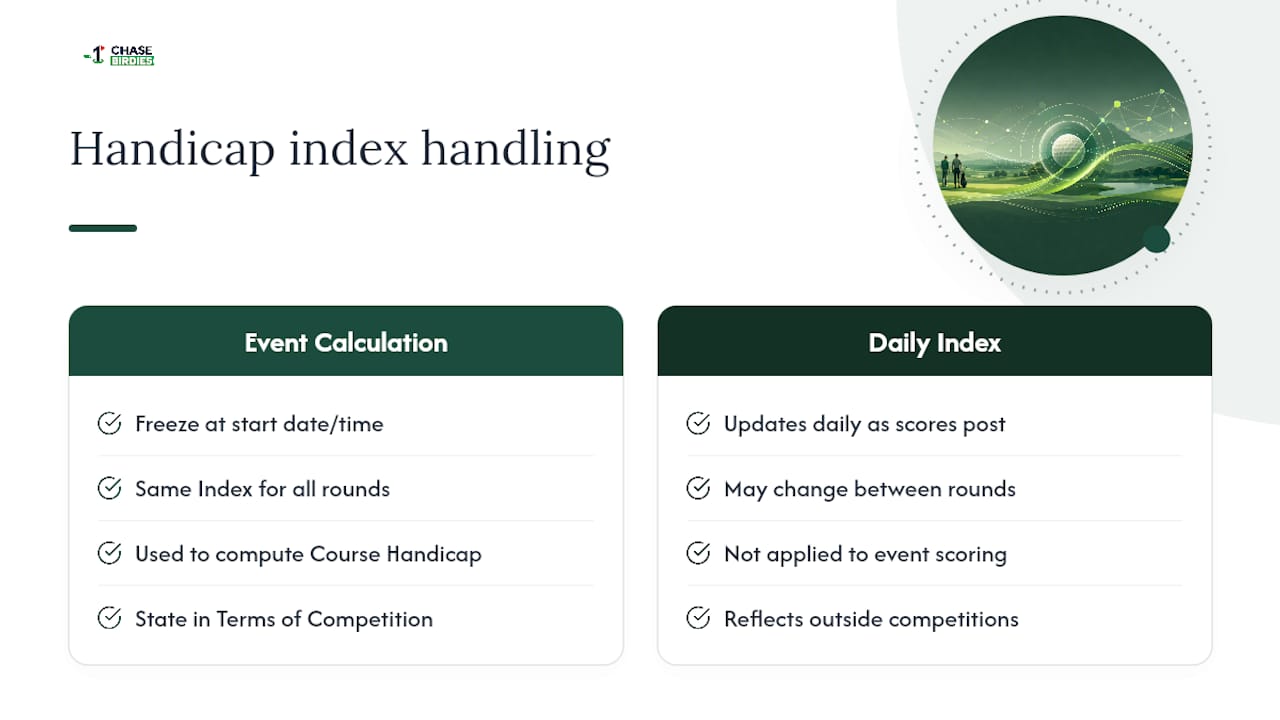
Multi-round tournaments introduce a wrinkle single-round events don't have: a player's Handicap Index can update between rounds, especially in longer events spanning a full week. The Index typically revises daily as new scores post, which means the Course Handicap you calculated for Round 1 might not match what the system generates for Round 3.
Most committees solve this by freezing the Handicap Index at the start of the event. Whatever Index a player carries when the tournament begins is the one used for every round, regardless of what happens to their Index during the event itself. This keeps the math simple and prevents the odd situation where a great Round 1 score lowers a player's Index and makes Round 2 harder for them to win net.
State this rule explicitly in your Terms of Competition. Something as short as "Handicap Indexes will be frozen as of [date/time] for the duration of this event" removes any ambiguity, and it's one of those details that seems minor until a player asks about it mid-tournament and nobody has an answer ready.
For flighted multi-day events, also decide upfront whether flights are locked after Round 1 based on gross or net scores, since re-flighting midway through creates its own fairness questions separate from handicapping.
Dealing With Exceptional Scores During Play
Every organizer eventually runs into the round that doesn't add up: a player posts a score dramatically better than their handicap suggests, and now the leaderboard looks lopsided. The WHS's exceptional-score reduction is designed to catch some of this automatically between events, adjusting a player's Index downward when a round significantly outperforms their demonstrated ability. But that adjustment applies to future rounds, not the one just played, which leaves organizers wondering what to do in the moment.
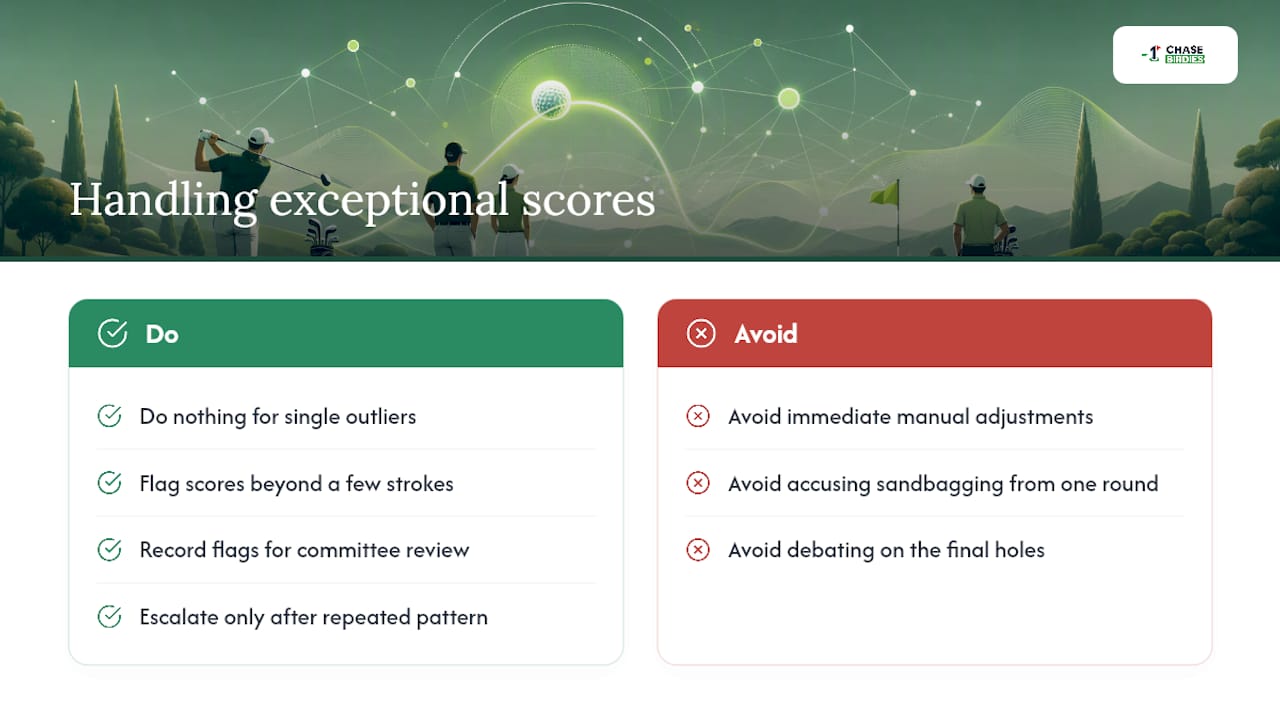
The honest answer is: usually nothing, if your allowances were set correctly going in. A single great round from a mid-handicap player isn't proof of sandbagging. It's proof that golf has variance, and the same player will post a mediocre round the following month. Chasing every outlier score with a manual adjustment erodes trust in the system faster than the occasional lopsided finish ever will.
Where intervention is warranted is pattern, not incident. If a player's tournament scores consistently and dramatically outperform their maintained Index across multiple events, that's a conversation for your handicap committee to have using established WHS review procedures, not something to litigate on the back nine of a single round. Build a simple post-event review step into your process, where any score more than a few standard strokes off a player's expected range gets flagged for the record, not for punishment, but so your committee has data if a pattern does emerge over time.
Balancing Competitiveness and Inclusion
The temptation for any organizer is to chase precision, tightening allowances until the math feels airtight. But fairness on paper and fairness in the field are not the same thing. The best tournaments I've seen prioritize clarity over cleverness: a simple, well-published allowance that everyone understands beats a mathematically perfect one nobody reads. Get the communication right, and the formula almost takes care of itself.
— Jon
Run Your Handicap Math Automatically With Live Scoring
Calculating Playing Handicaps by hand for a full field is doable for a dozen players. It gets error-prone fast once you're juggling mixed tees, flights, and formats like scrambles or four-ball on the same day. Chase Birdies was built for exactly this problem: enter each player's Handicap Index, and the platform handles Course Handicap conversion, allowance application, and hole stroke allocation automatically, then publishes a live net leaderboard players can check from their phones between holes.

It supports the formats covered in this guide, including scramble, four-ball, and stroke play, with hole-by-hole score entry from players or designated scorers. There's no subscription to manage and no hidden fee structure. Pricing is a flat $1 per player, billed once before your event goes live. If you're planning a member-guest, charity outing, or club championship this season, set up your tournament and see your handicap math and leaderboard running before your first group tees off.
Sources
FAQ
How do golf handicaps work in tournaments?
A player's Handicap Index converts into a Course Handicap for the specific tee being played, then a format-specific allowance (like 95% for individual stroke play) produces the Playing Handicap used to calculate net scores.
What does a +7 handicap mean?
A plus-handicap means a player is expected to score better than scratch, so instead of receiving strokes, they give strokes back on the easiest-rated holes.
What does a 54 handicap mean?
A maximum Handicap Index exists under the World Handicap System, allowing beginners and higher-scoring players to post rounds and compete in net competitions.
Is a 25 handicap a bad golfer?
Not at all. A 25 handicap simply reflects a player's typical scoring level relative to par, and the handicap system exists specifically so that player can compete fairly against lower-handicap golfers in net formats.