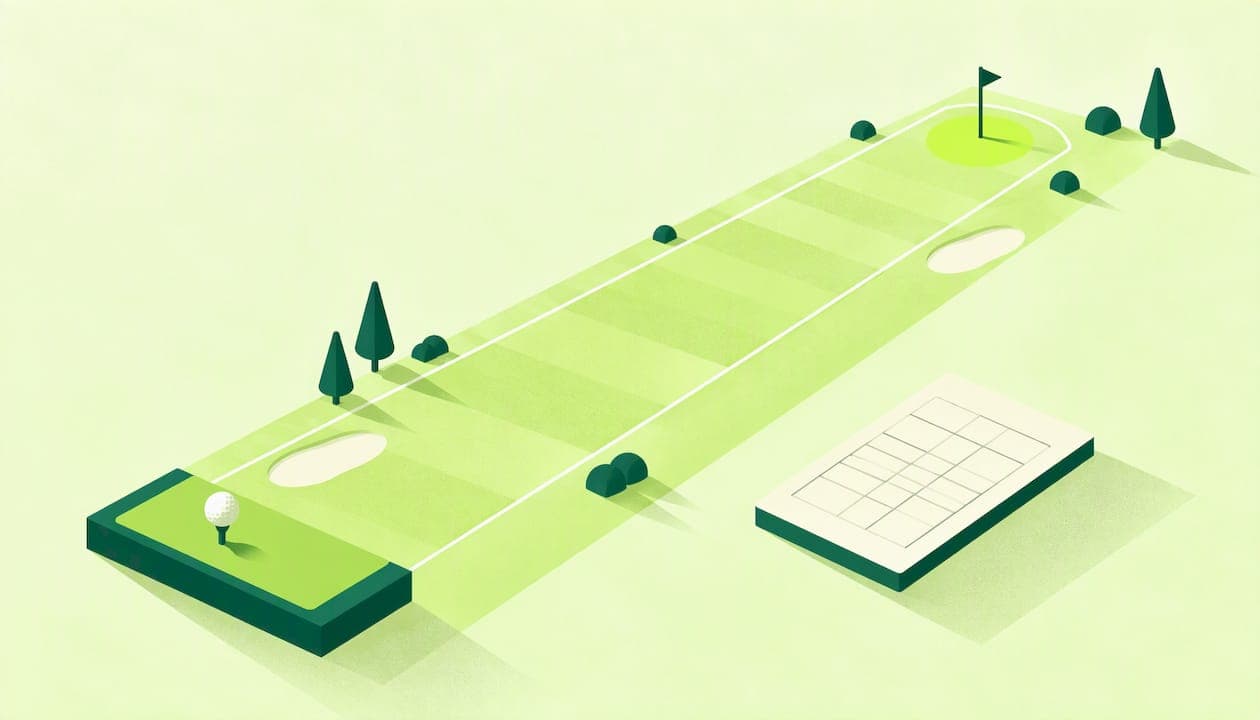
A long drive contest is one of the easiest side events to add to a golf outing. Pick one hole, mark where the best drive lands, and give the winner a prize. The ideas below go further than that. They cover formats, rules, course setup, prizes and ways to raise money, so you can run it without a hitch even if it's your first tournament.
TL;DR
- Pick a wide, straight par 5 (or a long par 4) with one clear tee box and a fairway landing zone you can see.
- Set the rules before anyone swings: fairway only, one ball per entry, and separate men's and women's divisions from their own tees.
- Track the leader with a marker stake on the course, so everyone can see the number to beat.
- Make it pay: sell extra attempts, add a mulligan-style "grip it and rip it" round, or find a sponsor for the hole.
- Keep the contest separate from your main scoring so volunteers aren't juggling two jobs.
Table of Contents
- Start with the hole, not the format
- Core rules that keep it fair
- Ten long drive contest ideas
- How to set it up on the day
- Prize ideas at every budget
- Ways to make money from the contest
- Coaching tips you can share with players
- Our perspective: keep the side contest simple and the scoring effortless
- Run the main round on Chase Birdies
- A sample schedule for a 72-player outing
- Common mistakes to avoid
- FAQ
- Sources
Start with the hole, not the format
Before you pick a format, pick the spot. The right hole does most of the work for you.
Look for a hole with these traits:
- A wide, forgiving fairway. You want a landing area that most golfers can hit, not a narrow chute that turns the contest into a lottery.
- A straight line from the tee. Doglegs reward shot shaping, not distance. Course architects often use doglegs and diagonal fairway zones to test players on turning the ball both ways. That's great for a tour event and a headache for a charity outing.
- Room behind the longest drives. Your biggest hitters may carry it well past where most groups land. Make sure the fairway keeps going.
- A spot spectators can stand safely. Put a cart path or a rope line well off the landing zone, and keep people behind the tee box.
For most events, a long, straight par 5 is the standard pick. A par 4 works too if it's long enough that your longest hitters won't reach the green. Talk to the pro shop before the day. They know which holes have the cleanest landing areas and can tell you where the ball tends to run.
Core rules that keep it fair
People search for "long drive contest rules" because arguments start the minute a ball lands near a line. Settle the rules in writing and read them aloud at the start.
Fairway only
The most common rule is that the ball must come to rest in the fairway. A drive that ends up in the rough or the trees doesn't count, however far it went. Standard practice is that anything outside the fairway boundaries is disqualified, so the contest rewards power and accuracy together.
If you expect a lot of beginners, consider a friendlier version: the ball must stop in the fairway or the first cut. Decide this up front and tell everyone.
Separate divisions
Run men's and women's contests on the same hole, each from its own tees. Many charity organizers use color-coded markers, with blue for men and red for women, so players and volunteers know which stake belongs to which division. You can add a senior or junior division the same way.
One ball, one swing
Keep it simple. Each entry gets one drive. No re-tees, no provisional balls, no "that one didn't count." If you sell extra attempts (more on that below), each attempt is its own entry.
Equipment
For an amateur event, there's no need to police equipment beyond the basics. If you want to keep things within standard golf rules, the USGA limits driver heads to 460cc and the overall club length to 48 inches. Most retail drivers are shorter than the maximum. Players showing up with a borrowed or novelty club should be told in advance whether it's allowed.
Who decides close calls
Name one volunteer as the final judge before the contest starts. Their call stands. That one decision saves you from a dozen debates.
Ten long drive contest ideas
Here are formats that work for casual outings, member days and fundraisers. Mix and match.
1. The classic marker stake
This is the format most people know, and it's still the best for first-timers. Place a stake or flag in the fairway. The first player to hit a valid drive writes their name on it. When someone beats that drive, a volunteer moves the stake to the new spot and updates the name. The marker works as a live leaderboard: anyone walking past can see the number to beat. By the end of the day, the stake sits where the winner's ball stopped.

This works well when the contest runs all day during a shotgun start or a spread-out round, because players hit as they pass the hole.
2. The grid or yardage-line contest
If you have time to prep, mark the fairway with painted lines or small flags every 10 yards. Volunteers then call out which band each drive landed in. It's faster than measuring every ball and gives spectators something to react to. Use a laser rangefinder only for the final tie-break.
3. The one-hit finale
Instead of an all-day contest, hold it at the end. Pull the field together after the round, line up the entries, and let each player hit once with the crowd watching. It turns a side contest into entertainment, especially with a microphone and a friendly announcer. It's a good fit when you have a post-round meal or awards party, since everyone is already there.

4. Straightest drive
This flips the goal. The winner is whoever lands closest to a center line painted or staked down the fairway. It gives your shorter hitters a real chance and is a nice companion event to a pure distance contest. You can run both from the same tee box.
5. Long and straight combined
Only drives that end inside the fairway count, and the winner has the longest one. That's the standard rule, but you can make it a feature: announce it as the "long and straight" challenge so players know accuracy matters.
6. Mulligan-style extra attempts
Let players buy a second or third swing. Each attempt costs a set amount and only the best counts. It raises money, keeps the line moving if you cap it, and lets people try again after a mishit. Set a limit, such as three attempts per person, and keep a volunteer at the tee to collect payment and wristbands.
7. Team longest drive
For scramble events, add up the combined yardage of all four players' drives, or take each team's best single drive. Team versions suit groups where not everyone wants to compete alone. If you're running a team format for the main round, see our scramble format guide for how the scoring works.
8. The mini-driver challenge
Hand every entrant the same club, such as a mini driver or a 3-wood. Equal equipment levels the field and removes the "my driver is newer than yours" factor. A mini driver sits between a driver and a 3-wood and has a more compact head that can be easier to control, which makes it a decent equalizer for mixed-skill groups.
9. Celebrity or sponsor hitter
Ask a local pro, a high school coach or a sponsor's executive to hit alongside the field. It draws a crowd and gives the sponsor visibility. Make sure the guest hits in a separate category or as an exhibition so they can't take the prize from a paying player.
10. Bonus-challenge combo
For corporate and organizational events, it's common practice to add a few bonus competitions alongside the main format to spice things up. Pair your long drive with a closest-to-the-pin hole on a par 3 and a putting contest near the clubhouse. Our guide to golf tournament games that raise money covers more of these.
How to set it up on the day
A long drive contest needs a few volunteers and about an hour of prep. Work through these steps.
- Get the course's okay. Tell the pro shop which hole you want and how many volunteers you'll have. Ask where you can safely put stakes and whether anything has to come out before play resumes.
- Mark the tee boxes. Use clear color-coded markers for each division. Put up a sign that lists the rules in three or four lines.
- Define the fairway. Make the boundaries obvious. If the cut line is hard to see, add flags or paint along the edge of the landing area.
- Station your volunteers. You need one person at the tee to check names and collect any fees, and one or two in the landing area to spot the ball and move the stake. Give them radios or phones so they can talk.
- Place the leader stake. Put it near the start of the landing zone and write the division name on it. Bring a permanent marker.
- Record the final results. Take a photo of each winning ball and stake position. Measure the winning drives with a rangefinder or a measuring wheel so you have official numbers for the awards.
- Announce winners with the main results. Read the long drive winners alongside your tournament standings so they get a moment.
If your event runs on a busy club tee sheet, pace matters too. A contest hole can slow groups down if players are stopping to hit extra attempts. Clubs that want to keep the sheet moving can look at how other committees think about fair tee time scheduling, then decide whether the contest hole needs its own staffed time window.
Prize ideas at every budget
Prizes don't have to be expensive. Players care about the bragging rights as much as the gear.
- Low cost: A sleeve of premium golf balls, a hat, a gift card to the pro shop, or a bag tag with the winner's name and year.
- Mid-range: A golf towel and ball set, a round of golf for two, or a dinner voucher from a local restaurant sponsor.
- Big-ticket: A laser rangefinder or GPS watch. One prize roundup lists a golf GPS watch at $299.99, and prices change often, so check before you budget.
- Sponsor-donated: Ask local businesses to donate prizes in exchange for a sign at the contest hole. That moves the cost off your budget entirely.
- Trophy or traveling trophy: A trophy that passes from winner to winner each year gives the contest a story. Engrave a plate each season.
For each division, award first place only, or add second and third if you have plenty of prizes. Keep the award list short so the ceremony moves.
Ways to make money from the contest
If you're running a fundraiser, the long drive hole can pay for itself.
- Entry fee per attempt. Charge a flat fee per swing, with a discount for three. This is the simplest option.
- Hole sponsorship. A business pays to have its name on the signs and stake.
- Prize donation in exchange for exposure. Sponsors give the prizes, you give them the shout-out.
- Bundle with other contests. Offer a "contest pass" that covers long drive, closest to the pin and putting at a single price.
- Donation challenge. Spectators pledge money per yard for a chosen hitter, and the total goes to the cause.
For a deeper walkthrough of event budgeting and logistics, see our charity golf tournament checklist.
Coaching tips you can share with players
Some of your players will ask how to hit it farther. A short note on the tee-box sign or in your welcome email helps.
- Keep the swing simple. Tour players often say consistency comes from simplicity. One PGA Tour player says his driver swing is simple, so there's not much that can go wrong.
- Load into the trail hip. Instruction from the same Golf Digest feature points to a stable load into the trail hip, without swaying, as a way to hit the ball harder and straighter.
- Swing at 90 percent. That's our own advice from watching outings: a smooth swing in the fairway beats a wild one in the trees, since out-of-fairway drives don't count.
If you're also planning a putting contest, level shoulders over the ball help the putt roll rather than hop, according to the same Golf Digest feature.
Our perspective: keep the side contest simple and the scoring effortless
We built Chase Birdies for organizers who aren't running a big facility. They're running a member day, a church outing or a fundraiser for a local cause, and they often have a handful of volunteers. Here's what we've seen work.
The long drive contest shines when it takes almost no effort to run. A stake, a marker and one volunteer who knows the rules is enough. What trips organizers up is trying to track side contests and the main round on the same clipboard. Players get confused, volunteers get stretched and results come out late.
So we suggest splitting the jobs. Let the contests live on the course, with the stake as the live leaderboard. Let your tournament scoring live online, where players or scorers enter scores hole by hole and the leaderboard updates instantly. That way, nobody has to "babysit" the scores, and your volunteers can focus on the contest hole.
And if you're deciding which format to play for the main round, start with one your group already knows. Scramble is a safe choice for mixed-ability groups. Best ball and stroke play suit club members who want to count their own scores.
— Jon
Run the main round on Chase Birdies
Once your contest hole is set, the rest of the day is scoring. Chase Birdies costs $1 per player per tournament, with no subscription and no hidden fees. You set up your event in minutes, players or scorers enter scores hole by hole from a phone, and your leaderboard updates live. You can make it public or protect it with a PIN. Players don't need to download an app or register to follow along.
Take a look at the live leaderboard and the hole-by-hole scoring pages to see how it works, or browse our format guides to choose the right game for your group.
A sample schedule for a 72-player outing
Here's how a shotgun-start fundraiser might use the long drive contest.
| Time | What happens |
|---|---|
| 7:30 a.m. | Check-in. Volunteers get contest rules and stakes. Players pay for extra attempts. |
| 8:30 a.m. | Rules briefing. The final judge for the long drive hole is introduced. |
| 9:00 a.m. | Shotgun start. Groups pass the contest hole as they play. |
| 9:00 a.m. to 1:00 p.m. | The stake moves as longer drives land. Scores are entered hole by hole. |
| 1:30 p.m. | Lunch and awards. Final stake position is measured. |
| 2:00 p.m. | Winners announced and prizes handed out. |
Adjust the times to your course, field size and format. The shape stays the same: a quick briefing, a contest that runs in the background, and results at the meal.
Common mistakes to avoid
- Picking a hole with a blind landing zone. If volunteers can't see where the ball ends up, they can't judge it. Walk the hole first.
- Skipping the divisions. Without separate tees and markers for men and women, the contest feels unfair to half the field.
- No named judge. Disagreements drag on. One final judge ends them.
- Too many attempts. If players can buy unlimited swings, groups back up. Cap it at three.
- Forgetting the sign. A small sign with the rules saves your volunteers from repeating themselves all day.
- Letting side contests take over the day. The long drive is a bonus. Keep it to one hole and a few volunteers.
FAQ
How far should a long drive contest hole be?
There's no official number for casual events. Choose a par 5 or a long par 4 with a wide, straight fairway that runs well past where your longest hitters will land. The goal is to give your strongest players room without making the landing area unfair for everyone else.
What are the basic long drive contest rules?
The usual rules are one drive per entry, the ball must finish in the fairway, and men and women compete from their own tees. Name a final judge before the contest starts and post the rules at the tee. Add any local tweaks, like allowing the first cut, in writing.
How do you track the winner during the day?
Use a marker stake in the fairway. The first valid drive writes a name on it, and each longer drive moves it. At the end, the stake shows the winning spot. Measure it with a rangefinder or measuring wheel and record the yardage for the awards.
Can beginners take part?
Yes. Offer a friendly set of rules, such as letting the ball stop in the first cut, and add a straightest-drive or equal-club category. Those options keep the contest open to golfers of every level.
What should I charge for a long drive contest?
That depends on your crowd and cause. Many organizers set a flat price per swing and a lower price for three. Check your costs and what sponsors are covering, then pick a number your players will happily pay.
Sources
- Golf Tournament Ideas: Longest Drive
- Longest Ball, Leaderboard glossary
- Golf Driver Buying Guide, Callaway Golf
- The PGA Tour's best in driving, iron play, putting and more, Golf Digest
- Players 2026: If you built a course today to test the world's best players, Golf Digest
- 47 Best Golf Outing Prizes & Award Ideas, Groovy Golfer