Here are ready-to-run golf tournament games and contest formats you can pick and implement today to increase fun and fundraising. This guide groups ideas by what they're best at: raising money, keeping every skill level engaged, or setting up fast with minimal fuss. You'll also get pricing guidance, a setup checklist, and a look at how live scoring cuts down on day-of headaches.
TL;DR:
- Selling bundled mulligans, ball drop raffle entries, and hole-in-one insurance maximizes voluntary player spending to boost overall fundraising revenue.
- Novelty holes like golf cannons or marshmallow drives are best placed on shorter, less congested holes to prevent slowing down the entire round.
- Using live scoring apps supports real-time leaderboards and reduces scorecard errors during large or contest-heavy events.
- A focused selection of three to five well-managed contests focused on inclusivity and pace creates a more engaging experience than a long list of unstaffed activities.
- Selecting tournament formats such as scramble or shamble encourages faster play and accommodates mixed skill levels while maintaining competitiveness.
Table of Contents
- Golf Tournament Games Organized by Goal
- Choosing a Tournament Format That Fits Your Group
- Pricing Games and Prizes So They Actually Raise Money
- Setting Up Contest Holes Without Slowing Down Play
- How Live Scoring Keeps Contest-Heavy Events Moving
- Fewer Games, Run Well, Beat a Long List Every Time
- Run Your Contests, Skip the Scorecard Chaos
- Sources
- FAQ
Golf Tournament Games Organized by Goal
Not every game belongs in every event. A 40-person office outing needs different contests than a 144-player charity scramble with a title sponsor. Sort your options by what you actually need them to do, then pick three or four instead of overloading every hole.
Revenue drivers exist to raise money, not just entertain. These work because players buy in more than once per round.
- Mulligans. Sell do-over shots before the round, usually 3 for $20 or similar bundles. Setup is a table near the first tee and a volunteer with a cash box or card reader.
- Ball drop or crane drop. Sell numbered golf balls, then drop them from a height (a cherry picker, a second-story balcony, even a ladder works for smaller events) onto a target green. Closest ball wins. This needs open space, a permit from the course if you're using equipment, and a spotter to track ball numbers.
- Hole-in-one contest. One par-3 hole offers a big prize (cash, a car, a vacation) for an ace. This is the single highest-liability game on this list, so hole-in-one insurance is standard practice rather than optional. Insurance turns a rare but real payout risk into a fixed, budgeted cost.
- Beat-the-pro. A local teaching pro plays a hole alongside groups; if a participant beats the pro's score, they win a prize or their entry fee back. Needs a willing pro and a modest appearance fee.
Classic contest staples are the ones every regular expects to see, and they double as easy sponsor-branded holes.
- Longest drive. Measured on a straight, wide par-4 or par-5. A simple stake-and-flag system works; a laser measuring tool speeds up disputes.
- Closest to the pin. Runs on any par-3. Mark the spot with a stake and record player name, time, and distance on a clipboard or a phone.
- Straightest drive. Less common but popular with higher-handicap groups since it rewards accuracy over power. Mark a centerline down the fairway with string or chalk.
- Putting contest. Best run before or after the round on the practice green. A simple bracket or closest-to-the-hole format works for large groups without slowing down the course.
- Skins game. Each hole has a cash or prize value; the lowest score on a hole wins the "skin," and ties carry the value to the next hole. This is one of the common side-game formats organizers have used for decades because it adds stakes to every single hole, not just the final score.
Team and format-based games change the rules of the whole round rather than adding a single contest hole.
- Scramble variants. All four players hit, then the team picks the best shot and everyone plays from there. Texas scramble and Florida scramble add small twists on how many drives each player must contribute.
- Shamble. Everyone drives, the team picks the best drive, then each player plays their own ball into the hole from that spot. It's a hybrid that keeps team speed but restores some individual scoring integrity.
- Best ball. Each player plays their own ball for the full hole; only the best score on the team counts. Slower than a scramble but fairer for handicap-based competition.
- Bingo Bango Bongo. Points go to the first player on the green, the closest to the pin once everyone's on, and the first to hole out. It's a favorite for mixed-skill groups because a weaker player can still score points against a low handicapper on any given hole, a format detail well documented among common side-games and variations.
Novelty and activation holes exist purely to make people laugh and remember the event. These pair well with a sponsor logo and a photo op.
- Golf cannon. An air-powered launcher shoots a ball toward the green instead of a swing. Fun for a par-3, but it needs a dedicated marshal and prior approval from the course, since it changes normal play at that hole.
- Plinko board. A giant pegboard where a dropped ball bounces into prize slots. Works well at a beverage cart stop or the 19th hole.
- Marshmallow drive. Players swing at a marshmallow instead of a ball for a photo-friendly laugh. Zero safety concern, minimal setup.
- Golf pong. A cornhole-style setup where players chip into cups instead of throwing bags. Great filler activity near the clubhouse before shotgun start.
- Club-draw hole. Players draw a random club from a bag (a 3-wood, a putter, even a wedge) and must play the entire hole with only that club. It's cheap, fast to set up, and it levels the field for a hole because everyone's stuck with the same limitation.
Pro Tip: Pick your novelty holes based on your crowd's tolerance for slow play. A golf cannon or a plinko board can double the time a group spends on that hole, so place them on shorter par-3s where backups won't ripple through the whole course.
Choosing a Tournament Format That Fits Your Group
The format you pick changes everything downstream: pace of play, how forgiving the day is for beginners, and which contests even make sense — properly managed as explained in this director's playbook. The Rules of Golf draw a clear line between match play (hole-by-hole competition against an opponent) and stroke play (total strokes across the round), and most tournament formats build on one of those two foundations.
- Scramble. Everyone hits, the team plays the best shot. Fastest pace, most forgiving for beginners, the default choice for charity and corporate outings because no single weak player can sink the team's score.
- Best ball / four-ball. Each player plays their own ball; the team counts the lowest score per hole. Slower than a scramble, but it rewards individual play and works well for mixed-handicap foursomes.
- Shamble. A hybrid: team picks the best drive, then everyone plays their own ball in. Faster than best ball, more individual than a scramble.
- Stroke play. Every player counts every stroke for the full round. This is the format for a serious club championship, not a casual fundraiser, since a single bad hole can wreck a player's day.
- Match play. Head-to-head, hole by hole. Great for bracket-style club events, less practical for a large one-day outing since pace varies wildly between matches.
- Alternate shot / foursomes. Two players share one ball, alternating shots. Slow and demanding, best reserved for experienced players in club events.
Net scoring (score minus handicap) versus gross scoring (raw strokes) matters here too. Net scoring keeps a tournament competitive across skill levels; gross scoring rewards the best players outright and works better for a small, skilled field. If you're weighing a scramble against a shamble for a mixed-ability charity field, the scramble usually wins on pace, while the shamble gives slightly better players more credit for their own game.
Pricing Games and Prizes So They Actually Raise Money
Fundraising add-ons work because they give players more ways to spend beyond their entry fee. Charity golf tournaments that layer contests with raffles, mulligans, and ball drops routinely outperform events that rely on entry fees alone.
- Price mulligans as bundles, not singles. A single mulligan for $10 undersells itself. Bundle three for $25 or five for $40, and sell them again at the turn for players who used their first batch fast.
- Structure the ball drop as a numbered raffle. Price balls at $20 to $50 each depending on the prize value, cap the sale at a known number (say, 300 balls), and drop from a fixed height onto a marked target. The math is simple: 300 balls at $30 nets $9,000 against one prize.
- Guarantee hole-in-one prizes with insurance, not your own budget. A large cash prize or a new car sounds great until someone actually aces the hole. Hole-in-one insurance costs a small flat fee relative to the prize value, and most courses require proof of coverage before they'll even let you offer a big prize on their property.
- Package sponsorships in clear tiers. Hole, contest, and title sponsorships can be made available at different tiers with increasing benefits such as signage and logo placement.
Pro Tip: Ask your title sponsor to underwrite the hole-in-one insurance cost specifically. It's a small, clean ask that gives them a concrete story to tell their own customers: "We made sure nobody walked away empty-handed."
Setting Up Contest Holes Without Slowing Down Play
Every contest hole needs three things before the shotgun start: written approval from the course for anything unusual (a cannon, a ball drop, a cash prize), a volunteer stationed at the hole with clear instructions, and a way to record results that won't get lost by the 18th green.
- Confirm insurance coverage and course approval at least two weeks out, especially for hole-in-one prizes or novelty activations that use equipment.
- Assign one volunteer per contest hole, armed with a scoring sheet, a tape measure or laser rangefinder, and a cash box or card reader if the hole sells anything.
- Use clear signage at every contest hole so players know the rules without asking a volunteer to repeat them all day.
- Decide upfront how you'll collect scores: paper scorecards turned in at the clubhouse, or a live scoring app that updates as groups finish holes.
- Build in a buffer between groups at any hole with a game attached, since even a simple closest-to-the-pin contest adds 60 to 90 seconds per group.
More than one million golf outings happen every year in the United States, and courses that host dozens of tournaments a season can tell within the first few groups whether your setup is going to bottleneck. A clean check-in and clear contest signage buy you goodwill with the course for next year's booking.
How Live Scoring Keeps Contest-Heavy Events Moving
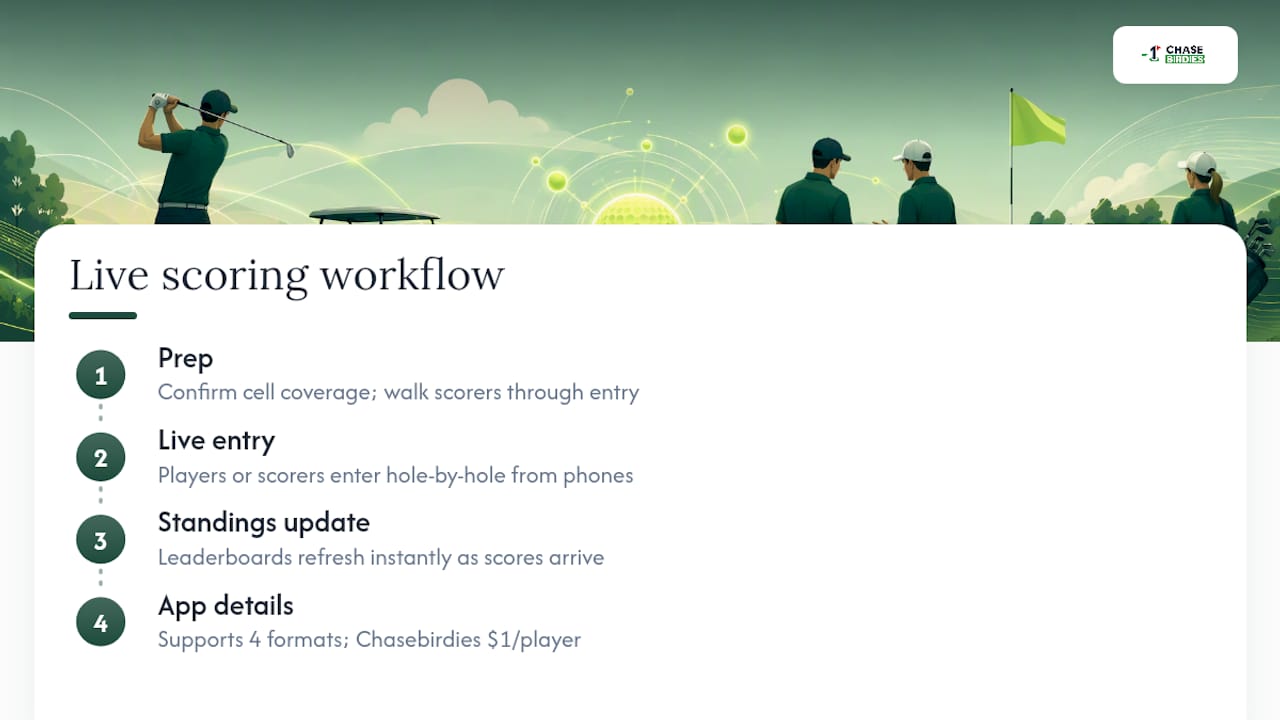
Once you've stacked a round with skins, closest-to-the-pin, and a team scramble, tracking it all on paper gets messy fast. Live scoring tools let players or scorers enter results hole by hole from a phone, so standings update instantly instead of waiting for scorecards to reach the clubhouse. Chasebirdies charges $1 per player with no subscription, supports scramble, shamble, best ball, and stroke play scoring, and works from any mobile browser. Before the round, confirm cell coverage at the course, walk scorers through hole-by-hole entry, and decide whether your leaderboard should be public or PIN-protected for a private group.
Fewer Games, Run Well, Beat a Long List Every Time
Most first-time organizers try to cram in ten contests because more feels safer. It isn't. Three to five well-run games, matched to your group's skill spread and your fundraising goals, beat a long list where half the holes have no volunteer and no signage. Pick your anchors, then test one new activation each year instead of overhauling everything at once.
— Jon
Run Your Contests, Skip the Scorecard Chaos
Chasebirdies is the tool to reach for once you've picked your games: instead of chasing down paper scorecards from ten different contest holes, players and scorers enter scores hole by hole and every standing updates live.
At $1 per player with no subscription, it fits a 40-person charity scramble just as easily as a 150-player member-guest event, and it supports every format covered here, from scrambles to best ball to straight stroke play. That means less time spent reconciling handwritten scores at the clubhouse and more time announcing winners while sponsors are still around to hand out prizes. Check pricing and set up your leaderboard before your next shotgun start.
Sources
- 17 Golf Tournament Ideas to Bring In the Big Bucks | Cvent Blog
- Variations of golf — Wikipedia
- Rule 3, The Rules of Golf — R&A
- HIO (hole-in-one insurance provider)
- 50 Charity Golf Tournament Ideas — Colorado Under Par
FAQ
What are some fun games to play on a golf course?
Closest-to-the-pin, longest drive, and skins games are reliable favorites because they're easy to set up and understood by every skill level. Novelty holes like a marshmallow drive or a club-draw hole add variety without slowing down the round much.
What are some fun tournament ideas for a group?
A scramble format paired with two or three contest holes (longest drive, closest to the pin, a putting contest) covers pace, inclusivity, and entertainment for most groups. Adding a themed name tied to your cause or organization, as Cvent notes, tends to boost participation and perceived value.
What are some fun and engaging types of golf competitions?
Skins games, Bingo Bango Bongo, and team scrambles all reward different skills, which keeps mixed-handicap fields engaged since no single style of play dominates every hole. Beat-the-pro contests add a memorable twist by letting amateurs measure themselves against a real teaching professional.
What games are good for tournaments?
For fundraising, mulligans, ball drops, and hole-in-one contests generate revenue beyond entry fees. For pure engagement across skill levels, skins games and Bingo Bango Bongo tend to perform best, and pairing either with a live scoring tool like Chasebirdies keeps results visible to players throughout the day.