Run your par 3 contest with hole-by-hole scoring and a live leaderboard. This gives players fast results, keeps everyone honest, and makes prize decisions easy to defend. The Committee still has to set the Terms of Competition and verify scores before anything is final, but with the right mobile tool, even a small club can pull this off with almost no setup time.
TL;DR:
- Most par-3 contests can be scored live using mobile web tools, but you must test connectivity and input before play begins.
- Choose a scoring format—such as stroke play, closest-to-pin, or one-club challenge—that aligns with your event goals and determines prize categories.
- Set clear rules on tie-break procedures and score verification methods, and communicate them well before the event to prevent disputes.
- A simple, flat fee app like Chase Birdies offers real-time leaderboard updates at a predictable cost, suitable for small or casual events.
- Assign designated roles for scorers, technology management, and score verification early to keep the event moving smoothly within a tight timeline.
Table of Contents
- What is a par 3 contest and which format fits your event
- Essential scoring rules and Committee items you must set first
- Live scoring options organizers can choose
- Step-by-step setup checklist to get live scoring ready in 30 to 60 minutes
- How to verify scores and resolve ties quickly and fairly
- Sample 2-hour event timeline and role assignments
- History and significance of par 3 contests in golf culture
- Common rules and etiquette specific to par 3 contests
- Strategies for players participating in a par 3 contest
- Field lessons for easy par-3 contests
- How Chase Birdies makes par-3 contest scoring simple
- Sources
- FAQ
What is a par 3 contest and which format fits your event
A par 3 contest is a short-hole event, usually played on a course's par-3 holes or a dedicated short course, built for speed and spectator appeal. Groups move fast, scores are easy to compare, and it works well for a standalone fundraiser or as a fun add-on before a bigger tournament.
Before you touch any scoring tool, pick your format. The format decides how you score, how you break ties, and how you structure prizes.
- Straight stroke play: lowest total score across the par-3 holes wins, simplest to explain and score.
- Closest-to-pin: each hole has its own winner, good for keeping a crowd engaged all day.
- One-club challenge: players use a single club for every shot, adds difficulty and comic relief for casual events.
- Stableford or net scoring: rewards consistency and lets players of different skill levels compete fairly using handicaps.
Gross scoring rewards the best raw play, while net scoring (score minus handicap) levels the field for a mixed-ability charity crowd. Whichever you pick, decide it early since it shapes your entry fee, your prize pool, and how many categories you announce at registration.
Essential scoring rules and Committee items you must set first
Before you open registration, your Committee (even if that's just you and one co-organizer) needs to nail down a few things in writing. USGA Committee Procedures require the Committee to set the Terms of Competition, including the form of play, gross or net scoring, tie-break method, groupings, and where scores get verified after the round.
- Form of play: stroke play, match play, or a hybrid closest-to-pin format, stated clearly on the entry form.
- Gross vs net: decide up front whether handicaps apply, and collect them at registration if they do.
- Tie-break method: pick one method (scorecard playoff, sudden-death hole, or split prize) and publish it before play starts.
- Score verification area: name a physical or digital spot where players confirm their card matches the leaderboard.
The Rules of Golf require markers to certify scores and players to check and sign their card. A wrong returned score can disqualify a player unless the Committee determines marker error caused the mistake, so make certification part of your routine, not an afterthought.
A published tie-break method resolves most disputes before they happen: stating it on the scorecard or entry form removes the guesswork that causes arguments at the awards table.
For most small par-3 contests, gross scoring with a scorecard playoff for ties keeps things simple and avoids drawn-out rules debates.
Live scoring options organizers can choose
You have three practical paths for keeping score during a par-3 contest, and the right one depends on your budget, group size, and comfort with tech.
- Spreadsheet or manual updater: someone collects paper cards and types scores into a shared spreadsheet, works for very small groups but lags behind live play.
- Simple event web apps: lightweight tools built for one-day events, usually free or low-cost, with basic leaderboard display.
- Mobile web scoring: players or markers enter scores hole by hole from their phone, with a public or PIN-protected leaderboard updating instantly.
Spreadsheets need no setup cost but demand a dedicated volunteer typing all day. Mobile scoring needs a phone signal at each hole but gives spectators and players real-time standings without anyone babysitting a laptop.
Think about who is entering scores. A public leaderboard URL works well for a casual outing, while a PIN-protected link suits a private club event or one where you want to control who sees results before the awards ceremony. For players less comfortable with a phone, assign a marker to enter scores on their behalf rather than asking every golfer to manage an app mid-round.
Pro Tip: Test your scoring link on one hole before the first group tees off, so you catch connectivity or input issues while there's still time to fix them.
Step-by-step setup checklist to get live scoring ready in 30 to 60 minutes
Most of the setup work happens before anyone swings a club. Work through this list a day or two ahead, then run a final check the morning of the event.
- Confirm your format and tie-break rule. Lock in gross or net scoring and the tie-break method so they're ready to print on entry forms.
- Collect handicaps if you're using net scoring. Ask for these at registration, not on the tee box.
- Choose your scoring category. Decide between manual, a simple web app, or mobile hole-by-hole scoring based on your group size and volunteer count.
- Set your leaderboard's privacy. Pick public for open events or a PIN for private ones.
- Create the event and generate your scoring link or code. Share it with markers and any tech-savvy volunteers ahead of time.
- Print simple instructions. A one-page sheet with the link, PIN if needed, and a quick "how to enter a score" note saves time at check-in.
- Test one sample hole. Enter a practice score and confirm it appears on the leaderboard before real play starts.
- Assign a tech lead. One person should be reachable by phone in case a marker gets stuck.
Running through this list once means tee time doesn't turn into a scramble to figure out who's entering what.
How to verify scores and resolve ties quickly and fairly
Treat your live leaderboard as provisional until scores are certified, a distinction USGA Committee Procedures call out directly: committees are expected to validate scores after play, not just display them in real time. Set up a verification table near the last hole or the clubhouse where players confirm their card matches what's on the leaderboard.
- Announce your tie-break method before play starts so nobody feels blindsided at the awards table.
- Keep the leaderboard labeled as unofficial until every card is checked and signed.
- Collect witness statements or photos if a dispute comes up and the scorecard alone doesn't settle it.
- Give the benefit of the doubt when evidence is inconclusive rather than letting a dispute drag out the awards ceremony.
The USGA's Local Rules and Terms of the Competition includes a model rule for missing marker certification, which lets committees avoid overly harsh penalties when the marker, not the player, caused the paperwork gap. Adopting that model rule ahead of time saves you from having to make a judgment call under pressure.
Sample 2-hour event timeline and role assignments
A par-3 contest moves fast, so a tight timeline keeps things on schedule without rushing players.
- 0:00 to 0:20, setup: tech lead tests the scoring link, markers get instructions, registration table opens.
- 0:20 to 0:40, check-in: players confirm handicaps, pick up scorecards, and get the leaderboard link or PIN.
- 0:40 to 1:30, play: groups rotate through holes, using ready golf order of play to keep a single-tee or multi-hole rotation moving.
- 1:30 to 1:50, verification: players check in at the verification table, markers confirm scores, leaderboard moves from provisional to final.
- 1:50 to 2:00, awards: announce winners by category and hand out prizes.
Assign four roles ahead of time: a Committee chair who owns final rulings, a tech lead who manages the scoring link, markers who enter or confirm scores at each group, and a rules contact players can find quickly if a question comes up mid-round. Ready golf, where players hit when ready rather than strictly by honor, keeps a crowded short-hole rotation from backing up.
History and significance of par 3 contests in golf culture
Short-hole contests have long served as the lighter counterpart to full-length tournament golf. Because a par-3 course or a set of par-3 holes can be played in a fraction of the time of a full round, clubs and charities have used the format for decades as a way to bring in casual players, families, and sponsors who might not commit to an all-day event.
The appeal is structural as much as social. A par-3 contest compresses the skill of shot-making into a small number of swings, which means a high-handicap player has a real shot at closest-to-pin or a hole-in-one prize alongside a scratch golfer. That leveling effect is part of why the format shows up so often at charity fundraisers, where organizers want an event that feels inclusive rather than intimidating.
For clubs, a par-3 contest also works as a social bridge. It's short enough to pair with a dinner or auction afterward, and it gives newer members or first-time players a low-pressure way to compete without the time commitment of 18 holes. That combination, quick play, approachable scoring, and prize variety, is why the format keeps reappearing at everything from casual member outings to nonprofit tournaments.

Common rules and etiquette specific to par 3 contests
Because par-3 contests move quickly and often involve mixed skill levels, a few etiquette points matter more here than in a standard round.
Honor and order of play still apply, but many organizers adopt ready golf under Rule 6 to keep things moving, meaning players hit when it's safe and ready rather than waiting strictly for the furthest-from-the-hole player. This matters more on short holes where groups can bunch up fast.
A few practical rules to set and communicate clearly:
- One shot per hole rules, common in closest-to-pin formats, should be stated explicitly so players don't assume they get a second try.
- Out-of-bounds or lost ball procedures need a simple local rule, since re-teeing eats up time in a fast-moving format.
- Spectator zones near the tee should be marked off if you're expecting a crowd, both for safety and to keep sightlines clear for closest-to-pin judging.
Basic etiquette still holds: repair divots, stay quiet during another player's shot, and keep pace with the group ahead. In a short-hole format, the biggest etiquette lapse is usually slow play from a group treating a par-3 contest like a leisurely back nine instead of the quick, energetic event it's meant to be.
Strategies for players participating in a par 3 contest
Club selection matters more in a par-3 contest than almost any other format, since every shot counts and there's little room to recover from a bad swing. Players who take an extra moment to check wind, pin position, and yardage before committing to a club tend to outperform those who grab the same iron out of habit.

Accuracy beats distance here. A par-3 contest rewards precision over power, so players are often better off taking one more club and swinging smoothly than forcing a shorter club to reach the pin. In one-club challenge formats, this matters even more: picking a versatile mid-iron that can handle a punch shot, a full swing, and a bump-and-run gives more flexibility than choosing based on distance alone.
For closest-to-pin formats, watch the flag position closely. A back pin means the smart play might be aiming for the center of the green rather than firing directly at the flag and risking a shot that sails long. Players chasing a net prize should also know their handicap strokes going in. Understanding exactly which holes get a stroke can change which shots are worth the risk and which ones call for a safer play toward the middle of the green.
Field lessons for easy par-3 contests
Every par-3 contest that runs smoothly has one thing in common: the organizer tested the tech before real scores were on the line. Skipping that step is the most common reason a leaderboard stalls mid-event.
Keep your Terms of Competition short and posted somewhere players actually see them, not buried in an email. Name your verification area out loud during check-in so nobody has to ask where to confirm their card. Small, clear decisions made early save you from bigger headaches once the awards table is set up.
— Jon
How Chase Birdies makes par-3 contest scoring simple
Chase Birdies lets you enter scores hole by hole from any phone, with a live leaderboard that updates the moment a marker submits a card. No app download, no registration for players, just a link you share before the first tee time. Example leaderboards are available to browse on the live leaderboard page, so you can see how results look to your players and spectators before your event even starts.
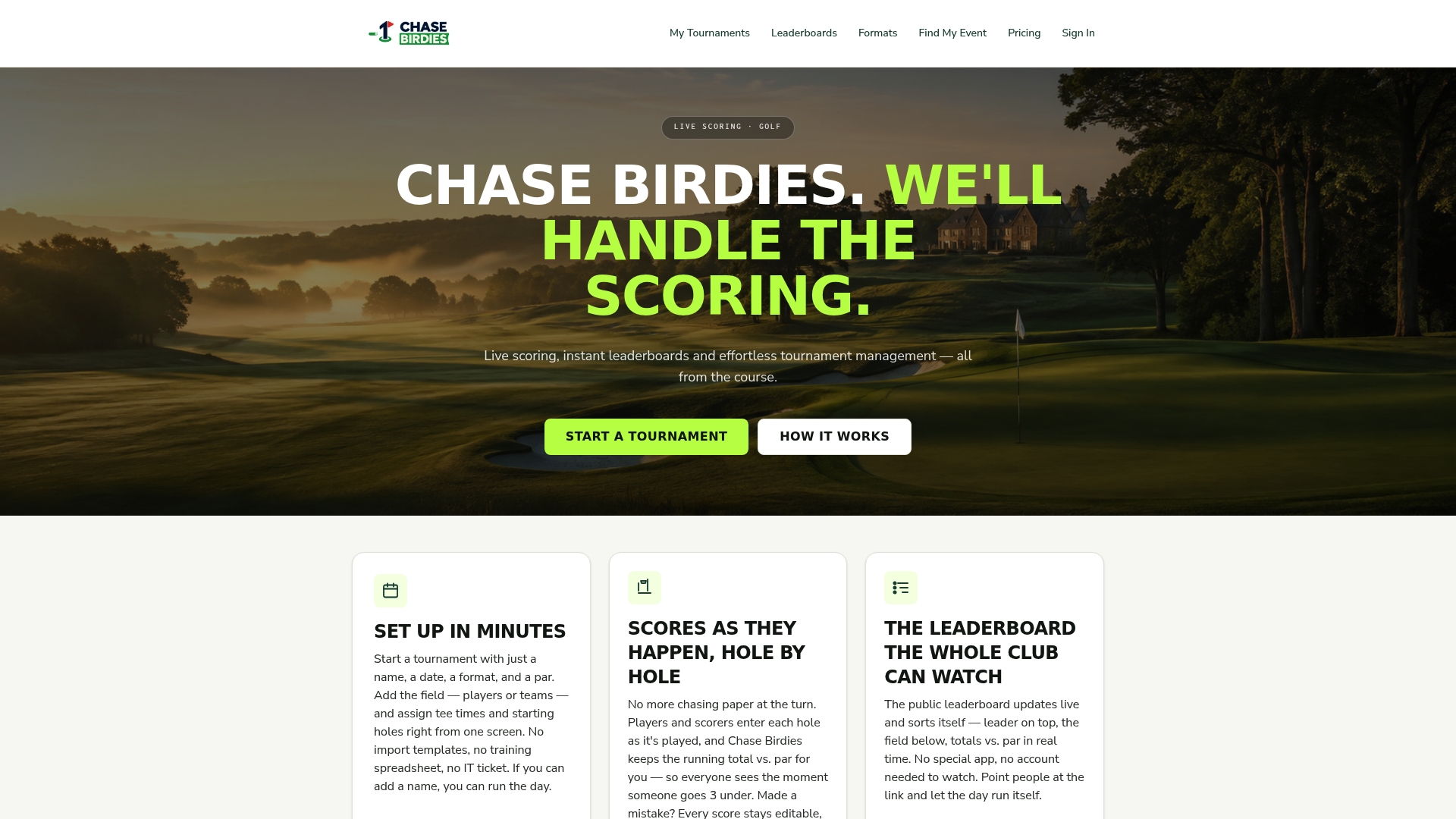
Pricing follows a flat $1 per participant, paid once before your event goes live, with no subscriptions or hidden fees. That means a 40-player charity par-3 contest costs a predictable amount, not a recurring bill you forget to cancel. If you're mixing formats, the scoring feature page covers editable scorecards and setup details.
To get started, create a test event, share the link with your markers, and confirm one sample hole updates correctly before your first group tees off.
Sources
FAQ
What is a par 3 contest in golf?
A par 3 contest is a short-hole event played on par-3 holes or a dedicated short course, usually scored for speed and spectator interest. Common formats include straight stroke play, closest-to-pin, and one-club challenges, often used for charity fundraisers or casual club outings.
How do you score a par 3 contest, gross or net?
Either works and the choice depends on your group's skill range. Gross scoring rewards raw performance and suits a skilled field, while net scoring subtracts each player's handicap to level the field for a mixed-ability charity crowd, a distinction the Rules of Golf address directly in how competitions are structured.
How do you break a tie in a par 3 contest?
Announce your tie-break method before play starts, whether it's a scorecard playoff, a sudden-death hole, or a split prize. The USGA's Local Rules and Terms of the Competition offers model language organizers can adopt so the method is clear and defensible.
What live scoring tool works best for a small par 3 contest?
Mobile hole-by-hole scoring with a public or PIN-protected leaderboard gives the fastest, clearest results for a small event. Chase Birdies offers this at a flat $1 per participant with no subscription required, built specifically for organizers running one-off events rather than large facilities.
Do you need a Committee for a casual par 3 contest?
Yes, even a two-person Committee should set basic Terms of Competition, including format, tie-break method, and where scores get verified. USGA Committee Procedures outline these responsibilities regardless of event size, and following them keeps results defensible if a dispute comes up.