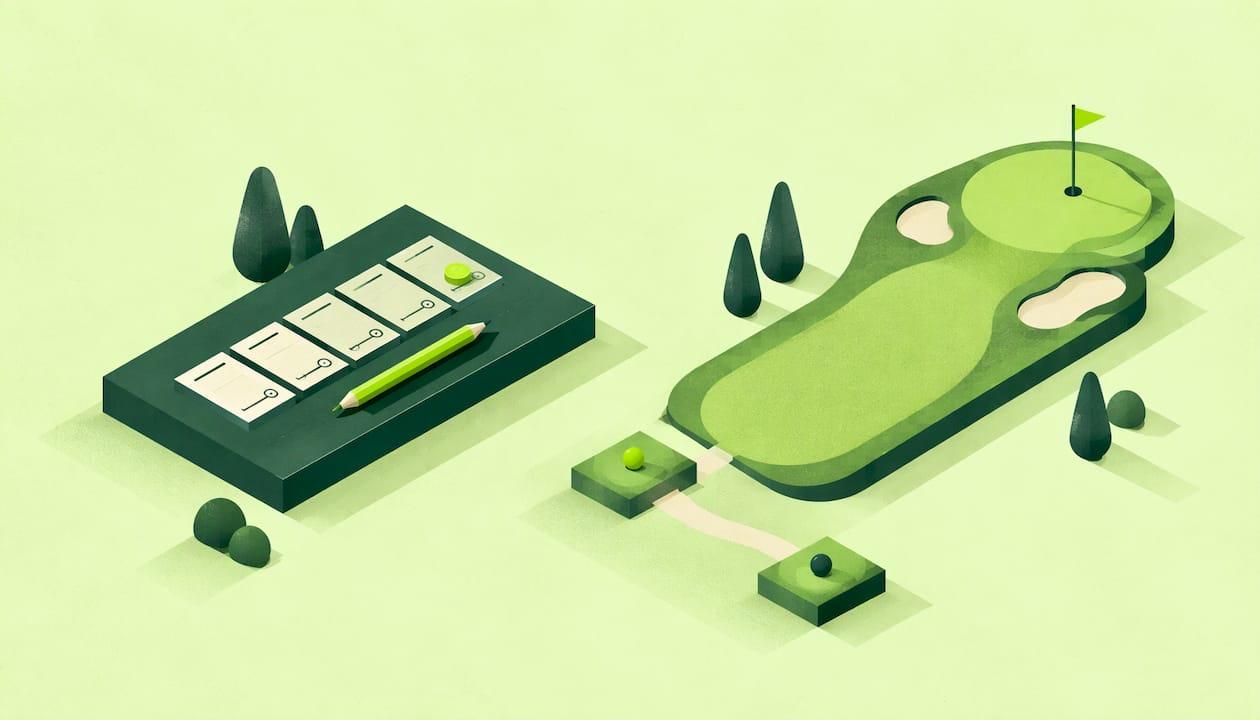
Florida scramble scoring is simple once you see it. Your team writes down one score per hole, the number of shots it took to get the ball in the cup. The twist is the step-aside rule: the player whose shot was chosen sits out the next shot. That changes who hits, but it does not change how you score.
This guide walks you through the rules, the scorecard, team handicaps and nine-hole events. It also covers what to tell players before the first tee. If you run the event, you will find an easy way to track it live at the end.
TL;DR
- Each team records one score per hole. It counts the shots in the chain that got the ball in the hole, not every ball played.
- The golfer whose shot was picked sits out the next shot. Everyone tees off on every hole.
- Team handicaps are set by the organizer. The USGA suggests 25/20/15/10 percent of the four players' Course Handicaps for a four-person scramble.
- Nine-hole scramble scoring works the same way. Just announce your handicap and tie-break rules before play.
- Settle the putting rule and the minimum drives per player before the first tee.
Table of Contents
- How a Florida scramble works
- Where the ball goes after a shot is chosen
- How to score each hole
- Team handicaps for a Florida scramble
- Nine-hole Florida scramble scoring
- Rules to settle before the first tee
- Common scoring mistakes, and how to avoid them
- How to track Florida scramble scores live
- Our take on Florida scramble scoring
- Run your Florida scramble with Chase Birdies
- FAQ
- Sources
How a Florida scramble works
A Florida scramble is a twist on the basic scramble. All four team members hit a tee shot on every hole. After that, only three players hit each following shot, because the golfer whose previous shot was selected sits out the next one. The same procedure carries on until the ball is holed. Then all four players tee off again on the next hole.
The USGA lists the format under several names: Dropout Scramble, Step Aside, Stand Aside and Stand Out. If your players use any of those names, they mean the same thing.
Here is a par-5 example:
- All four players tee off. The team picks the best drive, which is Player A's.
- Player A sits out the second shot. Players B, C and D hit from the spot of Player A's ball.
- The team picks Player C's second shot. Player C sits out the third shot.
- Players A, B and D hit the third shot from where Player C's ball lies.
- This continues until the ball is in the hole.
The sit-out rule makes every player matter. Nobody can coast while the longest hitter carries the team, because the best shot always takes its owner out of the next one. It also helps a mixed-ability group, since a newer golfer can still hit chosen shots and gets a turn.
Where the ball goes after a shot is chosen
A scramble depends on a few simple placement rules. The team picks the best shot, marks it with a tee, and the players who hit next play from that spot. Per one club's published rules, the players who hit next drop their balls within one scorecard length of the marker, no nearer the hole. Your event can set its own measuring tool, so say which one you use.
General scramble guidance from a state golf association fact sheet covers the other spots:
- Off the green, place the ball within one club length of the chosen ball. It can't be closer to the hole or improve the lie from a hazard, rough, fringe or out of bounds.
- On the green, place the ball within 3 inches of the chosen ball, no closer to the hole.
Another point causes arguments every season. The ball keeps its original condition of play. You can't move a ball from the rough into the fairway, for example. Put that on the rules sheet in plain words.
How to score each hole
The scorecard is the easy part. The team writes one shared score per hole. That score is the number of chosen shots, not the number of balls played. If the team's chain was drive, second shot, chip and one putt, the hole is a 4.
Three habits keep the card clean:
- Name a scorekeeper. One person writes the number after the ball drops. This stops "wait, was that a 4 or a 5?" at the next tee.
- Count the chain. Count only the shots that were picked and played. Do not count the shots that were passed over.
- Track who sat out. The step-aside rule is simple, but groups lose track of the sit-out player. A quick check before each shot fixes it.
Some events want a record of whose drives were used, because of a minimum drive rule. One club's rules, for example, require at least 3 tee shots from each player over an 18-hole round. A small tally on the back of the card does the job.
Gross score and net score
Your team's gross score is the actual total of strokes. You get it by adding up the score written for every hole. In a Florida scramble, one gross score is recorded for the team per hole, and the team handicap comes off at the end of the round to produce a net score.
An example: a team shoots 66 gross in an 18-hole event and has a team handicap of 6. The net score is 60. If the team beats every other net score, it wins.
For a closer look at the conversion, see our worked examples of gross to net scoring.
Team handicaps for a Florida scramble
A team always plays from the best ball. Because of that, the team handicap is much smaller than the sum of the individual handicaps. If you added all four handicaps together, the team would beat everyone.
The USGA recommends a formula for four-person scrambles: 25% of the lowest Course Handicap, 20% of the second, 15% of the third and 10% of the highest. You add the values and round.
Here is a worked example with four Course Handicaps of 4, 10, 16 and 24:
| Player (lowest to highest) | Course Handicap | Percentage | Result |
|---|---|---|---|
| 1 | 4 | 25% | 1.0 |
| 2 | 10 | 20% | 2.0 |
| 3 | 16 | 15% | 2.4 |
| 4 | 24 | 10% | 2.4 |
| Team total | 7.8, rounds to 8 |
A team that shoots 65 gross would post a net 57. Our guides on team handicap calculation, scramble scoring rules and scramble handicap rules cover more cases, including mixed groups.
Most players will not do this math themselves. In practice, the organizers have their own formula and usually give players the number, either beforehand or already on the scorecard. That puts the work on you, so decide the formula early and write it down.

Nine-hole Florida scramble scoring
A nine-hole scramble is popular for after-work outings, league nights and short fundraisers. The scoring works the same: one team score per hole, added over nine holes. The only changes are the totals and the handicap you apply.
Here is how to run it:
- Pick your handicap method. Many organizers use the same percentages as an 18-hole event, applied to nine-hole handicaps. Whatever you choose, state it on the rules sheet.
- Score nine holes. The team adds its nine hole scores for the gross total.
- Subtract the team handicap. The result is the net score. The lowest net score wins.
- Set the tie-break. Most events use a course tie-breaker. In a scramble, ties are decided by the course tie-breaker rule, so pick yours now. A common choice is to compare the back-nine or last-hole scores, but any fair rule works if everyone hears it first.
There is also a question about handicap posting. Nine-hole rounds are acceptable scores for handicap purposes. The system waits for a second nine-hole score and combines the two into an 18-hole score. A team scramble result is not a regular individual round, so check with your club or golf association before you tell players anything about posting scores from your event.
Rules to settle before the first tee
Organizers can set the conditions of play. They should settle them before the start, and the first question is whether the sit-out rule applies on the green. In many events the player whose putt was chosen sits out the next putt, but some organizers exempt putting. Either is fine. Confusion is the problem.
Use this checklist on your rules sheet or read it at the starting announcement:
- Sit-out on the green: yes or no.
- Minimum drives per player: none, or a number such as 3 for an 18-hole round.
- Placement: one club length or scorecard length off the green, 3 inches on the green, and no closer to the hole.
- Lie: a ball can't move from rough to fairway.
- Handicap formula: the exact percentages, and who calculates them.
- Tie-break: the rule, stated before play.
- Scorecard: who is the scorekeeper and where the card is turned in.
At the end of the round, the captain hands in the card. In one club's rules, the winner is the team with the lowest score after the team handicap comes off. That is a fine model for your own event.
If you also run other scrambles, you may like our notes on Texas scramble rules for organizers and the wider golf team formats guide. For a quick look at how formats compare, see our tournament formats page.
Common scoring mistakes, and how to avoid them
Most problems on the scorecard come from the same few places.
Writing the wrong number. Teams sometimes count each ball played. Remind them to count the chosen chain only.
Forgetting the sit-out. The player who just had the best shot picks up the club anyway. Ask the team to say "who sits out?" before each shot.
Mixing up handicaps. If you hand out handicaps at check-in, put the team number on the scorecard so the scorer does not have to calculate anything.
Changing rules mid-round. Do not change the putting or drop rules once play begins. Players plan their shots around them.
Waiting for paper cards. Paper means someone adds up 18 hole scores at the clubhouse while everyone waits. Live scoring avoids that.
How to track Florida scramble scores live
You can track the whole event on a simple scoring page instead of passing cards around. A scramble is a good fit for this, because each team has only one score per hole.
Here is the setup:
- Create the tournament. Choose the scramble format and add your teams.
- Set the handicap. Enter the team handicaps you calculated, or decide to rank by gross.
- Share the leaderboard. Make it public, or protect it with a PIN for a private outing.
- Enter scores hole by hole. The team scorekeeper enters one number per hole from a phone.
- Check the standings. Players, sponsors and volunteers see the updates as they come in.
For more on running a club event, see our club golf tournament scoring guide.
Our take on Florida scramble scoring
Most people who organize a scramble are not tournament professionals. They are a member of a club committee, a parent on a fundraiser team or a golfer who said yes when someone asked, "Can you run it?"
That is why we built Chase Birdies around simple things. Scoring should not need a spreadsheet, a subscription or a technical setup. The scorekeeper enters the team's number for each hole, and the leaderboard moves.
A Florida scramble is a great example. The format has a few extra rules, but only one score per hole goes on the card. Our platform is designed to keep the work on the golf, not the paperwork. You set up the tournament in minutes, share a link and let teams enter scores from their phones, with no app download or registration for viewers.
We charge $1 per player per tournament, with no subscription or hidden fees. We think that is the fair way to price an event that happens once or twice a year.
Jon
Run your Florida scramble with Chase Birdies
If you are organizing a scramble, Chase Birdies gives you hole-by-hole tournament scoring and a live leaderboard that updates as each score goes in. It supports scramble, shamble, scotch, best ball, stroke play and match play. You can keep the leaderboard public or protect it with a PIN, and scorecards stay editable if someone makes a mistake.

Pricing is a flat $1 per player per tournament, paid before the event goes live. A 24-player scramble costs $24. See the pricing page to get started, or visit Chase Birdies for an overview.
FAQ
Is a Florida scramble the same as a step-aside scramble?
Yes. The USGA lists Florida Scramble, Dropout Scramble, Step Aside, Stand Aside and Stand Out as names for the same variation. In each, the player whose shot was selected does not play the next shot. Everyone still tees off on every hole.
How many scores go on the scorecard for each hole?
One. The team records a single shared score per hole, which is the number of chosen shots it took to hole out. Do not write a score for each player. The team handicap, if you use one, comes off the total at the end.
Can organizers change the rules?
Yes. Organizers set the conditions of play, and they should announce them before the start. The usual choices are whether the sit-out rule applies to putts, whether each player must contribute a minimum number of drives, and how the team handicap is calculated. Put them in writing.
How do I score a nine-hole Florida scramble?
Add the team's score for each of the nine holes to get the gross total. Then subtract the team handicap to get the net score, and the lowest net score wins. Announce your handicap method and tie-break before play so there are no surprises.
Sources
- How to Play a Florida Scramble Golf Tournament
- USGA, 9. Other Forms of Play
- United Nations Golf Club, Florida Scramble Rules
- Appendix C, Scramble Tournament Fact Sheet
- Dan Bubany, What's a Step Aside Scramble?
- Florida Scramble, Golf Lounge glossary
- Florida Scramble Rules (Step-Aside), Team Handicap
- How to Keep Score in Scramble Golf
- USGA, Scramble handicapping
- Nine-Hole Scores: The Hows and Whys of Posting