
Round robin, often called Sixes, pairs four players into three six-hole partnerships so each golfer teams up with every other golfer once over 18 holes. Before tee-off, publish the partner rotation and scoring method you'll use, whether that's four-ball match play or stroke play, gross or net, and state the handicap allowance in your Terms of Competition. Getting these details out early keeps play moving and prevents disputes on the back nine.
TL;DR:
- Schedule A+B versus C+D, A+C versus B+D, and A+D versus B+C across the three six hole segments, in that order.
- In four ball, each player plays their own ball and the lower score counts; use a 90% allowance for match play or 85% for stroke play.
- For nine hole matches, alternate flights between the front and back nines to spread players across the course and reduce tee box backups.
- Choose tiebreakers before play: use head to head results first, then sudden death for match play or a scorecard comparison for stroke play.
Table of Contents
- How the round robin (Sixes) format works
- Standard partner rotation and a sample schedule you can copy
- Scoring options and handicap rules you'll need to specify
- Creating pairings and scheduling a round-robin event
- Tools, templates, and quick generators for round-robin pairings
- Organizer quick checklist and printable rulesheet
- Strategies for handling ties and playoffs within round robin golf tournaments
- Organizer perspective: when to pick round robin for your event
- Make round-robin scoring easier to run and watch
- FAQ
- Sources
How the round robin (Sixes) format works
Round robin golf splits four players into rotating two-person teams for 18 holes. You'll also hear it called Sixes, COD, Rotation, or Hollywood, depending on the club or region, but they all describe the same idea: everyone partners with everyone else exactly once across three six-hole segments, according to how the format works.
This structure makes round robin a natural fit for groups with mixed skill levels. Nobody gets stuck with the same partner all day, and weaker players get a fresh shot at scoring points in each new partnership.
A few variants are worth knowing before you set your event:
- 9-hole round robin flights work well for member-guest events where you want shorter matches and faster turnover.
- Double round robin doubles the rotation for larger fields or multi-day competitions, giving each pairing two chances to compete.
Pick the version that matches your group size and the time you have on the course, then build your pairing sheet around it.
Standard partner rotation and a sample schedule you can copy
The classic four-player rotation uses three six-hole matches, and you can publish this exact structure for your event, according to this sample schedule:
- Holes 1 through 6: Player A and Player B versus Player C and Player D.
- Holes 7 through 12: Player A and Player C versus Player B and Player D.
- Holes 13 through 18: Player A and Player D versus Player B and Player C.
Assign your four real players to letters A through D before the round starts, then hand out a printed copy of this grid at check-in or post it near the first tee. Everyone should know exactly who they're playing with and against for each six-hole stretch.
For 9-hole matches, adapt the same logic by swapping front and back nines between flights. This keeps tee boxes from bottlenecking when multiple groups run the rotation at once, a detail covered in member-guest round-robin notes.pdf) on running flighted events.
Scoring options and handicap rules you'll need to specify
Round robin events typically run as four-ball, also called better ball. Each golfer plays their own ball, and the lower score between the two partners counts as the team's score for that hole. Partners can choose their own playing order instead of defaulting to whoever is farthest from the hole, according to the USGA's four-ball guidance.
Four-ball is different from foursomes, where partners alternate shots using a single ball. Name the exact format on your rulesheet so players don't confuse the two. If your event mixes formats across rounds, spell out which one applies to each segment.
The USGA recommends a 90% handicap allowance for four-ball match play and 85% for four-ball stroke play, calculated relative to the lowest-handicap player in the group, according to Appendix C: Handicap Allowances. Your committee should pick one allowance and write it into the Terms of Competition so every player applies it the same way.
For point scoring, most round robin events use a simple hole-by-hole system:
- 1 point for winning a hole outright.
- ½ point for a halved hole. This is a common scoring approach in member-guest events.
- Aggregate points across all three segments determine the final standings.
If you want to dig deeper into format mechanics before finalizing your rulesheet, our match play scoring guide and best ball scoring breakdown cover the operational differences in more detail.
Creating pairings and scheduling a round-robin event
Running a smooth round robin comes down to setting up your pairings correctly before anyone steps on the first tee.
- Form your flights first. Group players by skill level or handicap so each foursome has a fair mix.
- Assign team numbers or letters. Give every player a clear A, B, C, or D designation that matches your rotation grid.
- Set all-round pairings at once. Many organizers build every round's pairings in a single session rather than one round at a time, which makes last-minute changes far easier to manage.
- Print round-by-round pairing sheets. Hand these out at check-in so players know their partners and opponents for each segment.
For 9-hole matches, alternate which flights start on the front nine and which start on the back. This spreads players across the course evenly and keeps tee boxes from backing up.
Shotgun starts work best when you have several flights playing simultaneously and want everyone finishing around the same time. Tee-time waves suit smaller fields or events with more flexible schedules.
Pro Tip: If a player drops out last minute, reflight quickly and republish the pairing sheet rather than trying to patch the existing rotation on the fly.
Tools, templates, and quick generators for round-robin pairings
A good pairing generator saves time once you're managing more than one flight. Look for tools that support multi-round pairings, front and back nine assignment, fast reflighting, and printable sheets you can hand out at check-in.
Generators earn their keep when you're running several flights at once or expect last-minute changes, since manually rebuilding a rotation grid for a larger field eats into time you'd rather spend greeting your group. Our guide to setting flights in one meeting walks through flighting players efficiently before you touch a pairing sheet.
Before your event, prepare these four pieces:
- A rotation grid showing each segment's pairings.
- A scoring rulesheet naming the exact format and handicap allowance.
- Hole-by-hole scorer instructions for whoever is tracking results.
- A leaderboard layout so players can check standings between segments.
Organizer quick checklist and printable rulesheet
Use this checklist the week of your event and again the morning players arrive:
- Publish the partner rotation and scoring method before players check in.
- State the handicap allowance in your Terms of Competition.
- Prepare pairing sheets for all rounds in advance.
- Plan tee assignments, alternating front and back nines for 9-hole matches.
- Have a reflight procedure ready for no-shows or late changes.
- Decide whether your leaderboard will be public or PIN-protected.
| Item | What to confirm |
|---|---|
| Rotation | Partner schedule published before tee-off |
| Handicap allowance | 90% match play or 85% stroke play stated in writing |
| Pairing sheets | Printed for every round, not just the first |
| Tee assignments | Front/back nine balance set for 9-hole matches |
| Leaderboard access | Public or PIN-protected, decided ahead of time |
Strategies for handling ties and playoffs within round robin golf tournaments
Ties happen often in round robin because points accumulate across three separate segments, and two teams can easily finish with matching totals. Decide your tiebreaker method before the event starts, not after the last putt drops.
A common approach is to use the result of the head-to-head segment between the tied teams as the first tiebreaker. If Team A and Team B finish with equal total points but Team A won their direct six-hole matchup, Team A takes the higher finish.
When no head-to-head result settles it, or when more than two teams are tied, a sudden-death playoff hole works well for match play formats. For stroke play scoring, a card-off comparing back-nine or last-six-hole scores is a quicker alternative that doesn't require pulling players back onto the course.
Whichever method you choose, write it into your Terms of Competition alongside your handicap allowance and scoring format. Players appreciate knowing the tiebreaker rules going in, and it saves you from having to invent a fair solution on the spot while a group waits around the 18th green.
For larger events with multiple flights, consider whether playoffs happen within each flight only or whether flight winners advance to a separate round. Either option works, but your rulesheet should state it clearly before the first tee time.

Organizer perspective: when to pick round robin for your event
Round robin shines when you want everyone to play with everyone else. It's a natural choice for member-guest flights, invitationals, and charity scrambles where the social mix matters as much as the score.
— Jon
Make round-robin scoring easier to run and watch
Once your rotation and scoring rules are set, the hardest part of round robin is often just keeping score straight across three segments and multiple flights. Chase Birdies lets players or scorers enter results hole by hole on any phone, with editable scorecards and leaderboards that update instantly, whether you want standings open to everyone or locked behind a PIN.
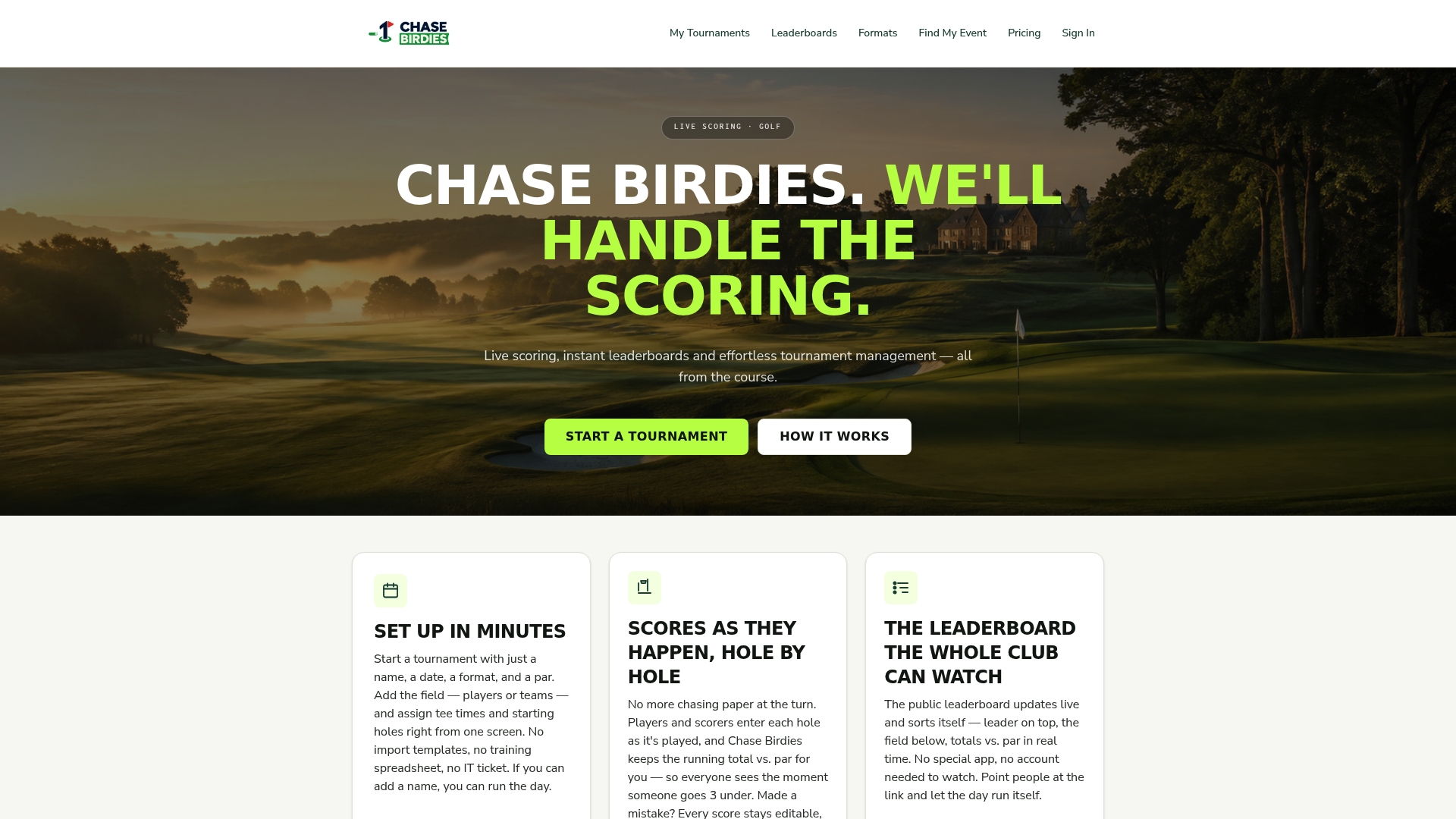
Setup takes minutes, and we charge $1 per participant with no subscription or hidden fees, which keeps the cost proportional whether you're running a four-player flight or a full member-guest field, as shown on our pricing page. Check out live tournament leaderboards to see how scoring looks in action before your next event.
FAQ
What is a round robin golf tournament?
A round robin golf tournament pairs four players into three six-hole partnerships so each golfer partners with every other golfer exactly once over 18 holes. It's also called Sixes, 6-6-6, COD, or Hollywood depending on where you play, according to this format breakdown.
What is a Dolly Parton in golf?
"Dolly Parton" is an informal nickname some golfers use for a handicap-related joke, but it isn't a standard scoring term tied to round robin play. Definitions vary by region and group, so check with your own club or organizer for local usage before including it on a rulesheet.
How does a round robin tournament work?
Four players rotate partners across three six-hole segments using a fixed schedule, commonly holes 1 through 6 as A+B versus C+D, holes 7 through 12 as A+C versus B+D, and holes 13 through 18 as A+D versus B+C. Most groups score it as four-ball, where each player plays their own ball and the lower partner score counts, per USGA four-ball guidance.
How do you run a round robin tournament with four teams?
Assign each team a letter or number, then build a rotation grid so every team faces every other team across separate segments or rounds. Publish the full schedule and scoring method before play begins, and use a pairing sheet so each team knows their opponent for every segment.
What handicap allowance should I use for round robin scoring?
The USGA recommends a 90% allowance for four-ball match play and 85% for four-ball stroke play, calculated against the lowest-handicap player in the group, according to Appendix C. Your committee should choose one allowance and state it clearly in the Terms of Competition.