
Wolf is a rotating betting game where each player takes a turn as "Wolf" and watches the other three tee shots before picking a partner or going it alone. Standard scoring gives 2 points to a winning Wolf-and-partner team, 3 points to Hunters who beat them, and up to 4 points for a Lone Wolf win, with Blind Wolf declarations often tripling the payout.
TL;DR:
- Up to 4 points are awarded for a Lone Wolf win, with Blind Wolf declarations typically tripling the payout and adding risk.
- Points are usually set at $1 per point, making a Lone Wolf victory worth $4 and a Blind Wolf potentially $9 or more.
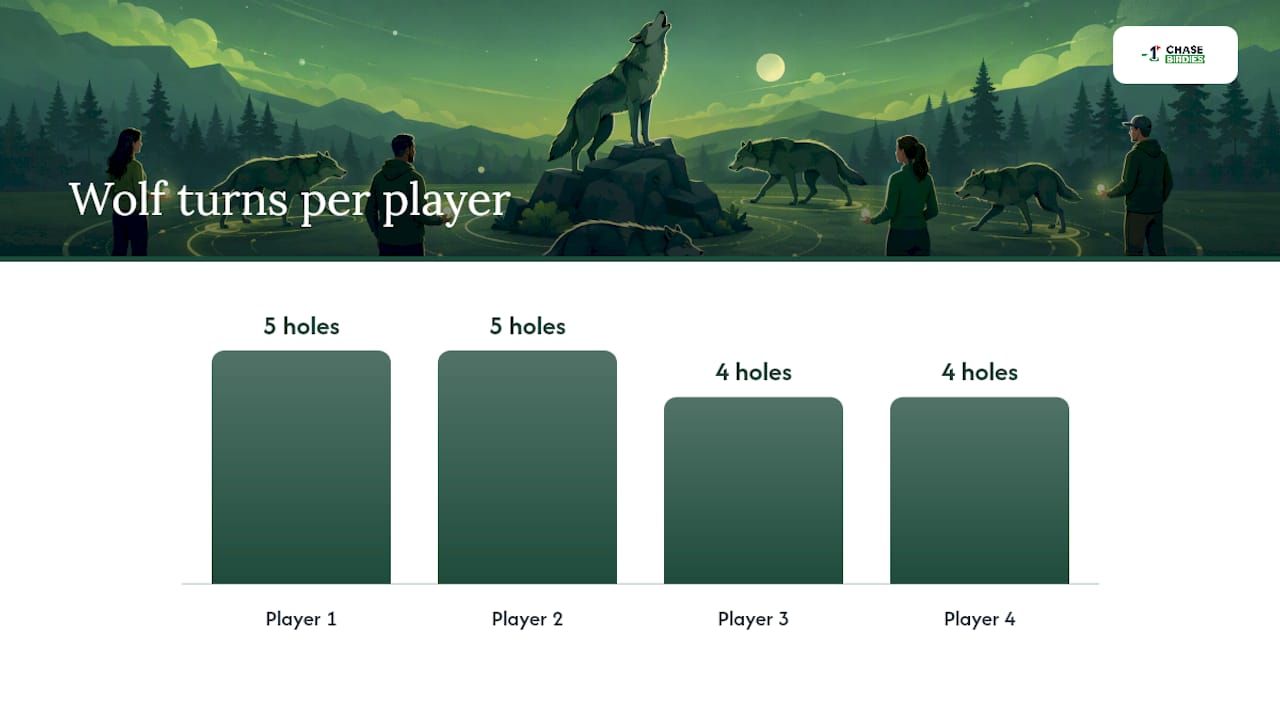
- The standard rotation gives Players 1 and 2 five Wolf turns, while Players 3 and 4 only get four, which affects scoring opportunities.
- Variations like Pig and Re-Hammer modify gameplay, but groups often skip these to keep the game simple and fast.
- Tracking scores with digital tools like Chase Birdies reduces mistakes and keeps real-time standings visible, enhancing the experience.
Table of Contents
- Wolf Game Rules for Setting Up Your Round
- Standard Wolf Game Scoring and Popular Variations
- Wolf Game Scoring Examples and a Ready-to-Use Scorecard
- Running a Wolf Event Without Scorekeeping Headaches
- How Chase Birdies Simplifies Wolf-Style Scoring
- What the Rules Don't Tell You About Wolf
- Ready to Run Your Own Wolf Round?
- Sources
- FAQ
Wolf Game Rules for Setting Up Your Round
Before anyone tees off, you need three things locked in: who's Wolf when, how points convert to dollars, and which optional rules your group is using. Skip this step and you'll spend more time arguing on the 4th green than actually playing golf.
Start with tee order. Draw for it, flip a coin, or use last week's stroke-play finish. It doesn't matter how you pick it, as long as everyone agrees before the first shot.
Once you've got tee order, the rotation takes care of itself. In a standard four-player group, each golfer gets a fixed set of holes where they're Wolf, and the Wolf tees off last on that hole, watching the other three drives before deciding whether to pick a partner or play solo. The standard 18-hole map looks like this:
- Player 1: Wolf on holes 1, 5, 9, 13, 17
- Player 2: Wolf on holes 2, 6, 10, 14, 18
- Player 3: Wolf on holes 3, 7, 11, 15
- Player 4: Wolf on holes 4, 8, 12, 16
Notice Players 1 and 2 get five turns as Wolf while 3 and 4 only get four. That's normal. If you're playing with three players, just drop Player 4's holes and rotate through the remaining three. With five players, add a fifth line to the rotation and expect a slightly longer front nine while everyone adjusts.
Before you play, settle on a base bet per point (many groups use $1), decide whether you're allowing Pig or Hammer, and agree on how holes 17 and 18 will work. Some groups make the player with the fewest points Wolf on 17 (the "Big Loser" rule) to keep the back nine competitive.
Pro Tip: Write the rotation on the scorecard before you start. It takes thirty seconds and eliminates the "wait, whose turn is it?" conversation on every tee box.
Standard Wolf Game Scoring and Popular Variations
Every group tweaks Wolf slightly, but the core point structure stays consistent across most versions you'll find at clubs and outings. Here's the standard table most foursomes use:
| Outcome | Points Earned |
|---|---|
| Wolf + partner win the hole | 2 points each |
| Hunters (non-Wolf team) win the hole | 3 points each |
| Lone Wolf wins the hole | 4 points |
| Lone Wolf loses the hole | 1 point to each opponent |
| Blind Wolf wins (declared before any tee shots) | Typically 3x the standard payout |
At $1 per point, a Lone Wolf win nets $4 while the three losers each pay out $1. Blind Wolf, where the Wolf commits to going alone before anyone hits a shot, multiplies the risk.
A few variations worth knowing:
- Pig: the player the Wolf tries to pick can decline, forcing the Wolf to play alone whether they wanted to or not.
- Hammer (or Re-Hammer): an opponent can double the bet mid-hole, and the other side can double it again before it's played out, which Golf Digest describes as one of the more common escalation rules.
- Tie handling: most groups carry the points to the next hole rather than splitting them, which builds tension into later holes.
Pick your variations based on the group. Casual outings usually skip Hammer entirely. Money games with regulars tend to run the full set.
Wolf Game Scoring Examples and a Ready-to-Use Scorecard
Numbers make this easier to picture than rules alone. Here are two quick scenarios using $1 per point.
Example A: Wolf picks a partner and wins. On hole 6, Player 2 is Wolf. After watching the other three drives, Player 2 picks Player 4 as partner. Their team wins the hole outright. Player 2 and Player 4 each earn 2 points ($2), while Players 1 and 3 lose nothing but gain no points either.
Example B: Lone Wolf backfires. On hole 13, Player 1 is Wolf and decides to go it alone after a shaky drive from every partner option. The Wolf team loses the hole. Each of the three opponents earns 1 point ($1), for a total swing of $3 against the Wolf on that hole alone.
A simple scorecard keeps this from turning into a math argument on the 18th green. Six columns handle it:
- Hole number
- Who's Wolf
- Partner chosen (or "Lone" / "Blind")
- Outcome (win/loss/tie)
- Points earned this hole
- Running total per player
Pro Tip: Running totals matter more than per-hole points. A player who's down after 12 holes but knows exactly how many points separate them from the leader will play very differently on 17 and 18.
One detail worth flagging early: tracking Wolf on paper works fine for casual rounds, but assigning one dedicated scorer, whether on paper or in an app, cuts down on the arithmetic errors that show up after four hours and several beverages.

Running a Wolf Event Without Scorekeeping Headaches
Two things ruin a Wolf round faster than bad weather: slow decisions and disputed points. Fix both before you start.
- Assign a scorer and a rules arbiter. One person tracks points on the card or app; another has final say on any disputed call. They can be the same person, but everyone needs to know who it is.
- Announce Wolf declarations out loud, on the tee. "Lone Wolf" or a partner's name, said clearly before the group walks to their balls, prevents any "I thought you picked me" confusion later.
- Resolve disputes immediately. If there's a question about who won a hole or whether a declaration counted, settle it on that tee box with the other three players as witnesses. Once the group moves on, the ruling is final.
- Settle up using a simple ledger. At day's end, total each player's points and multiply by your agreed rate. In a typical four-player $1 round, someone might finish +14 points ($14 owed to them) while another finishes at negative 9. Converting points to cash right after the round avoids the "I'll get you next time" IOUs that never actually get paid.
If you're running Wolf at a club outing or fundraiser, keep it as a side game layered on top of your official stroke-play scoring. That way the tournament prizes stay clean and the Wolf pot is just a bonus layer of fun for players who want it.
Pro Tip: Post a visible mid-round scoreboard, even a whiteboard by the cart barn, so players can see where they stand at the turn. It keeps energy up on the back nine.
How Chase Birdies Simplifies Wolf-Style Scoring
Running the math by hand works until someone forgets a multiplier or mis-adds a column. Chase Birdies handles hole-by-hole score entry directly on a phone, so points update automatically instead of relying on a scorecard someone might lose in a cart cupholder.
Setup takes four steps: create your event, choose your scoring format, invite your players, and start the round. Pricing runs $1 per participant with no subscription, which fits a casual Wolf outing just as easily as a full club tournament. The live leaderboard keeps standings visible in real time, so players know exactly where they stand heading into holes 17 and 18.
What the Rules Don't Tell You About Wolf
Most Wolf guides treat the rules like a rulebook to memorize and move on. That's backwards. The actual skill in Wolf isn't knowing that a Lone Wolf win pays 4 points. It's reading three tee shots in about ten seconds and deciding whether your best bet is a partner, a solo run, or a Blind Wolf gamble you haven't even seen yet.
Conventional advice overweights the point table and underweights the pre-round conversation. Groups that skip the five-minute talk about multipliers, Hammer, and how ties carry over are the same groups arguing on hole 15 about whether a Blind Wolf declaration even happened. The rules matter less than everyone agreeing on them out loud, on the first tee, before money's on the line.
If there's one thing to prioritize, it's this: pick a scorer you trust before you pick your rotation. A great set of house rules run by someone who can't keep a running total straight is worse than a simple point system tracked accurately from hole 1 to hole 18.
— Jon
Ready to Run Your Own Wolf Round?
Chase Birdies is the alternative to a scribbled scorecard for a Wolf-format outing. It gives every player hole-by-hole entry from their own phone and a live leaderboard that updates instantly, so nobody's doing multiplier math on the 18th green.

Setup takes minutes: create the event, pick your format, invite the group, and go. There's no subscription to manage and no per-club licensing fee. It's $1 per player for the event, whether you're running a casual Wolf side game or the entire tournament through stroke play, scramble, or another format. If you want players checking a live board instead of comparing paper scorecards after the round, start your event and see standings update in real time.
Sources
- The Wolf Golf Game: This Strategic Game Will Change Your Weekend Tee Time
- How To Play Wolf: The Golf Betting Game That Keeps Every Hole Interesting | MyGolfSpy
- Golf Game: Wolf betting and variations explained | Golf Digest
FAQ
How Many Players Do You Need for Wolf?
Wolf works best with four players using the standard rotation, though three-player and five-player variants exist by adjusting who gets Wolf duty on which holes.
When Does the Wolf Choose a Partner?
The Wolf tees off last on their assigned hole and picks a partner after watching the other three drives, unless declaring Lone Wolf or Blind Wolf first.
What's the Difference Between Lone Wolf and Blind Wolf?
Lone Wolf is declared after seeing the other tee shots and typically pays double; Blind Wolf is declared before any shots are hit and typically pays triple.
How Do You Handle a Tie in Wolf?
Most groups carry tied points forward to the next hole rather than splitting them, which raises the stakes on later holes.