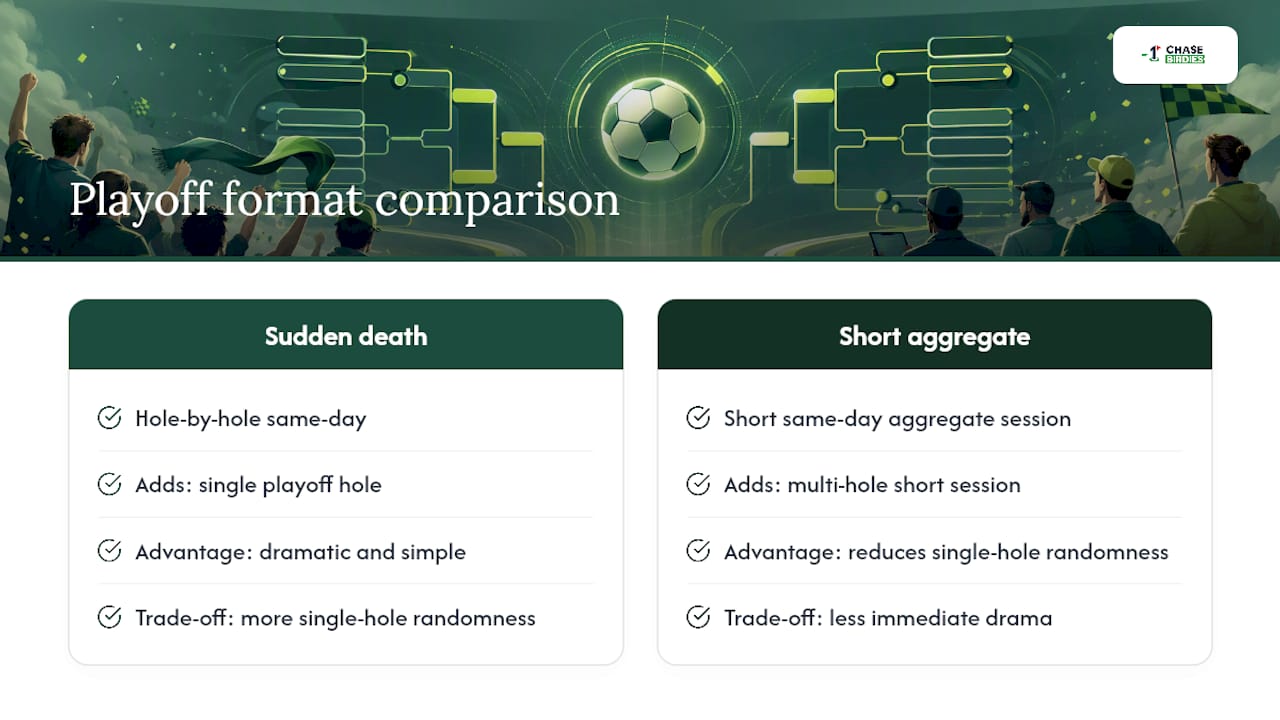
A sudden-death playoff settles a tie by sending players back onto the course to play hole after hole until someone posts a lower score than everyone else. The player, or players, with the best score on that hole moves on; anyone left behind goes home. It's the most common tiebreaker in stroke play and match play alike, though it's not the only option. The main alternative is an aggregate playoff, where scores are added up over a set number of holes instead of settled on a single one, and the two formats now get mixed together at the majors in ways worth understanding.
TL;DR:
- Most professional sudden-death playoffs resolve within one to three holes, making extended marathons very rare in tournament history.
- Major tournaments may use two-hole or three-hole aggregate playoffs before switching to sudden death if scores are still tied, balancing fairness and time considerations.
- On the course, playoff rules remain standard, with scores recorded as in regulation, and playoffs can suspend for darkness or weather, to resume later if needed.
- For casual events, using a scorecard count-back is often more practical than sudden death, especially when daylight or player availability is limited.
- Clear pre-event rules, live scoring, and designated playoff procedures help organizers manage sudden-death situations efficiently and avoid confusion.
Table of Contents
- How a Sudden-Death Playoff Works, Step by Step
- How the Majors Structure Their Playoffs Today
- The Rules Officials and Players Actually Follow on the Course
- Choosing Between Sudden Death and a Count-Back at Club Events
- Notable Sudden-Death Playoffs Worth Knowing
- Where Sudden Death Came From in Golf
- Sudden Death in Golf Versus Other Sports
- What Playoff Pressure Actually Does to a Golfer's Game
- A Publisher's Note on Running Playoffs Without the Chaos
- Sources
- FAQ
How a Sudden-Death Playoff Works, Step by Step
The playoff starts almost immediately after the final round ends, once the leaderboard confirms who's tied. There's no overnight wait unless weather or darkness forces one. Officials pull the tied players straight from the scoring area to a designated hole, and the format runs the same way every time:
- Players tee off on the designated playoff hole. Everyone tied for the lead plays that hole under normal stroke play or match play rules.
- Scores are compared hole by hole. Whoever posts the lowest score wins outright. If two or more players tie for the best score, they all advance together.
- The group moves to the next designated hole. This repeats until only one player has the lowest score.
- The tournament ends the moment someone wins a hole outright. There's no cumulative math. One good swing, or one bad one, decides everything.
Hole selection varies by event. Some tournaments replay the same hole over and over; others rotate through a pre-announced sequence, often mixing a par 3, a par 4, and a par 5 to test different skills. The committee sets this before the tournament even begins, so there's no debate once players are standing on the tee. Order of play typically follows the honors system from the final hole of regulation, and pairings for the group are locked in as soon as the tie is confirmed. Daylight is the real wildcard. Broadcasters, marshals, and rules officials all stay on standby, because a playoff can end in one shot or drag on long enough that darkness becomes a factor.
Pro Tip: If you're watching on TV and want to know how many holes a playoff might run, check whether the event uses pure sudden death or an aggregate session first. That single detail tells you whether you're watching a sprint or a marathon.
How the Majors Structure Their Playoffs Today
Not every major jumps straight to sudden death, and the differences trip up plenty of casual fans. Here's how it breaks down heading into 2026:
- The Masters goes straight to sudden death. Tied players head to a rotating set of holes, usually starting at the 18th, and play continues one hole at a time until someone wins outright.
- The U.S. Open uses a two-hole aggregate playoff first. If players remain tied after adding up their scores on those two holes, the format shifts to sudden death, according to the U.S. Open tournament guide from the DP World Tour.
- The PGA Championship uses a three-hole aggregate session. The PGA of America format, in place since 2000, moves to sudden death only if the tie survives those three holes.
- The Open Championship has its own multi-hole aggregate variants, following a similar logic to the other majors.
The reasoning behind the aggregate step is straightforward. A single playoff hole introduces a lot of randomness into a tournament that just tested players over 72 holes, and organizers wanted a middle ground that rewards sustained play over one lucky bounce. That fairness argument comes with a scheduling cost, though. Aggregate sessions take longer, and majors have to weigh broadcast windows against the extra holes.
The Rules Officials and Players Actually Follow on the Course
Once a playoff starts, standard golf rules stay in force. A birdie beats a par, a par beats a bogey, and penalty strokes count exactly as they would in regulation play. Nothing about the sudden-death format changes how a score gets recorded.
A few procedural details matter more than fans usually realize:
- Order of play follows honors from the previous hole, and officials assign pairings the moment the tie is official.
- Teeing ground and hole selection are set in advance by the tournament committee, not chosen on the fly.
- Suspension of play happens for darkness, dangerous weather, or course conditions, and organizers can resume the next morning if needed rather than force a finish in bad light.
- Recordkeeping language follows a standard pattern. A result gets logged as "won on the 19th hole" for a single extra hole, or "won at the 2nd playoff hole" when the format takes longer.
A quick fact worth knowing: extended sudden-death playoffs are rare enough that most professional events settle in one or two extra holes, which is part of why golf broadcasters treat every additional hole as a genuine event rather than a formality.
Suspended playoffs create their own wrinkle. If darkness stops play mid-playoff, the group typically resumes on the same hole the next morning rather than restarting the sequence, preserving whatever competitive edge or disadvantage existed when play stopped.

Choosing Between Sudden Death and a Count-Back at Club Events
Running a professional-style playoff at a club event sounds fun until you're standing on the 18th green at 6:45 p.m. with players who have dinner reservations. Sudden death works well when you've got daylight left and players willing to stick around, but it's not always the right call for casual tournaments.
- Check your daylight and player availability first. If sunset is close or half your field needs to leave, sudden death creates logistical headaches you don't need; organizers comparing scoring approaches can find helpful examples of tournament formats and tiebreaker practices at RALLIO's padel tournament management site.
- Consider a scorecard count-back instead. This method compares scores over the final 18, 9, 6, 3, or 1 holes of the round already played, and it's a standard alternative organizers use when an on-course playoff isn't practical.
- Publish your tiebreaker method before the event starts. Players should never learn the rule for the first time when they're already tied.
- Assign a scorer and recording plan ahead of time. Know who's tracking the playoff hole and how the result gets posted to the leaderboard.
Pro Tip: You don't need a marshal army to run a sudden-death hole for a club event. One volunteer at the tee and one at the green, plus a phone with your live scoring app open, covers most casual tournaments just fine.
Notable Sudden-Death Playoffs Worth Knowing
Most sudden-death playoffs end quickly, which is exactly why the long ones stick in golf's memory. Golf's playoff history) includes multi-hole marathons on professional tours that stretched well past what most fans expect from a tiebreaker, with tour records documenting these extended battles as outliers rather than the norm.
- Multi-hole sudden-death playoffs running deep into extra holes appear throughout tour history, though they're the exception rather than the rule.
- Most professional sudden-death playoffs resolve within one to three extra holes.
- The rarity of long playoffs shows just how much single-hole variance depends on nerves and one well-timed mistake, not raw skill gaps between competitors.
A playoff that runs long isn't proof of a weak field. It shows that a single hole offers limited opportunity for skill to prevail over chance.
Where Sudden Death Came From in Golf
Sudden death wasn't always the default. Early tournament tiebreakers leaned almost entirely on scheduling a full extra round the next day, a practice that made sense when tours had looser calendars and fewer TV contracts to satisfy. As professional golf grew into a broadcast product, waiting a full day to settle a tie became impractical for networks and fans alike.
The shift toward same-day, hole-by-hole resolution picked up through the back half of the twentieth century as tournaments needed faster, more broadcast-friendly endings. Sudden death solved the scheduling problem instantly. It also introduced the fairness debate that still shapes format decisions today: a full extra round tests sustained play, while a single playoff hole tests something closer to nerve.
That tension is exactly why the majors eventually split into two camps. Events like the Masters kept pure sudden death for its drama and simplicity, while others layered in short aggregate sessions to soften the randomness of a single hole. Neither approach is objectively correct. They're different answers to the same question: how much of a 72-hole tournament should a single swing get to erase?
Sudden Death in Golf Versus Other Sports
Golf isn't the only sport that settles ties by playing until someone breaks through, but its version works differently than most. Hockey's sudden-death overtime, for example, ends the instant either team scores, and the entire format compresses into minutes rather than holes. Golf's version can stretch across an hour or more, since players need to finish full holes rather than react to a single scoring play.
Football's overtime rules, particularly in the NFL, borrow the sudden-death concept but wrap it in more procedural complexity. Both teams often get a possession before sudden death fully kicks in. Golf skips that buffer entirely in its purest form. The first hole decides everything unless there's another tie, which is closer to how soccer's penalty shootouts work.
What makes golf's version distinct is the individual nature of the competition. Team sports resolve sudden death through one collective play. Golf isolates each player's swing on the same hole under identical conditions, which strips away almost every variable except execution and nerve. That's part of why golf broadcasters treat every playoff hole as legitimate drama rather than a formality tacked onto the real competition.
What Playoff Pressure Actually Does to a Golfer's Game
Sudden death rewards a specific kind of mental toughness that doesn't always match who played best over the previous 72 holes. Players who thrive in the format tend to shrink their focus down to one shot at a time, treating the playoff hole like an isolated event rather than an extension of the tension that built up over four rounds.
The players who struggle usually aren't lacking skill. They're carrying the weight of the round that just ended, replaying a missed putt from the 16th hole instead of committing fully to the tee shot in front of them. That mental carryover is often the real difference between two players with nearly identical scoring averages.
Course knowledge matters more in sudden death than it does during a normal round, too, since the same one or two holes often get replayed if the tie continues. A player who knows exactly where trouble hides on that specific hole has a real edge over someone seeing it for the first time under pressure. Combine that with the fact that a single bad bounce can end a tournament instantly, and it's easy to see why some genuinely excellent ball strikers have shaky playoff records. Sudden death doesn't measure who's the better golfer over four rounds. It measures who can execute one shot cleanly while everything is on the line.
A Publisher's Note on Running Playoffs Without the Chaos
Sudden death sounds simple until you're the one running the event and trying to figure out, in real time, exactly who's tied and who isn't. Hole-by-hole live scoring solves that problem cleanly, because the leaderboard updates the moment a score gets entered, so there's no guessing about who belongs in the playoff group.
For small clubs and casual outings, that clarity matters more than people expect. Instant pairings mean no confusion about who tees off first. A shared live leaderboard means players can check standings on their phones instead of crowding the scoring table. Chase Birdies was built around exactly this kind of moment: mobile-friendly access for scorers standing on the course, hole-by-hole entry that updates instantly, and a flat $1-per-player pricing model with no subscription to manage. If you're organizing a scramble or shamble event where a tie is even remotely possible, having that clarity built into your scoring setup saves you from scrambling for answers when it counts most.
— Jon
Sources
- 2026 U.S. Open tournament guide — European Tour / DP World Tour
- 2026 US Open format, cut rules and playoff format — GolfNewsNet
FAQ
What is the longest sudden-death playoff in golf history?
Extended sudden-death playoffs running well beyond the typical one or two extra holes are documented in tour playoff history, though these long marathons are rare compared to the vast majority of playoffs that end within a few holes.
How does a sudden-death playoff differ from an aggregate playoff?
Sudden death ends the moment one player posts the best score on a hole, while an aggregate playoff adds up scores across a set number of holes, such as the U.S. Open's two-hole aggregate format, before sudden death kicks in if the tie remains.
Why did Bryson DeChambeau face a PGA Tour suspension?
That situation involves separate PGA Tour conduct and membership matters unrelated to playoff formats, and it isn't something this format guide can verify or speak to accurately.
Who is considered one of the most well-liked players on the PGA Tour?
Player reputation is subjective and shifts with fan sentiment, so there's no verified, sourced answer to point to here rather than offer a guess.
What does "won at the 19th hole" actually mean?
It means the tournament reached a single sudden-death playoff hole beyond the regulation round, and the winner secured the title by posting the best score on that first extra hole.