Slope rating measures how much tougher a set of tees plays for a bogey golfer than for a scratch golfer. The number runs from 55 to 155, with 113 marking a course of standard difficulty. The higher the slope, the more strokes a higher-handicap player needs to compete fairly with a scratch player, which is exactly why it matters every time you post a score or set up a tournament.
TL;DR:
- Slope ratings quantify how much more strokes a bogey golfer needs compared to a scratch golfer on a specific course, ranging from 55 to 155.
- Calculating slope involves the difference between bogey and course ratings, multiplied by gender-specific constants, and requires detailed obstacle measurements.
- A slope of 113 indicates average difficulty, while higher numbers reflect tougher courses that penalize missed shots more severely.
- Course ratings and slopes are assigned by authorized regional bodies based on extensive field measurements, not simple yardage or par.
- Using the correct Course Handicap formula ensures fair competition, especially when scores are posted or tournaments are organized, with most scoring apps automating this calculation.
Table of Contents
- What Slope Rating Actually Measures
- How Slope Rating Gets Calculated
- How Slope Rating Changes Your Course Handicap
- Who Sets Slope Rating and What They're Actually Grading
- Reading Slope on a Scorecard: What 113, 125, and 140 Actually Mean
- Slope Rating Myths That Trip Up Recreational Golfers
- Why This Matters Beyond the Math
- Where to Dig Deeper on Course and Slope Ratings
- Sources
What Slope Rating Actually Measures
Slope isn't a difficulty score for you personally. It's a comparison between two specific golfers: a scratch player (0 handicap) and a bogey golfer, generally someone carrying a handicap in the 20 to 24 range. Two other numbers make slope possible:
- Course Rating is the expected score for a scratch golfer playing that set of tees.
- Bogey Rating is the expected score for that same bogey golfer.
- Slope Rating captures the gap between those two scores and varies accordingly.
This is why slope is a relative metric, not an absolute one. A 6,800-yard course loaded with forced carries and tiny greens might punish a bogey golfer far more than a scratch player, pushing slope up even if the yardage looks tame on paper. You can't compare two courses by slope alone. You need the Course Rating alongside it to know which one is actually harder for a scratch player.
How Slope Rating Gets Calculated
The formula behind slope is straightforward once you see it written out:
Slope = Constant × (Bogey Rating − Course Rating)
The constant depends on gender, because ratings are built from separate scratch and bogey models for each: 5.381 for men and 4.240 for women. Plug in a Course Rating of 71.0 and a Bogey Rating of 92.5 for men, and you get 5.381 × 21.5, which lands right around a typical slope rating for a mid-length course.
Pro Tip: Ratings differ by tee box and by gender, so the slope printed on the men's scorecard rarely matches the women's slope for the same tees.
Getting to those Course and Bogey Ratings takes real fieldwork. Raters walk the course and measure effective playing length, then score roughly ten obstacle factors across each hole. That process pulls in more than 460 variables per course: fairway width, rough height, green size and firmness, bunker placement, water, trees, elevation change, and even the psychological weight of a hole that looks scarier than it plays. Nothing about slope comes from a single yardage number on a sign.
How Slope Rating Changes Your Course Handicap
Slope by itself doesn't tell you how many strokes to give or take. You need to run it through the Course Handicap formula, which the USGA lays out clearly:
Course Handicap = Handicap Index × (Slope ÷ 113) + (Course Rating − Par)
- Find your Handicap Index. Say it's 18.0.
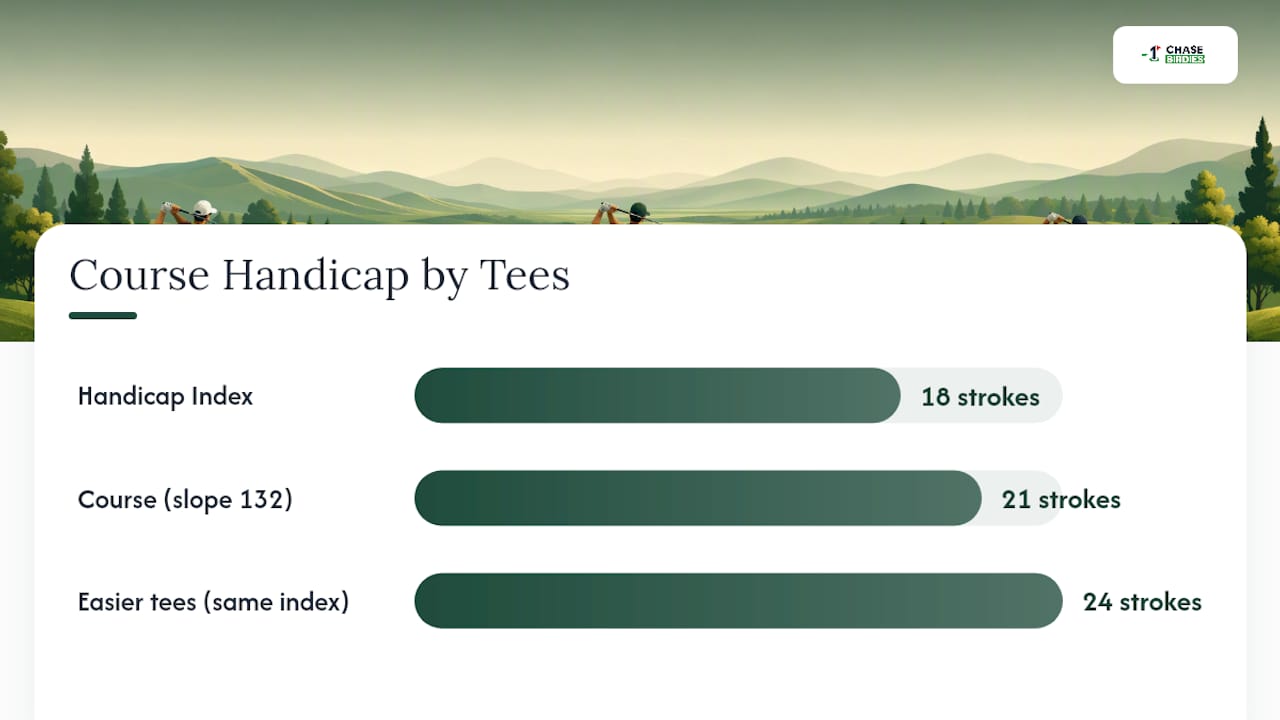
- Multiply by Slope ÷ 113. On a course with a slope of 132, that's 18.0 × (132 ÷ 113) = 21.0.
- Add the Course Rating minus Par adjustment. If Course Rating is 72.5 and par is 72, add 0.5.
- Round to the nearest whole number. Your Course Handicap here comes out to 21.
Now compare that same 18.0 index on an easier course:
Same golfer, same index, three extra strokes just from the tees they chose. That's the entire point of Course Handicap: it converts your portable Handicap Index into a number that fits the specific course you're playing today. Never compare raw slope numbers between courses and assume they tell you anything about your actual scoring. Run the math, or let an app run it for you.
Who Sets Slope Rating and What They're Actually Grading
Slope and Course Ratings aren't assigned by the club pro or a computer algorithm scanning satellite images. They come from Authorized Associations, regional bodies operating under USGA Appendix G, which sets the rulebook every rating team follows.
A few things worth knowing about that process:
- Courses need a minimum length to qualify: 1,500 yards for 18 holes, 750 yards for nine.
- If a course closes a tee or changes yardage mid-season, committees can request a temporary rating adjustment rather than waiting for a full re-rating.
- Raters evaluate topography, fairway landing areas, green surfaces, bunkering, water and trees, and recoverability from trouble spots, weighing each obstacle by how much it affects a bogey golfer's score.
A links-style layout like El Robledal Golf can carry a very different obstacle profile than a tree-lined parkland course of similar yardage, which is exactly the kind of variation this rating system is built to capture.
Reading Slope on a Scorecard: What 113, 125, and 140 Actually Mean
Think of 113 as sea level. A course rated right at 113 is built so that your Course Handicap should land close to your raw Handicap Index, no big swings either way.
- 113 to 119: Roughly average difficulty for a bogey golfer. Expect your Course Handicap to sit close to your index.
- 120 to 129: Noticeably tougher. Narrow fairways, demanding carries, or small greens are likely inflating the bogey golfer's expected score.
- 130 to 139: Hard. An 18.0 index golfer here often plays to a Course Handicap of 20 or 21, as shown in the earlier example.
- 140 and up: Among the toughest rated courses in the country. The USGA caps slope at 155, and courses anywhere near 140 typically punish missed shots severely.
Pro Tip: Don't just glance at the slope number before a big event. Check the posted Course Handicap conversion table at the pro shop or in your GHIN app, since that's the number that actually applies to your scoring.
Slope Rating Myths That Trip Up Recreational Golfers
- "A 130 slope course is always harder than a 125 slope course." Not necessarily. Slope only measures the gap between scratch and bogey scoring, so you need the Course Rating too before declaring one course tougher overall.
- "Slope tracks with par." A par-72 course can carry a low slope, and a par-70 course can carry a high one. Par has nothing to do with the calculation.
- "I need to calculate this myself." You don't. GHIN and most WHS-compliant scoring apps already apply the slope multiplier and Course Rating offset the moment you select your tees.
Why This Matters Beyond the Math
Slope rating exists to keep competition fair, and that shows up most clearly at the club level, where a scratch player and a 20 handicap are teeing off in the same group. Getting the Course Handicap conversion right is what makes a casual outing or a fundraiser tournament feel equitable instead of lopsided. Most modern scoring tools handle that conversion automatically now, which removes one more thing an organizer has to babysit on tournament day.
— Jon
Where to Dig Deeper on Course and Slope Ratings
For the official rules, read the USGA's Appendix G and its Course Rating and Slope Rating explainer. For a plain-language breakdown of the calculation, Golf Monthly covers the obstacle-factor scoring in more depth. Before any tournament, pull the specific Course Rating and slope for your tees from your club's posted database rather than relying on memory.
Running a shotgun scramble or a member-guest where handicaps vary widely puts this math to work in real time. If you're setting up an event and want scoring that applies each player's Course Handicap automatically instead of by hand, Chase Birdies' scoring platform handles hole-by-hole entry and live leaderboards for $1 per player, with no subscription required. It works whether you're running a scramble, a shamble, or straight stroke play, and it's built for the organizer running one clean event, not managing a facility.
Sources
- What Exactly are Course Rating and Slope Rating? USGA
- Slope Rating in Golf: What Is It And How Is It Calculated? Golf Monthly