
A skin goes to the single player with the outright lowest score on a hole. If two or more players tie for low, nobody claims it, and the skin rolls into the next hole. Groups can play gross skins (raw scores) or net skins (handicaps applied), and payouts follow whatever fixed value or shared pot the group agreed to before the first tee shot.
TL;DR:
- Carryovers occur when holes tie, and their value rolls into subsequent holes, making the game more unpredictable as multiple ties accumulate.
- Net skins account for handicaps by applying strokes on the hardest holes, ensuring fairness in mixed-ability groups, but require verification of handicap accuracy.
- Proper pre-round rules agreement, including carryover policies and validation criteria, prevents disputes and maintains the game's integrity.
- Manual scoring becomes cumbersome with multiple carryovers or larger groups; live scoring tools can automate tallying and improve transparency.
- The origin of skins comes from professional money games, making the format appealing for casual players seeking hole-by-hole excitement rather than total score focus.
Table of Contents
- What Is Skins Scoring and How Does a Skins Game Work?
- Gross Skins vs. Net Skins: Which One Fits Your Group?
- How Carryovers and Payouts Actually Work
- Worked Examples: Doing the Skins Math by Hand
- Pre-Round Checklist Every Organizer Should Run Through
- Balancing the Drama Against the Bookkeeping
- Where the Skins Game Actually Came From
- How Skins Scoring Compares to Other Golf Betting Formats
- The Real Tension in Skins Games Nobody Talks About
- Let Chase Birdies Handle the Skins Math for You
- Sources
- FAQ
What Is Skins Scoring and How Does a Skins Game Work?
Every hole in a skins game is its own contest. You don't add up 18 holes like stroke play. Instead, each hole either produces a winner or gets pushed forward, and that structure is what makes skins feel more like a series of small showdowns than one long round.
Here's how a typical group sets it up:
- Pick your format. Decide if this is gross skins, net skins, or a mix, and lock that in before anyone tees off.
- Fund the pot. Either assign a fixed dollar value per hole ($5 is common) or have everyone chip in a set amount that gets split by skins actually won.
- Play the hole. Whoever posts the sole lowest score on a hole wins that skin outright; a tie means no winner and the value carries over.
- Track the running total. Keep a visible count of who has won what, especially once carryovers start stacking.
A typical foursome playing a fixed dollar amount per hole is playing for a total corresponding to the number of players once all are in. With 18 holes on the line, the pot can move fast.
Gross Skins vs. Net Skins: Which One Fits Your Group?
Gross skins work best when everyone in the group plays to a similar level. Lowest raw score wins, no math required beyond counting strokes on the card.
Net skins level the field for mixed-ability groups by applying handicap strokes based on stroke index, the ranking on the scorecard that shows which holes are hardest. Here's the process:
- Calculate each player's Course Handicap using their index and the course's slope rating.
- Identify the lowest Course Handicap in the group. That player gets zero extra strokes.
- Subtract each other player's handicap from that baseline to find their strokes received.
- Apply those strokes on the holes ranked hardest by stroke index, working down the list.
Before you start, confirm every handicap number on the scorecard matches what players actually claim, and put one person in charge of checking net scores after each hole.
Pro Tip: Assign your scorekeeper before the round, not on the first tee box. Someone who's also trying to make a par putt is a bad choice to verify handicap math mid hole.
How Carryovers and Payouts Actually Work
Carryover, or "push," is the mechanic that turns skins from a quiet side bet into real drama. When a hole ties, that skin's value rolls forward and stacks on top of the next hole's value. String together three tied holes, and the next hole becomes worth multiple skins to whoever wins it outright.
Some groups add a validation rule: a skin only counts if the winning score is birdie or better, which cuts down on someone winning a skin with a lucky bogey nobody else could match. It's optional, but it changes the game's pace.
Payouts settle one of two ways:
- Fixed value per hole. Winning multiple skins pays out a multiple of the per-skin value won, regardless of what anyone else in the group owes.
- Divided pot. A $100 group pot split across 10 skins won pays $10 per skin, so the payout depends on how many skins actually got claimed.
Worked Examples: Doing the Skins Math by Hand
Numbers make this click faster than rules alone. Take a four-player group at $5 a hole:
- Hole 1: Two players tie for low. No winner, $5 carries to hole 2.
- Hole 2: One player wins outright. That player collects the combined value of the carried skins plus the current hole's skin.
- Hole 3: Clean win, no tie. Winner takes $5.
- Hole 4: Three-way tie. No winner, $5 carries to hole 5.
Net skins add another layer. Say a 15-handicap player and a 5-handicap player are both fighting for a hole. The 15-handicap gets a stroke on that hole (it's ranked among the hardest by stroke index), turning a bogey into a net par, which is now the low score and the skin winner.
The more carryovers stack, the easier it is to lose track of who's actually owed what by hole 15. That's exactly where manual tallying breaks down and a live scoring tool starts paying for itself.
Pre-Round Checklist Every Organizer Should Run Through
Most skins disputes trace back to one thing: rules that were never nailed down before the round started. Fix that with a five-minute conversation at the first tee.
- Confirm gross or net. Say it out loud, don't assume everyone agrees.
- Set the skin value. Fixed per hole or shared pot, decided in advance.
- Define the carryover policy. Does it roll forward every time, or is there a cap?
- Decide on validation. Birdie-or-better only, or any outright low score counts?
- Agree on the 18th-hole tiebreaker. Sudden-death playoff, a straight pot split, or carryback to hole 1 if you're replaying.
Put one person in charge of tracking skins on the line, and require everyone to hole out on putts that could affect a skin, even the "give me that" three-footers.
Pro Tip: Settle up right after the round while everyone still remembers who won which hole. Waiting until the clubhouse means someone's going to misremember a carryover, and now you're relitigating hole 7 over beers.
Balancing the Drama Against the Bookkeeping
Skins reward the group willing to nail down rules before the first tee shot. The format's biggest strength, hole-by-hole drama, is also its biggest administrative risk once carryovers start piling up three and four holes deep.
For a casual foursome, a scorecard and a sharp memory are enough. For a fundraiser, club event, or anything with more than one group on the course, agree on rules upfront and lean on live scoring to keep the tally honest for everyone watching.
Where the Skins Game Actually Came From
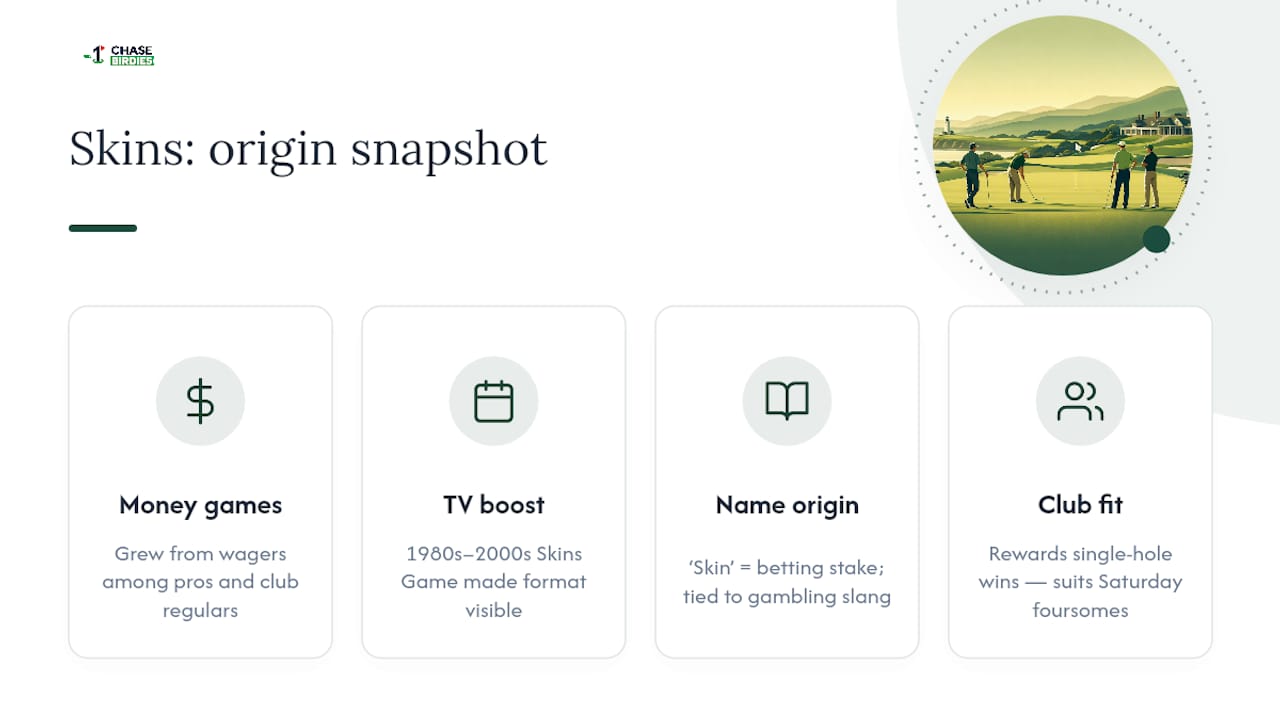
Skins didn't start as a casual weekend bet. The format grew out of money games played among touring professionals and country club regulars looking for a way to make even a mediocre round interesting on every single hole, rather than just at the finish.
Its biggest publicity boost came from television. The Skins Game, a made-for-TV exhibition that ran through the 1980s and into the 2000s, pitted a handful of top professionals against each other for cash prizes tied to individual holes rather than an 18-hole total. That format made the appeal obvious to casual audiences: you didn't need to track a leaderboard for four hours to know who just won money. You just needed to watch one hole.
The name itself borrows from older betting slang, where "skin" referred to money or a stake put into a wager, the same root behind phrases like "having skin in the game." Golfers took that betting vocabulary and built a hole-by-hole format around it, one where every tee shot carries its own separate payoff instead of contributing to one long grind toward a final score.
What kept the format alive at the club level, long after the TV specials faded, is how well it fits a Saturday foursome. Stroke play rewards consistency over 18 holes. Skins reward showing up for the one hole that matters, even if the other 17 were forgettable.
How Skins Scoring Compares to Other Golf Betting Formats
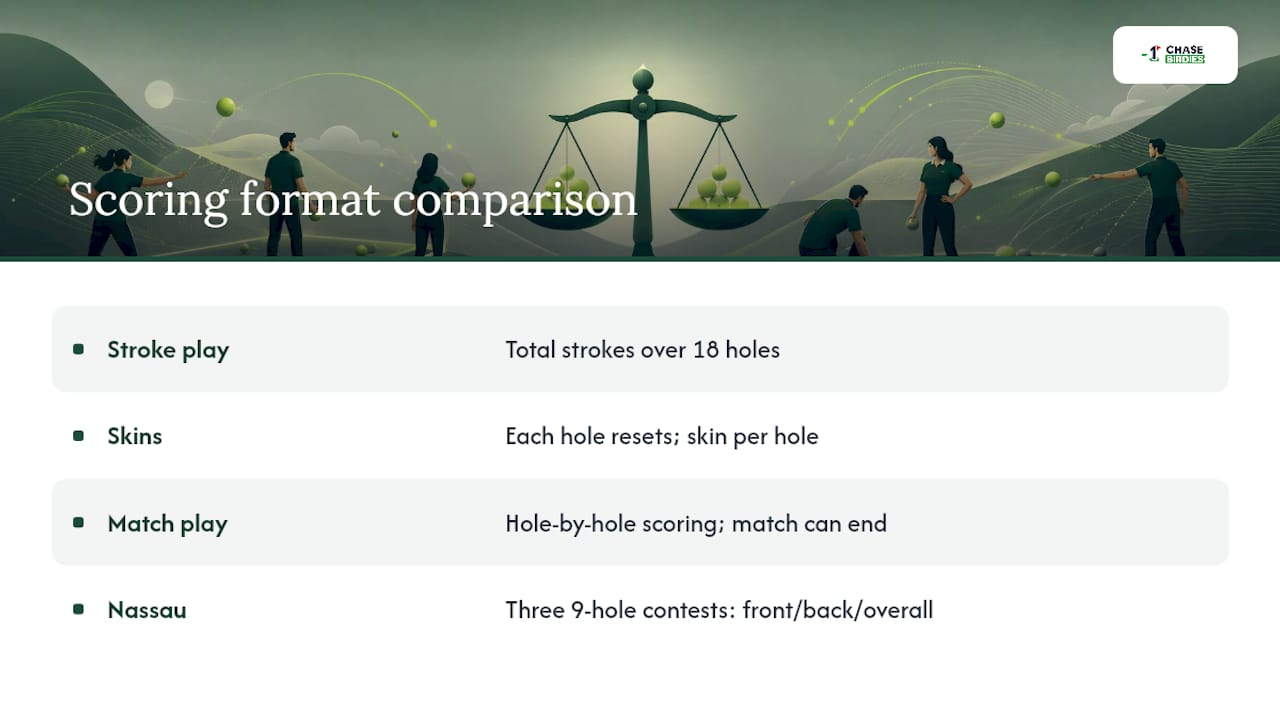
Stroke play and skins measure completely different things, even when the same foursome plays both in the same round. Stroke play adds every shot across 18 holes into one cumulative number, so a bad hole early can still get erased by a strong back nine. Skins wipes the slate clean every hole. A double bogey on hole 3 costs you that skin and nothing more. It doesn't follow you to hole 4.
Match play splits the difference. Like skins, it's decided hole by hole, but match play tracks holes won across an entire match between two sides, and the match can end early once one side is mathematically unable to catch up. Skins keeps every hole alive independently, all the way to 18, and a carryover from hole 3 can still be sitting unclaimed at hole 15.
Nassau, a common side bet structure, splits a round into front nine, back nine, and overall bets, essentially running three separate stroke-play contests inside one round. It rewards steady play across nine-hole stretches. Skins rewards a single great hole, even inside an otherwise rough stretch.
For organizers choosing a format, the real question is what kind of tension you want. Stroke play and Nassau reward the round as a whole. Skins and match play reward the moment. Many groups run skins as a side game layered on top of a stroke-play or scramble event, since nothing about tracking skins requires abandoning whatever main format the group already plays.
The Real Tension in Skins Games Nobody Talks About
Skins games sell themselves on drama, and that part of the pitch is true. What gets underplayed is how much that drama depends on the group actually agreeing on rules before anyone swings a club. Most of the disputes I've seen traced back in golf forums and rules guides aren't about golf skill at all. They're about someone assuming validation was required when nobody said so, or a carryover getting miscounted three holes back.
The conventional advice stops at "know the rules." That's incomplete. The better advice is to write the rules down, even informally, and assign one person to track them. Skins scale fine for a relaxed foursome with good memories. They scale badly for a 40-person club event with six groups on the course, where six different scorekeepers are each tracking their own carryovers by hand.
If you're running anything bigger than a single group, the honest priority isn't picking gross versus net. It's deciding, upfront, who verifies the math.
— Jon
Let Chase Birdies Handle the Skins Math for You
Chase Birdies is the alternative to a scorecard and a calculator for skins scoring. Instead of tallying carryovers by hand across six groups on a Saturday, hole-by-hole scores get entered live, and the leaderboard updates the standings automatically, no more relitigating hole 7 in the clubhouse.

Setup takes minutes, and pricing runs on a flat $1 per player, with no subscription and no hidden fees tacked on after the fact. That works whether you're running a casual foursome bet or a full club fundraiser with multiple groups competing for the same pot. Scores get entered from any phone, hole by hole, through the live scoring feature, and standings show up instantly on a public or PIN-protected leaderboard that anyone in the group can check without downloading an app.
If your next skins game involves more than one foursome, set it up on Chase Birdies before you tee off. It's built for exactly this kind of event.
Sources
For the core mechanics, Golf Digest's skins explainer covers basic rules and betting history. CaddieHQ walks through scoring math, and GolfGameshub details carryover, validation, and settlement options for organizers.
- How to play 'Skins': A basic guide to one of golf's best money games | Golf Digest
- How to Score a Skins Game in Golf | CaddieHQ
- Skins Golf Game: Official Rules, Scoring & Strategy Guide | GolfGamesHub
- Skins — TheStick Golf (skins game rules and variants)
FAQ
What Are the Basic Rules for Skins in Golf?
The lowest score on a hole wins that hole's skin outright, and a tie means no one wins, so the skin carries over to the next hole. Groups agree beforehand on skin value, gross versus net scoring, and how to settle any skins still unclaimed after 18 holes.
How Do You Play Skins With Handicaps?
Net skins apply each player's Course Handicap strokes to specific holes based on the stroke index printed on the scorecard, which ranks holes by difficulty. The player with the lowest handicap in the group plays without extra strokes, and everyone else gets strokes on the hardest holes until their handicap gap is covered.
What's My Handicap If I Shoot 84?
Your handicap depends on the course rating and slope, so the handicap differential varies by course difficulty. There's no single fixed answer without those course-specific numbers, which is why net skins calculations always start from Course Handicap, not raw score.
Is 200 a Bad Golf Score?
For 18 holes, high scores are common among beginners at most courses. It won't affect your ability to play skins, since skins are decided hole by hole rather than by your total round.
How Do You Settle Skins That Are Still Unclaimed After 18 Holes?
Groups typically choose a sudden-death playoff hole, split the pot evenly, or carry the value back to hole 1 for a rematch, and this should be agreed before the round starts. A sudden-death playoff tends to preserve the competitive finish better than simply splitting the pot.