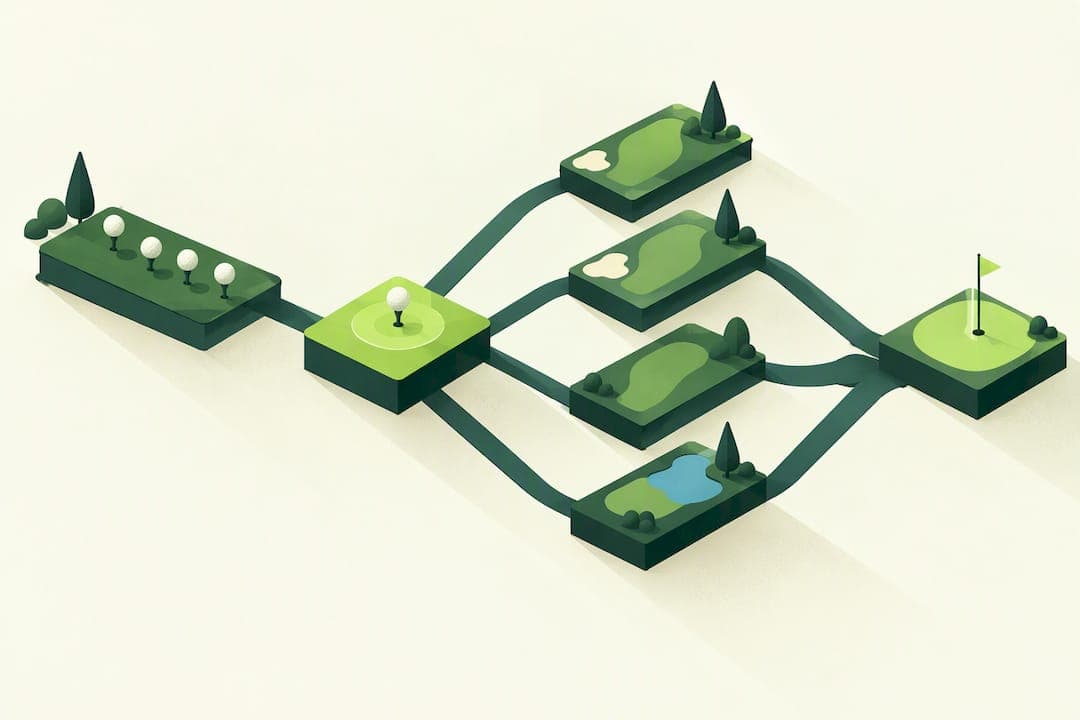
A shamble is a team format where every player tees off, the team picks the best drive, and each player then plays their own ball into the hole; the team score comes from the lowest individual score (or scores) or an aggregate, whichever the organizer declares before play starts, with useful organizer templates and formats available to help structure your event. You get to set the scoring method and handicap percentages yourself, and the USGA offers clear guidance on both.
TL;DR:
- Using 75% of each player's course handicap for two-person teams and 65% for four-person teams balances fairness and competitiveness.
- The score-sharing methods are best ball (lowest net score), two-best balls (sum of the two lowest net scores), and aggregate (all scores combined), influencing team strategy accordingly.
- Minimum drives are typically required in ABCD and Texas formats to ensure balanced contributions and prevent domination by high-handicap players.
- Pace-of-play can increase with individual play, so setting a cap like net double bogey and having clear scoring and penalty procedures help maintain timely rounds.
- Clarifying rules on drop allowances, out-of-bounds, hazards, and par-3 play before tee-off prevents disputes and ensures smooth tournament operation.
Table of Contents
- How a shamble plays from tee to green
- Scoring methods and handicap math made simple
- Common shamble variations organizers should know
- Organizer checklist: rules, logistics, and tiebreakers
- Team strategy and keeping the round moving
- Using tournament scoring software to run shambles
- Equipment to think about before you tee off
- Etiquette and sportsmanship specific to shamble play
- Penalty handling and pace once balls are in individual play
- When a shamble is the right call
- Run your shamble scoring without the spreadsheet headaches
- FAQ
- Sources
How a shamble plays from tee to green
Every shamble hole follows the same basic pattern, and once your players know it, the round moves fast. Here's the sequence you'll want to print on your rules sheet:
- All four (or two) players hit a tee shot from the same tee box.
- The team picks the best drive among those shots.
- Players whose ball was not selected move their ball to the chosen spot, typically within one club length, no closer to the hole.
- Each player then plays their own ball from that point, through the green and into the hole.
- Every player records their own score for the hole, and the team score is calculated using whichever method you've chosen.
A shamble starts like a scramble, with everyone teeing off and the team selecting one drive, but it splits from there: instead of all players hitting the second shot from the same spot and continuing as a team, each player plays an individual ball to the hole. That difference is what makes a shamble feel more like real golf for the back nine while still giving every player the benefit of the best drive.
A few details are worth nailing down before anyone tees off. Decide whether the placement allowance is one club length or two, since two-club-length drops are common on firmer courses where a one-club drop leaves an unplayable lie. Say clearly what happens when the best drive lands out of bounds or in a hazard: most events simply allow the team to replay from the tee or drop under penalty, same as the player who hit it would have faced individually. Par-3s skip the drive-selection step entirely since there's no tee shot to choose from, so state in your rules whether par-3s are played as straight individual stroke play. None of this is complicated, but your tournament committee needs to decide it in advance rather than let players argue it out on the course.
Scoring methods and handicap math made simple
Once the drives are chosen, how do you turn five scorecards into one team number? Three methods cover almost every shamble played today.
- One best ball (1BB): the team score on each hole is the lowest individual net score among all players. This rewards aggressive play since one hot round can carry the whole team.
- Two best balls (2BB): the two lowest net scores are added together for the hole. This format rewards consistency across the team rather than one standout performance.
- Aggregate: every player's net score counts, which keeps everyone engaged on every hole but tends to produce higher team totals.
The USGA recommends that committees consider applying 75% of each player's Course Handicap for two-person teams and 65% for four-person teams, though plenty of events use other figures depending on the field.
Worked example: Say you're running a four-person shamble under 2BB scoring. Player A has a Course Handicap of 10, Player B has 14, Player C has 18, and Player D has 22. On a par-4 where Players A and C shoot net scores of 4 and 3, the team's 2BB score for that hole is 7 (the two lowest net scores added together).
Pace-of-play tip: many organizers cap each hole at net double bogey, which keeps a single rough hole from stalling the group behind them.
Common shamble variations organizers should know
Not every shamble follows the same format, and the label on your event notice matters because it tells players what to expect.
- ABCD shamble: teams are built with one player from each handicap tier, A through D (lowest to highest), and organizers typically require each player to contribute 2 to 4 drives over the round so no single low-handicap player dominates tee selection, a point reinforced by common organizer practices around minimum-drive enforcement.
- Texas (two-person) shamble: just two players per team, both teeing off, selecting the better drive, then playing individual balls; handicap allowances here often mirror the USGA's 75% two-person guidance.
- Step-aside shamble: once a player's drive has been used a set number of times, that player "steps aside" on subsequent holes to force balanced contribution from the whole team.
- Other labels: some events call this format a bramble or champagne scramble. The name varies by club, so always confirm the exact scoring method in the event notice rather than assuming.
Organizer checklist: rules, logistics, and tiebreakers
A shamble runs smoothly when the rules are decided before anyone arrives, not debated on the first tee. Use this as a starting point for your event notice:
- Team size: two-person or four-person, stated clearly on the sign-up sheet.
- Scoring method: 1BB, 2BB, or aggregate, named explicitly rather than left to assumption.
- Handicap allocation: your chosen percentage, whether you follow the USGA's 75%/65% guidance or a local variant.
- Placement rule: one club length or two, no closer to the hole.
- Minimum drives: required if you're running ABCD or Texas formats.
- Max score cap: net double bogey is the most common choice for pace.
- Penalty handling: confirm penalties apply to the individual player, not the team.
- Tiebreaker procedure: back nine, then last six, then last three, then the 18th hole, or sudden-death if time allows.
For scoring logistics, decide who signs each card (usually the player and a teammate), how corrections get handled if a hole is missed, and whether you'll collect paper cards or run everything through an electronic scoring app.
Pro Tip: Announce the scoring method and handicap percentage out loud before the shotgun start, not just in the printed rules; players remember what they hear.
Team strategy and keeping the round moving
The scoring method you pick changes how teams play. Under 1BB, teams tend to play aggressively since only the best score counts, while 2BB and aggregate formats reward steady, conservative play because more scores go into the total.
- Send your longer hitter first off the tee to set a target line for teammates.
- On the green, putt in order from farthest to nearest the hole, same as stroke play.
- Set a hole-score cap and a pick-up policy once a player is clearly out of the hole, to protect pace.
- Agree on who records scores before the round starts, so nobody's guessing at the turn.
Pro Tip: A clear shot order avoids the five-minute huddle that happens on every tee box when nobody knows who's hitting first.
Using tournament scoring software to run shambles
You can set up a shamble in a few steps with tournament scoring software: create the event, set the format to shamble, choose your scoring method and handicap rule, invite scorers, and let the leaderboard update live as cards come in.
- Hole-by-hole scoring and editable scorecards cut down on the math errors that come with paper cards.
- Live leaderboards remove the guessing game about standings mid-round.
- Mobile-friendly setup means scorers enter results from the course, not a clubhouse table afterward.
- A flat $1-per-player price, as listed on the pricing page, replaces the subscription fees some platforms charge.
This kind of setup directly addresses the scorecard disputes and tiebreak confusion that paper-based shambles tend to produce.
Equipment to think about before you tee off
A shamble doesn't require special gear, but a few practical choices make the round easier for everyone involved. Players should carry enough balls for full individual play on every hole, since once the best drive is chosen, each golfer is playing their own ball the rest of the way, unlike a scramble where the team shares one ball per shot.
A rangefinder or GPS device helps individual players judge approach distances quickly once they've moved to the selected drive spot, which matters for pace since four players are now making separate decisions instead of one team choice. Clubs suited to a player's actual handicap matter more in a shamble than in a scramble, because weaker players are hitting full approach shots and short games on every hole rather than relying on a teammate's strong second shot.
If your event uses GPS-based scoring or an app like Chase Birdies for live entry, make sure each scorer has a charged phone and a data connection at the course, since dead zones on some back nines can delay updates. Nothing here needs to be fancy: standard clubs, enough balls, and a way to track distance cover what a shamble actually demands.
Etiquette and sportsmanship specific to shamble play
Shamble etiquette borrows from both team and individual golf, which is exactly where confusion tends to show up. Once the best drive is picked, players whose balls weren't selected should pick up quickly rather than finishing out that shot, since the format moves on to individual play from the chosen spot.
Because each player is now responsible for their own score, it's worth being generous with reads and club advice before the drive is picked, then stepping back once individual play starts, since offering too much coaching can slow the group and blur the line between team and individual effort. Respect the minimum-drive rules if your event uses ABCD or Texas formats. A player sandbagging to avoid contributing drives is a common sportsmanship complaint, and it's one your rules sheet should address directly rather than leaving to peer pressure on the course.
Keep celebrating team moments, a great drive selection or a clutch individual putt, since that mix of team spirit and individual recognition is part of what makes a shamble popular for charity and club events.
Penalty handling and pace once balls are in individual play
Once players move to individual balls after the drive selection, penalties apply the same way they would in regular stroke play: to the individual player, not the team. If a player's ball goes out of bounds or into a water hazard during their individual play, that player takes the penalty and resulting score, and only their net result feeds into whichever scoring method the team is using.
This individual accountability is actually where shamble pace-of-play challenges show up most. Four players making separate decisions and separate shots on every hole, rather than one team playing from a single ball, naturally takes longer than a straight scramble. Score caps like net double bogey help here, since they limit how long a group lingers over a rough hole. Observational guidance from club organizers suggests shamble team scores often run four to eight strokes higher than comparable scramble scores, a reasonable expectation to set with players ahead of time so nobody's surprised by a slower pace or a higher number.
Marshaling a shamble field benefits from the same tools as any stroke-play event: clear gaps between tee times, a stated pace policy, and a way to flag groups falling behind early rather than at the 15th hole.

When a shamble is the right call
A shamble fits events where you want weaker players to stay engaged off the tee while still rewarding better individual play through the green. For pure fun and speed, a scramble beats it. For serious competition among strong players, best ball often makes more sense. For a club outing or fundraiser aiming for a middle ground, I'd default to a shamble every time.
— Jon
Run your shamble scoring without the spreadsheet headaches
Chase Birdies handles shamble scoring hole by hole, with live leaderboards that update as scores come in and mobile-friendly setup that works from any device at the course. 
Pricing runs a flat $1 per player, with no subscription attached. Set your format to shamble, pick your scoring method, and get your leaderboard live before the first group tees off.
FAQ
What is a common mistake in a shamble?
The most common mistake is failing to state the scoring method and handicap percentage before the round starts, which leads to disputes once cards come in. A close second is not enforcing minimum-drive rules in ABCD or Texas formats, letting one strong player dominate every tee shot.
What percentage of handicap should a shamble use?
The USGA suggests committees consider 75% of each player's Course Handicap for two-person teams and 65% for four-person teams. Some events use alternatives like 80% or 85% depending on the field, so organizers should always state their chosen percentage in the event notice.
What is the ABCD shamble format in golf?
An ABCD shamble groups teams with one player from each handicap tier, labeled A through D from lowest to highest handicap. Organizers typically require each player to log a minimum number of drives, often two to four over the round, so every player contributes to tee selection.
What is a shamble versus a scramble?
A scramble has the whole team play every shot together from the best position, including the approach and putt. A shamble only shares the tee shot: after the best drive is chosen, each player plays their own ball individually to the hole.
Sources
- Shamble (USGA)
- What Is a Golf Shamble vs. Scramble? (CaddieHQ)
- Scramble vs Shamble (GolfGamesHub)
- What is a Shamble in Golf? (GolferHive)