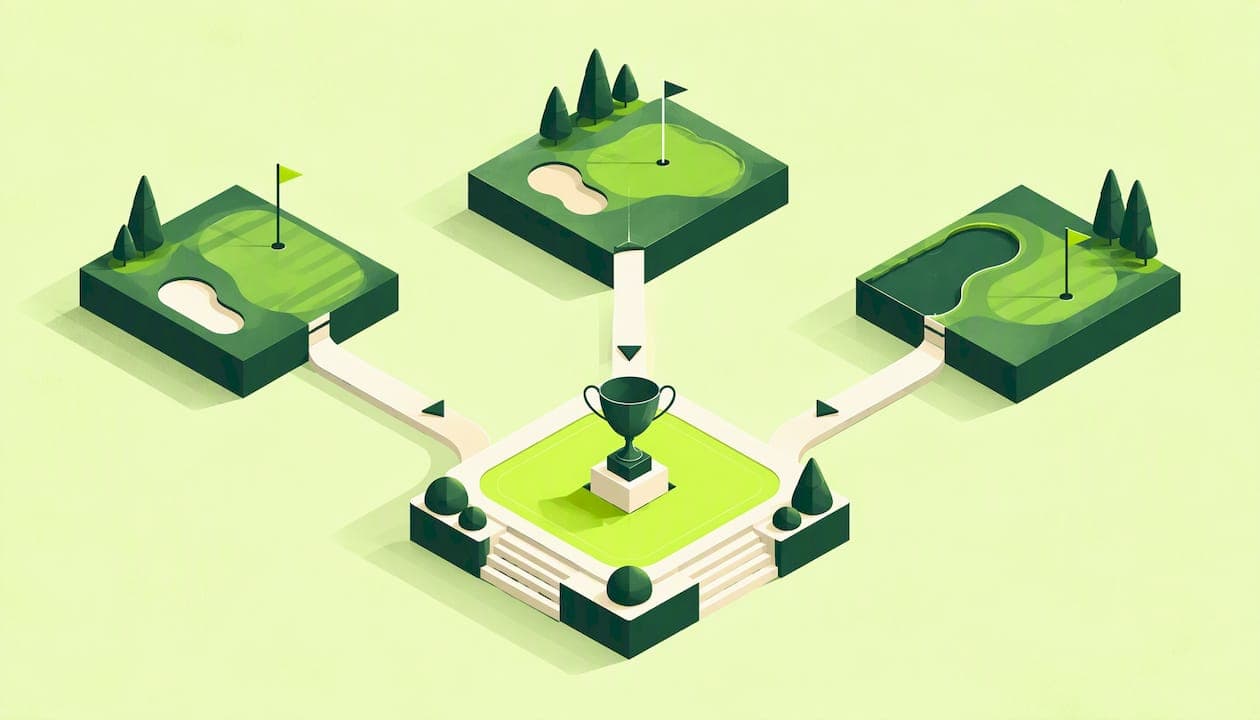
Run your ryder cup style tournament with three formats: foursomes, four-ball and singles, worth 28 points in total, with 14½ needed to win. For most amateur groups, play foursomes and four-ball on Friday and singles on Sunday, or adapt the format to fit into one day. Publish the USGA handicap allowance in your rules and have captains submit singles lineups in sealed envelopes.
TL;DR:
- Publish handicap allowances in the rules: USGA recommendations are 100% for singles, 90% for four ball, and 50% of combined team handicaps for foursomes.
- Name substitutes before play; for a no show, choose from a standby list and arrange a matching opponent or agree to halve the match.
- Captains should submit singles lineups in sealed envelopes by a set deadline, preventing either side from changing its order after seeing its opponent’s choices.
- Set the tie rule in advance: at 14 points, the defending team can retain the cup, or a playoff can decide the winner.
Table of Contents
- How do the three Ryder Cup match formats work and score?
- Which sample schedules and team sizes work for amateur events?
- How should handicap allowances work in match play?
- What do captains do, and how does the sealed-envelope singles order work?
- What logistics keep a Ryder Cup style event running on time?
- How do you manage scores and leaderboards with digital tools?
- How do you add a mobile scoring app without causing chaos?
- How do you keep players and spectators engaged all weekend?
- What should captains and players say to coordinate matches?
- How do you adapt Ryder Cup formats beyond 24 players?
- Why do team events beat solo tournaments?
- How can live leaderboards help your Ryder Cup style event?
- FAQ
- Sources
How do the three Ryder Cup match formats work and score?
Every Ryder Cup match is match play. You win holes, not strokes. The team that wins a hole goes one up, and the match ends when one side leads by more holes than remain. Here is how each format plays:
- Foursomes (alternate shot): Two partners share one ball. One player tees off on the odd holes, the other on the even holes, and you alternate shots until the ball is holed.
- Four-ball (better ball): Each partner plays their own ball. The lower score of the two counts for the team on each hole.
- Singles: One player from each team goes head to head. Lowest score on a hole wins it.
Match play uses "holes up" language. If your side has won two more holes than the other, you are "2 up." If you have won the same number, you are "all square." A result of "3&2" means one side led by three holes with only two left to play, so the match ended on the 16th green. Stopping at that point is standard etiquette, and as Golfpass, conceding a decided match keeps pace moving so groups reach the post-round events on time.
Scoring is simple. Each match is worth one point, and a halved match (tied after 18 holes) splits it, half a point for each side. The professional event uses two sessions of foursomes and four-ball across the first two days, eight matches per day, then 12 singles on the final day. That adds up to 28 matches and 28 points, and a team needs 14½ to win outright.
What if the teams finish tied at 14 points each? In the pro game, the previous winner keeps the cup. For your event, decide this in advance. Many organizers let the defending team keep the trophy, and first-year events often name a tiebreak like a sudden-death singles match or a team playoff hole. Whatever you pick, put it in writing before the first tee time.
Which sample schedules and team sizes work for amateur events?
You do not need 24 players or three days. Pick a template that fits your headcount and daylight. The classic weekend runs 12 versus 12, and the rest scale down from there.
Classic 12v12 weekend: Four foursomes matches and four four-ball matches per day for two days, then 12 singles on the last day. That gives you 28 points.
Scaled versions: For smaller teams, trim the number of matches per session so players get a similar amount of play. Adjust the schedule to the group size and available time.
One-day format: Six foursomes matches in the morning, six four-ball matches after lunch, and six singles in the late afternoon. That gives 18 points, and 9½ wins. It works for 12 players per side only if you can run 18 holes of golf in each session, so most groups play 9 holes per session instead.
9-hole variants: You can split play into shorter sessions, but decide in advance how the points will work and whether the sessions count as separate matches. Some long-running amateur events adapt in just this way, like the Blue Ridge Ryder Cup, which uses 9-hole matches and special named rounds.
Here is a sample two-day timetable:
- Friday morning: Foursomes session, with tee times spaced to suit the course.
- Friday afternoon: Four-ball session after lunch and a break.
- Friday evening: Team dinner and captains announce the next pairings.
- Sunday morning: Singles session, with matches teeing off in sequence.
- After play: Awards ceremony and trophy presentation.
For a compressed single day, start at 7:30 AM, take a 45-minute lunch break, and plan the last tee time no later than 2:30 PM so you finish before dark.
For mixed-handicap groups, build flights or divisions by handicap range and have each captain pair players within a similar band. Name substitutes before the event, not on the first tee. If someone no-shows, the captain must choose a replacement from a standby list, and the opposing side should get a matching player or an agreed halved match. Our guide on building a golf tournament roster walks through standby lists and substitutions.
Pro Tip: Draft a one-page substitution rule before registration closes. Late dropouts are the most common cause of disputes.
How should handicap allowances work in match play?
Fair handicaps are what make a ryder cup style tournament feel competitive for everyone, not just scratch players. The USGA publishes recommended allowances, and your Terms of Competition should state the one you choose.
Per USGA Appendix C, the recommended match play allowances are:
- Singles: 100% of the Course Handicap difference between the two players.
- Four-ball: 90% of each player's Course Handicap, with strokes taken off the lowest handicap in the match.
- Foursomes: 50% of the combined team Course Handicap difference.
- Field size matters: The USGA says allowances may be adjusted based on field size, so check the table when your group is large or small.
The USGA says Committees should state the handicap allowance in the Terms of Competition. If it is not written down, players will argue about it on the first tee.
Let's work a four-ball example with made-up numbers. Say Team A has players with Course Handicaps of 10 and 18, and Team B has 8 and 20. The low player (7) plays to zero. Everyone else gets the difference: 2, 9 and 11 strokes, placed on the hardest holes by stroke index.
For foursomes, add each team's two Course Handicaps. Team A has 10 and 18, so 28. Team B has 8 and 20, also 28. The difference is zero, so nobody gets strokes.
Our post on match play handicaps for organizers covers the same math, and our golf team formats guide goes deeper on team handicap rules.

What do captains do, and how does the sealed-envelope singles order work?
Captains make or break the weekend. They set pairings for each session, decide who sits, settle rules disputes and keep their team's spirits up. Choose captains for organization and emotional intelligence as much as for their handicap. The USGA's committee guidance reinforces that the person in charge of rules and handicap decisions has to be someone the whole group trusts.
For pairings, balance skills. Put a long hitter with a steady putter, or match a nervous player with a calm one. Think about the course too: if the par 3s are tough, give them to your best iron players in four-ball. Friends often play better together in foursomes because they communicate.
The singles order is the big moment. As Rydercup, each captain submits their singles lineup in a sealed envelope, and the envelopes are opened at the designated time. Nobody can counter-stack the order. It is fair, and it adds suspense. Many captains stagger their lineups, putting strong players at the front, middle and back.
Here is a short captain checklist:
- Before the event: Call every player to confirm availability and handicaps.
- Before play: Send the schedule, tee times, dress colors and rules.
- Before each session: Submit pairings by the deadline the committee set.
- Before singles: Hand your sealed envelope to the committee before the deadline.
- On the course: Bring a rules app or rulebook and a list of team phone numbers.
Pro Tip: Set a submission deadline and a sealed-envelope handoff time in your schedule. Without a hard deadline, someone always asks for "five more minutes."
What logistics keep a Ryder Cup style event running on time?
A smooth day is mostly planning. Here is what to lock down:
- Tee spacing: Space matches in the same session to suit the course, and allow enough time for rounds and breaks between sessions.
- Pace of play: Stop matches once they are decided and keep marshals on the course. Foursomes plays faster than four-ball because only one ball is in play per side.
- Scoring workflow: Paper cards work if each match has one designated scorer who tallies holes won and the running "up" total. A live platform records hole-by-hole results and shows the team standing instantly. Decide who settles disputes before play starts, ideally a committee member, not a captain.
- Atmosphere: According to GolfPass, the "Ryder Cup feel" comes from team uniforms or colors, a retained trophy and a structured awards ceremony, details players often remember more than the scores. Add captains' speeches at dinner and a cup that stays with the winners until next year.
- Permissions and safety: Get written course permission, confirm cart policies, and brief players on on-course communication such as who calls the committee if rules questions come up.
- Spectators: If friends and family will follow matches, set clear rules for where they can walk. This spectator policy template is a good starting point.
- Food and awards: Time the awards ceremony right after the last singles match finishes, and book the room or tent with a cushion so it does not start late.
- Accessibility: Plan for players who need a cart, shorter walks between holes or a quiet place to rest.
For a full event checklist covering registration and sponsors, see our guide on how to run a golf tournament.
How do you manage scores and leaderboards with digital tools?
Match play is awkward to track on paper. A scorer has to remember who is one up after the 11th, and the overall team score changes every few minutes. A digital leaderboard fixes that.
With Chase Birdies, players or scorers enter results hole by hole on a phone, and the leaderboard updates the moment a score is saved. The leaderboard updates during the round as scores are entered. If one team is ahead in some matches and behind in others, the standings show the situation live.
Examples of how organizers use that:
- Between sessions: After foursomes, captains see which pairings won, lost or halved and adjust the four-ball lineup.
- During singles: Spectators at the clubhouse can follow the leaderboard as scores are entered.
- After the round: Editable scorecards let you fix a mis-entered hole without redoing the whole sheet.
Our live leaderboard page shows how this works for multi-session events. For format-specific scoring rules, see our match play scoring guide.
How do you add a mobile scoring app without causing chaos?
A mobile scoring app should reduce setup, not add it. Follow these steps so the technology helps instead of slowing play.
Set up before the event. Enter teams, players and the session schedule a few days early. Then send players the link, so they can check it on their own phone.
Name one scorer per match. Two people entering the same score creates conflicts. Choose one scorer per group, and give the other players view-only access.
Run a brief demo. At the first-tee briefing, show players how to enter a hole and fix a mistake. Most errors come from people who never saw how it works.
Keep a paper backup. Hand each scorer a simple card in case phones die or signal drops. Our hole-by-hole scoring feature lets you edit scores later, so the paper card can fill gaps.
Check the leaderboard after each session. Have a committee member compare the standings against the cards. Small slips, like a halved hole entered as a win, are easy to catch at that point.
Choose public or PIN-protected. If you want spectators and family to follow along, share the public link. If the event is private, use the PIN option.
How do you keep players and spectators engaged all weekend?
The best team events feel like events, not just rounds of golf. A few small touches go a long way.
Start with the opening ceremony. Each captain introduces their team, and you read the format and handicap rules out loud. It sets the tone and gets everyone on the same page.
Give teams identity. Matching hats or polo colors make the groups easy to spot on the course, and spectators can instantly tell who is winning. Organized amateur events often include team uniforms, evening dinners and ceremonies to recreate a championship feel.
Make the scoreboard visible. A big screen or poster at the clubhouse, plus a live link for phones, keeps non-players in the loop. When the team score gets close, people will gather around.
Use the sealed-envelope reveal as theater. Open the envelopes in front of the whole group at dinner or on the first tee. Read the matchups aloud, and let both teams react.
Give spectators something to do. Let them walk with matches, cheer on a favorite pairing, or vote for a "shot of the day." A small prize for best team spirit gets everyone involved, including players who are not in the current session.
End well. Hold the trophy ceremony promptly after the final match, let captains say a few words, and take a team photo with the cup.
What should captains and players say to coordinate matches?
Clear messages save you from texts at 7 AM asking where to be. Copy and adapt these templates.
Captain to team, before the event: "Hi team, our event is [date] at [course]. Friday foursomes start at 8:00 AM. Please arrive by 7:15 for the briefing. Wear our team color, navy. Handicaps are due by [date]. Reply to confirm."
Captain to pairing: "You two are paired for Friday morning foursomes against Team Red's second group. Decide who tees off on odd holes before we start. Stick to the alternate shot rule and call me if anything is unclear."
Committee to captains, singles day: "Singles lineups are due in sealed envelopes by 7:45 AM. Envelopes will be opened at 8:00 AM at the first tee. Late lineups will be placed at the bottom of the order."
Player to opposing player before the match: "Looking forward to our match. Can we confirm our handicap strokes? Per the rules, I have [number] strokes on holes [list]. Let me know if you see it differently."
Substitution request: "[Name] cannot play Saturday morning due to [reason]. I'd like to substitute [name], handicap [number]. Please confirm."
Keep every message short, include times and names, and always send the same schedule to both captains.
How do you adapt Ryder Cup formats beyond 24 players?
The traditional setup is 12 per side, but your group may be 6, 20 or 40. The rule is to keep the point structure balanced and make sure every player plays a similar number of matches.
For a small group, schedule foursomes, four-ball and singles matches to suit the number of players. For a medium group, scale up the matches while keeping the points balanced, and state the winning threshold in advance.
For large groups, split into divisions. Run two parallel Ryder Cups, or create a main cup and a "second flight" cup for higher handicaps. Another approach is to rotate players: not everyone plays every session, and each captain tracks who has sat out.
With an odd number of players, use a ghost player or a captain's pick. Let one team play with a substitute on a given match. Agree beforehand how that match is scored, such as awarding the missing side a halved match or allowing a committee member to fill in.
Nine-hole sessions also help large groups. Two 9-hole sessions can double the number of matches without extending the day. In every version, tell players the total points available and the winning threshold, and publish the schedule before registration closes. Our golf team formats article covers other team structures if a full Ryder Cup does not fit.
Why do team events beat solo tournaments?
I have run plenty of stroke play days, and the energy never compares to a team weekend. Once you put a name on a jersey and a trophy on a table, players show up for each other. They return the next year because their teammates expect it.
The sealed-envelope reveal is my favorite part. When both captains tear open their lineups and the room reacts, you can feel the weekend turn into something people will talk about for months. My advice is simple: pair people inclusively, communicate early and often, and put fun and fairness ahead of everything else.
— Jon
How can live leaderboards help your Ryder Cup style event?
We built Chase Birdies for organizers who want instant, hole-by-hole standings without the paperwork. Players or scorers enter results from any phone, and the leaderboard updates the moment each hole is saved. There is no app to download and setup takes minutes.
Multi-session team events can benefit from live scoring. You can time the awards ceremony around the final result. Our pricing is a flat $1 per player per tournament, with no subscription. See the pricing page or explore our live leaderboard features to set up your event.
FAQ
How many points are needed to win the Ryder Cup?
A team needs 14½ points to win outright out of 28 available. Each match is worth one point, and a halved match gives half a point to each side. If the teams tie at 14, the previous winner keeps the cup.
How are Ryder Cup matchups determined?
Captains choose their foursomes and four-ball pairings before each session. For singles, each captain submits a lineup in a sealed envelope, and the envelopes are opened at the designated time. This keeps either side from reacting to the other's order, as rydercup.com explains.
What handicap allowance should I use for an amateur event?
Write your choice into the Terms of Competition. Larger or smaller fields may call for a different allowance, so check USGA Appendix C.
Can I run a Ryder Cup style tournament in one day?
Yes. A one-day 6–6–6 format has six foursomes, six four-ball and six singles matches, played as 9-hole sessions if daylight is short. Plan an early start and stop decided matches early to protect your schedule.
Sources
- Appendix C: Handicap Allowances
- Ryder Cup 2025: How does the competition, format and scoring work? - BBC Sport
- Rydercup
- Golfpass