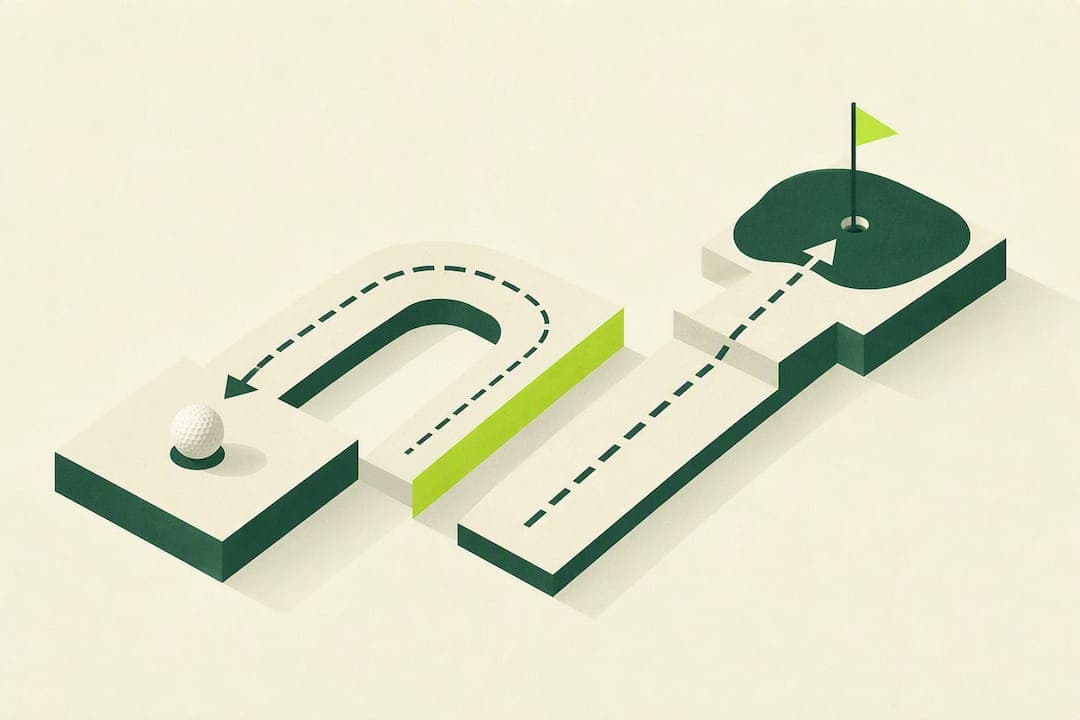
A mulligan is an informal do-over in casual golf. You hit again from the same spot with no penalty added to your score, but only when your group has agreed to allow it beforehand. It has zero standing under the official Rules of Golf, so it never applies in sanctioned competition and it makes a round unacceptable for handicap posting.
TL;DR:
- Most casual groups limit mulligans to one per round or nine holes to prevent slowing pace and maintain fairness.
- USGA and R&A rules explicitly exclude mulligans from sanctioned play, making them invalid for official score posting or handicaps.
- Charity mulligans are often sold as a fundraising tool, but organizers must set clear limits and track purchases to ensure fairness.
- Using mulligans should be agreed upon before the round starts and recorded on the scorecard to avoid disputes and unofficial scoring issues.
- The best practice is to reserve mulligans for the first tee shot or short putts and avoid applying them after errors like out-of-bounds shots.
Table of Contents
- What Is a Golf Mulligan, and How Is It Different from a Provisional Ball?
- The Most Common Mulligan Rules Tournaments and Casual Groups Use
- How to Use Mulligans Without Slowing Down the Group Behind You
- Are Mulligans Legal? What USGA and R&A Rules Actually Say
- Setting Group Rules: Three Templates You Can Copy This Weekend
- Your Quick Mulligan Checklist for a Fair, Fast Round
- Why One Simple Rule Beats an Endless Debate
- Run Your Casual Round or Fundraiser Without the Spreadsheet Headache
- Sources
- FAQ
What Is a Golf Mulligan, and How Is It Different from a Provisional Ball?
A mulligan lets you replay a shot as if the first one never happened. You erase the stroke, drop another ball at the same spot, and swing again. There's no formal procedure for it because there doesn't need to be. It exists entirely outside the rulebook, which is exactly what separates it from the official remedies golf actually provides.
A provisional ball works differently. Rule 14 governs how you mark, lift, and replace a ball on the course, and stroke-and-distance penalties are built into the Rules for shots that are lost or out of bounds. A provisional ball counts as a stroke. A mulligan doesn't count at all, because you and your playing partners simply agree to pretend it didn't happen.
The name has a couple of colorful backstories, neither one confirmed:
- David Mulligan, a Canadian club member in the 1920s, supposedly re-teed after a shaky first drive and called it a "correction shot."
- A club locker room attendant named Buddy allegedly got the same do-over treatment from sympathetic members.
Etymology researchers who've dug through the record note that both origin stories are anecdotal rather than documented fact. Good story, thin proof. That's fine. Golf runs on that kind of folklore.
The Most Common Mulligan Rules Tournaments and Casual Groups Use
Every group that plays with mulligans ends up inventing its own version of the concept, and most of them fall into a handful of recognizable patterns. Here are the ones you'll run into most often:
- One per round. Each player gets a single mulligan to use whenever they want, usually saved for a tee shot that goes sideways.
- One per nine. The same idea, doubled, so you get a fresh do-over on the front and another on the back.
- Breakfast ball. A mulligan reserved strictly for the first tee shot of the day, when cold hands and nerves are most likely to wreck a swing.
- Two-off-the-first. Some groups let every player hit two balls off the opening tee and simply keep the better result.
- Lunch ball. A second breakfast ball, granted on the first tee after the halfway turn.
- Charity mulligan. Sold for a small donation before the round, often in scramble events raising money for a cause.
- Reverse mulligan or gilligan. A do-over used when your ball ends up in an unexpectedly great spot, so you can try for something even better.
Charity mulligans deserve a caveat. Selling extra shots is a common fundraising mechanic in scramble tournaments, and it works well when it's transparent. It changes the math of fairness the moment one team buys five mulligans and another buys none, so organizers who use this format need a clear, published cap and a way to track who bought what.
How to Use Mulligans Without Slowing Down the Group Behind You
Mulligans are supposed to make golf more fun, not more frustrating for everyone else on the course. A few habits keep it that way.
- Agree on the rule before you tee off on hole one, not after someone hits a bad shot on hole three.
- Apply the same rule to every player in the group. Nothing sours a friendly round faster than a mulligan policy that bends for the loudest guy in the cart.
- Skip the mulligan when the group ahead is still on the green or the group behind is stacking up. Waving people through takes longer than just playing your next shot.
- Be upfront about when you use one. Announce it, don't quietly drop a second ball and hope nobody notices.
- Cap it. A round with unlimited do-overs isn't really golf anymore, and it stops being fun for the players who don't need the extra help.
Pro Tip: Save your mulligan for the tee shot, not the approach or the putt. A blown drive costs you the whole hole; a blown three-footer just costs you one stroke, and most groups don't think that's worth burning your one do-over on.
Are Mulligans Legal? What USGA and R&A Rules Actually Say
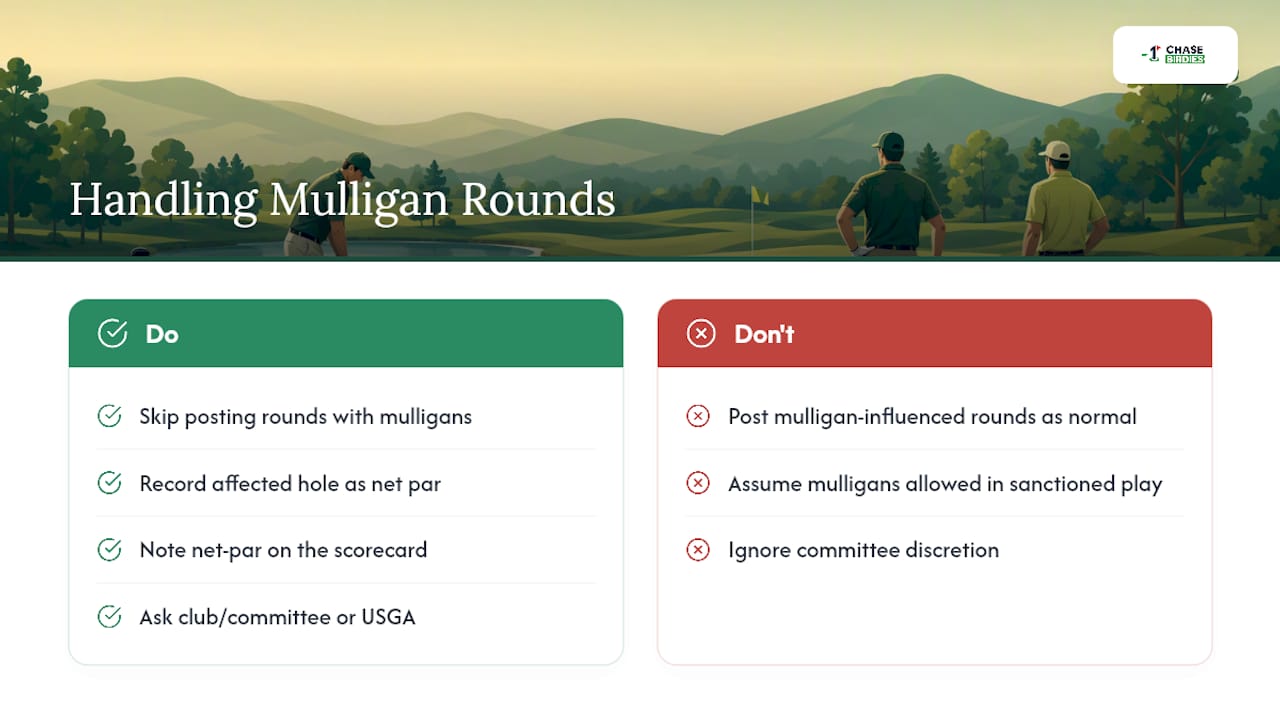
Mulligans have no place in sanctioned play, full stop. The USGA and R&A do not permit them under the Rules of Golf, and any round where one gets used is technically non-compliant the moment it happens.
That matters most for handicap posting. The USGA's guidance on acceptable scores states plainly that a round has to be played under the Rules of Golf to count.
Holes played other than under the Rules of Golf may be recorded as net par, and a round in which mulligans were used is generally unacceptable for handicap posting unless a Committee applies specific discretion.
In practice, this means a casual Saturday round with a breakfast ball or two shouldn't go into your handicap record as-is. The SCGA's volunteer handicap guidance reinforces the same standard for regional committees evaluating scores. If you want an accurate handicap, the safest move is to skip posting rounds where a mulligan factored into the score, or to record the affected hole as net par and note it on the card. If you're unsure how your local club or association wants scores like this handled, the USGA and R&A resources above walk through the exact procedures for edge cases.
Setting Group Rules: Three Templates You Can Copy This Weekend
Deciding your mulligan policy takes thirty seconds if you use a template instead of negotiating hole by hole.
- Template A: One breakfast ball each. Every player gets exactly one mulligan, usable only on the first tee shot of the round. Simple, fast, and it takes the edge off first-tee jitters without opening the door to abuse later in the round.
- Template B: One mulligan per nine. Each player gets one do-over on the front nine and one on the back, usable on any shot they choose. Track it by circling the hole number on the card so nobody argues about it on 18.
- Template C: No mulligans in scoring, charity mulligans sold beforehand. Scores count as played, but players can buy extra shots before the round starts, with proceeds going to a fundraiser. Track purchases on a simple sign-in sheet so results stay transparent.
For scorecard notes, mark the hole where a mulligan happened with an "X" or write "net par" next to the score. That way anyone reviewing the card later, including you, knows exactly which holes weren't played straight, and you'll remember not to post that round for handicap.
Your Quick Mulligan Checklist for a Fair, Fast Round
Before you tee off, run through this list with your group:
- Agree on the mulligan rule out loud, before the first swing.
- Set a limit. One per round or one per nine, never unlimited.
- Watch the pace. Skip the do-over if it holds up the course.
- Record it on the card so scoring stays honest later.
- Don't post the round for handicap if a mulligan affected your score.
Pro Tip: Reserve mulligans for the breakfast ball or a missed short putt, never for a ball that sails out of bounds. Handling charity mulligans before the round, not mid round, keeps the sales organized and the pace of play intact.
Why One Simple Rule Beats an Endless Debate
I once watched a foursome burn ten minutes arguing about whether a "gimme mulligan" applied to a chunked chip. Nobody remembers who won that argument. Everybody remembers the group behind them getting annoyed. Setting one rule, applied to everyone, before the round starts protects both the fun and the integrity of the score. That's the whole game, really.
— Jon
Run Your Casual Round or Fundraiser Without the Spreadsheet Headache
If your group sells charity mulligans or runs a scramble with relaxed rules, you still need a clean way to track who paid, who's leading, and whose score counts. There are online platforms designed for events like this offering mobile-friendly live scoring and leaderboards for individual organizers, not big facilities juggling club software.

Score entry happens hole by hole from any phone, so you can log a mulligan purchase or a net-par hole the moment it happens instead of reconstructing the round afterward. Pricing runs a flat $1 per player, with no subscription and no hidden fees, which makes it practical for a small club outing or a one-day charity scramble where mulligans are part of the fundraising plan. It supports scramble, best ball, and several other formats where relaxed rules are common, and every player can check the live leaderboard from their own phone without downloading anything. If you're organizing your next event, set up your scoring on Chasebirdies and get your leaderboard live before the first tee shot.
Sources
FAQ
How Many Mulligans Are You Allowed in Golf?
There's no official number because mulligans aren't part of the Rules of Golf at all. In casual play, groups typically agree on one per round, one per nine, or a single breakfast ball on the first tee.
Can You Take a Mulligan Anywhere on the Course?
Only if your group agrees to it beforehand and on which holes it applies. Most house rules restrict mulligans to the first tee or cap them at one per nine to keep the round fair and moving.
Is a Mulligan Allowed in Professional or Sanctioned Golf?
No. The USGA and R&A do not recognize mulligans under the Rules of Golf, and using one in sanctioned competition makes that round non-compliant.
Does a Mulligan Count as a Stroke in Golf?
No, that's the entire point of one. The original shot is erased and only the replayed shot counts toward your score, which is also why rounds using mulligans generally can't be posted for handicap purposes.
Does Chasebirdies Support Events That Use Mulligans or Charity Shots?
Chasebirdies handles hole-by-hole score entry, so organizers can track a mulligan purchase or annotate a net-par hole in real time. Pricing is a flat $1 per player with no subscription required.