Modified Stableford is a points-based scoring format where the highest total wins instead of the lowest strokes. Points swing sharply for good and bad holes, so a double eagle nets several points while a double bogey or worse costs a significant penalty. That imbalance is the whole point: it rewards aggressive play and makes birdies and eagles worth chasing, which is why the PGA TOUR uses it at the Barracuda Championship.
TL;DR:
- Modified Stableford significantly rewards aggressive play with large point swings for eagles and doubles, making risk-taking more attractive than in stroke play.
- Tailoring the points chart and implementing a pick-up rule can shape the difficulty level, balancing competitiveness for different skill groups.
- Live scoring platforms simplify event management, offering instant leaderboards and reducing disputes, especially in formats with big point variations.
- The format is best suited for entertainment-focused events and wide-handicap fields, where leaderboard volatility and pace of play are priorities.
- Variations like net scoring or softer penalties adapt Modified Stableford for different competition styles and participant abilities.
Table of Contents
- What Is Modified Stableford Scoring?
- How Modified Stableford Compares to Stableford and Stroke Play
- Playing Smart: Strategy and Tactics for Modified Stableford
- Running a Modified Stableford Event at Your Club
- How Live Scoring Simplifies Modified Stableford Events
- Where Modified Stableford Came From
- Weighing the Pros and Cons of Modified Stableford
- Where Else You'll See Modified Stableford
- Common Variations You'll Run Into
- When Modified Stableford Makes Sense
- Run Your Modified Stableford Event Without the Headaches
- Sources
What Is Modified Stableford Scoring?
Standard Stableford, as laid out in Rule 21 of the Rules of Golf, awards points based on your score relative to a fixed target, usually par, with zero as the floor. You can never go negative. Modified Stableford changes that by adding negative points for bad holes, which is what makes it feel like a different sport once you're standing over a tricky par-3.
The chart the PGA TOUR uses at the Barracuda Championship has become the reference point for the format:
| Result | Points |
|---|---|
| Double eagle or better | +8 |
| Eagle | +5 |
| Birdie | +2 |
| Par | 0 |
| Bogey | −1 |
| Double bogey or worse | −3 |
Plenty of clubs use gentler versions. A common recreational chart drops the penalty for double bogey to −1 or −2 and caps eagle at +4, which keeps higher handicappers from getting buried on one bad hole. Golf Digest's breakdown notes that tailoring the chart to the group is standard practice, not a deviation from the "real" rules.
Most groups also adopt a pick-up rule once a player reaches double bogey. If your next shot can't improve your score enough to matter, you pick up and move to the next tee. This single rule does more for pace of play than any other adjustment you can make, and it lines up with the R&A's own guidance allowing committees to let players stop once a hole result is locked in.

How Modified Stableford Compares to Stableford and Stroke Play
The three systems measure completely different things, and that changes how you should play.
- Stroke play rewards the lowest total strokes. Every shot counts equally, whether it happens on hole 3 or hole 17.
- Standard Stableford rewards points relative to par, with a zero floor. A blowup hole costs you points, not strokes, but it never costs you more than the points you'd have earned for par.
- Modified Stableford stacks negative points on top of that, so a disaster hole actively drags your total down instead of just capping your gain.
Picture the same three holes: birdie, par, double bogey. In stroke play, that's one over par for the stretch. In standard Stableford, you'd score 2 points for the birdie, 0 for par, and 0 for the double bogey (the floor absorbs the damage), for a total of 2. In Modified Stableford, using the Barracuda chart, that same stretch nets +2, 0, and −3, for a total of −1. Same golf, wildly different outcome. That gap is exactly why Modified Stableford forces a different mindset than stroke play or classic Stableford.
Playing Smart: Strategy and Tactics for Modified Stableford
Par stops being a good result and starts being a neutral one. Under the Barracuda chart, shooting even par all day earns you exactly zero points, which won't win much of anything. The players who contend are the ones treating bogeys as tolerable and birdies as the actual currency.
- Attack reachable par-5s. A two-putt eagle is worth +5. Even a bogey on the same hole only costs −1. The math favors going for the green almost every time.
- Take on shorter par-4s when the pin is friendly. The upside of +2 for a birdie outweighs the downside of a bogey, especially with a wide fairway or forgiving miss.
- Play safer on holes guarded by water or deep bunkers. A double bogey there costs −3, which erases a birdie and a par combined. Some holes simply aren't worth the gamble.
- Putt more aggressively for birdie, lag more conservatively for par. PGA TOUR players have pointed out that this format changes the value of every putt on the green, since par putts matter less and birdie putts matter more than they would in stroke play.
Pro Tip: Once you're staring at a bogey or worse with no realistic recovery shot, pick up. Chasing a lost cause under Modified Stableford doesn't just waste time, it risks turning a −1 into a −3 if you compound the mistake.
A round built on steady pars won't move the leaderboard. A round with three eagles and four blowups might win the whole event.
Running a Modified Stableford Event at Your Club
Staging this format well comes down to a handful of decisions made before anyone tees off.
- Pick a points chart that fits your field. Use the Barracuda chart for low-handicap, competitive groups; soften the penalties for mixed-ability outings or charity scrambles so nobody's day gets ruined by one hole.
- Apply handicaps at the hole level. Convert each player's playing handicap into strokes received per hole before points get calculated, consistent with USGA guidance on Stableford scoring. Decide up front whether you're using a full handicap or a percentage of it, and publish that decision.
- Set and announce the pick-up rule. Print it on the scorecard so nobody argues about it on the 14th green.
- Decide your tie-break order. Total points first, then back nine, back six, back three, then a hole-by-hole playoff if needed.
- Post results fast. Points-based formats create big swings, and players want to see where they stand while the round is still fresh.
How Live Scoring Simplifies Modified Stableford Events
Manual scorecards make Modified Stableford harder than it needs to be, because organizers have to do point conversions by hand while players are already three holes ahead. A platform built for hole-by-hole scoring removes that bottleneck entirely.
- Players or scorers enter results hole by hole, and the point swings show up instantly on a live leaderboard.
- Mobile-friendly setup means no laptop, no printed sheets, and no waiting for someone to tally cards at the clubhouse.
- Organizers can choose a public leaderboard for spectators or a PIN-protected one for a private outing.
- Scores stay editable, so a miscount on hole 6 doesn't require restarting the whole card.
Live scoring tools that update hole-by-hole results in real time cut down on scoring disputes and get final standings out faster than manual tallying, which matters even more in a points format where one eagle can flip the leaderboard. Setup typically takes a few minutes, and pricing runs at a flat $1 per player, with no subscription tacked on.
Where Modified Stableford Came From
Stableford itself dates back to 1898, invented by Dr. Frank Stableford as a way to keep bad holes from ruining an entire round for higher-handicap players. The original format only added points, never subtracted them, which made it far more forgiving than stroke play for the average club golfer.
Modified Stableford emerged later as clubs and tour organizers looked for a version with more drama. Adding negative points for bad holes turned a forgiving format into a competitive one, since a single blowup hole could now actively cost a player ground rather than just capping their gain at zero. The Wikipedia entry on Stableford documents several point-chart variations that have circulated among clubs and tours over the decades, each tweaking the reward-to-penalty ratio to fit a different kind of event.
The format reached its widest audience when the PGA TOUR adopted it for what's now the Barracuda Championship, giving professional golf a rare weekly event where a mid-round collapse doesn't necessarily end a player's chances the way it would in stroke play. That single tournament did more to popularize the format among recreational players than decades of club-level use ever did, mostly because television coverage exposed casual fans to a scoring system built around risk instead of caution.
Weighing the Pros and Cons of Modified Stableford
The biggest advantage is pace and entertainment. Because bad holes get capped at a fixed penalty instead of ballooning into an 8 or 9 on the scorecard, players pick up sooner, rounds move faster, and nobody's stuck watching a group hunt for a lost ball on hole 12. The format also keeps leaderboards volatile, which is exactly what makes it fun to follow, since a mid-pack player can vault into contention with two or three aggressive holes.
The tradeoff is that Modified Stableford punishes consistency less predictably than stroke play does. A player who shoots a clean, steady round of pars can finish behind someone who made four birdies and three double bogeys, even though the steady player's actual strokes were lower. For skill-based rankings, qualifying events, or anything tied to an official handicap differential, that unpredictability is a real drawback, not a quirk.
It also demands more setup work from organizers. You need a published points chart, a clear pick-up rule, and a plan for handicap conversion, none of which stroke play requires. For a one-off charity outing, that extra prep is minor. For a recurring league trying to keep records consistent year over year, it's a bigger commitment.
Where Else You'll See Modified Stableford
Outside the Barracuda Championship, Modified Stableford shows up most often in settings where entertainment value matters as much as competitive integrity. Corporate outings and charity fundraisers use it constantly, since it keeps every group engaged even when a few players are having rough days, and it produces leaderboard drama that makes awards ceremonies more fun to run.
Member-guest events at private clubs frequently adopt a version of the format for the same reason: it flattens the gap between strong and weak players better than stroke play while still rewarding great shots more than standard Stableford does. Some college and amateur circuits have experimented with it for a single round in a multi-round event, using it as a change of pace that shakes up a leaderboard that's grown stagnant after 36 holes of stroke play.
Mixed-ability leagues, where handicaps range widely across a single flight, also lean on Modified Stableford because the point system naturally rewards moments of brilliance from a higher-handicap player without requiring a complicated net-score calculation. A 20-handicapper who cards one unlikely birdie gets rewarded on the spot, in a way that stroke play's raw totals would never show.
Common Variations You'll Run Into
Almost no two organizers run the exact same chart, and that's by design rather than sloppiness.
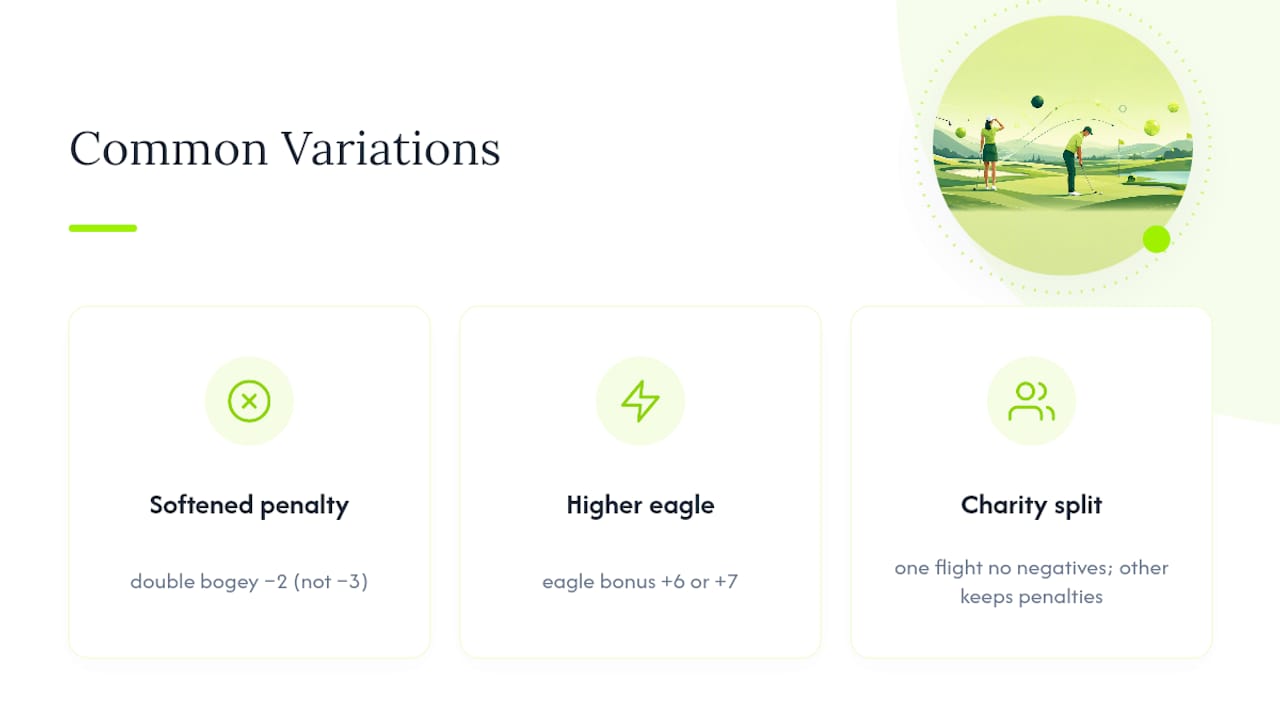
Some leagues soften the double bogey penalty to −2 instead of −3, giving higher-handicap fields more room to recover from one rough hole without falling out of contention entirely. Others push the eagle bonus even higher, to +6 or +7, specifically to reward big par-5 risks in fields full of long hitters. A few charity events strip out negative points entirely for one flight while keeping the full penalty structure for the competitive flight, effectively running two formats under one name at the same event.
Net Modified Stableford is another common twist, where a player's course handicap gets applied hole by hole before points are calculated, so a bogey on a hard hole where a player received a stroke actually counts as a net par worth zero points instead of a −1. This version shows up often in member-guest events specifically because it keeps a wide handicap range competitive from the first tee to the last. Whatever chart a specific event lands on, the underlying philosophy stays the same: reward the exceptional shot more than it punishes the bad one.
When Modified Stableford Makes Sense
Modified Stableford earns its keep at charity events, member-guest outings, and any field with a wide handicap range, since the format keeps a leaderboard moving and gives spectators something to watch swing back and forth. It's less useful for a pure qualifying round, where the goal is ranking players by actual scoring ability rather than by who took the biggest swings. If you're running a casual or mixed-skill event, this is the format that produces the most excitement per round.
— Jon
Run Your Modified Stableford Event Without the Headaches
Chase Birdies is the alternative to spreadsheets and paper scorecards for Modified Stableford events of any size. Instead of tallying point swings by hand between holes, players or scorers log results in real time, and the leaderboard updates itself instantly, showing every eagle-fueled surge as it happens.

Setup takes minutes, not hours. Choose your points chart, share the PIN or public link, and let your field self-manage most of the score entry through their phones. Pricing runs at a flat $1 per player, with no subscription and no setup fee buried in the fine print. If your club or charity outing runs other formats too, the tournament formats page covers scramble, shamble, best ball, and stroke play with the same live scoring setup. Head to the scoring features page to see how hole-by-hole entry works, then set up your next Modified Stableford round in one sitting.
Sources
- How it works: Modified Stableford format - PGA TOUR
- Stableford - Wikipedia
- R&A — Rules of Golf: Rule 21 (Stableford and other forms)
- How to play 'Stableford': The game where the highest score wins | Golf Digest
- Individual Stableford (95%) — USGA