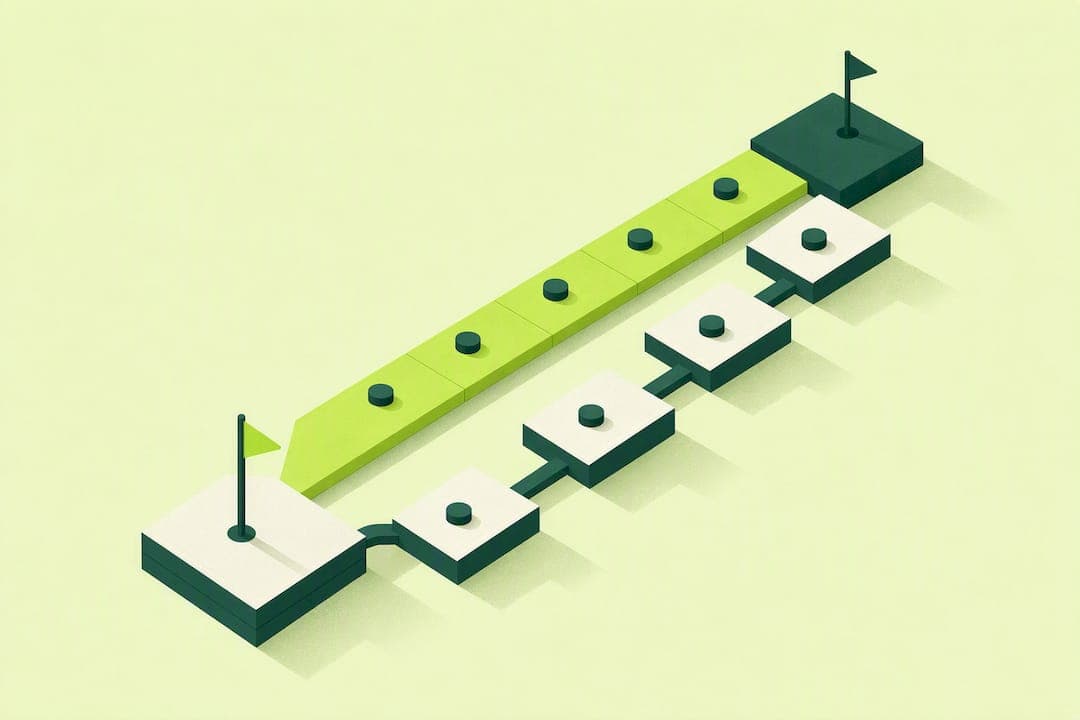
Match play pits you hole by hole against one opponent, and every stroke you lose on a hole disappears the moment the next tee shot starts. Stroke play adds up every swing across the whole round, so one bad hole can follow you for eighteen more. That single distinction changes how you should manage risk, how ties get settled, and even how handicaps get applied on your scorecard.
TL;DR:
- Match play involves winning holes individually, making it more forgiving for bad holes, especially for beginners or high handicappers.
- Penalties differ: a two-stroke penalty in stroke play often costs strokes on the scorecard, while in match play, it can result in losing the hole outright.
- Strategy varies: players in match play can take risks since a bad hole only loses a single hole, whereas stroke play penalizes big mistakes across the entire round.
- Match play is ideal for head-to-head contests and team events, while stroke play suits large fields and tournaments aiming for a fair overall ranking.
- Organizing either format benefits from hole-by-hole scoring apps, which streamline entry, standings, and reduces scoring errors.
Table of Contents
- Match Play vs Stroke Play: How Scoring Actually Works
- How the Rules of Golf Apply Differently to Each Format
- What Strategy Actually Looks Like in Each Format
- Which Format Fits Your Event: Use Cases and Trade-Offs
- Stableford, Fourball, and Other Formats You'll See on a Scorecard
- Running Your Event: An Organizer's Format Checklist
- Where These Formats Came From
- Which Format Suits Your Skill Level
- The Mental Game: Pressure Feels Different in Each Format
- Pace of Play and How Long a Round Actually Takes
- How Ties Get Broken in Each Format
- Author Perspective: Where Each Format Actually Shines
- Run Either Format Without the Scoring Headache
- Sources
- FAQ
Match Play vs Stroke Play: How Scoring Actually Works
Match play scoring is about holes won, not strokes saved. You win a hole by shooting a lower score than your opponent on that hole, halve it by tying, and the match itself ends once one player leads by more holes than remain to be played. A result such as "3 & 2" means one player led by more holes than remained to be played, so the match ended at that point. If the match is tied after the agreed number of holes, it either ends in a halve or moves into sudden-death extra holes, depending on the event's rules.
Stroke play works differently. You add up every stroke across the full round (or multiple rounds in a championship), and the lowest total wins. There's no such thing as conceding a hole early. You play every hole out, hole every putt, and post your total.
A few terms come up constantly in match play that stroke players never need:
- Dormie: a player is up by exactly as many holes as remain, meaning the opponent must win every remaining hole just to tie.
- Halved: both players tie a hole, and neither gains an advantage.
- Conceded putt: an opponent grants you the hole or the remaining putt without you having to play it out, a courtesy unique to match play.
Handicaps get applied differently too. In match play, strokes are given or received hole by hole, based on where each player's handicap allowance falls on the course's stroke allocation table. In stroke play, you calculate net score by subtracting your full handicap from your gross total at the end of the round. According to the USGA's rules on forms of play, match play and stroke play are treated as genuinely distinct competitions, with separate rules covering concessions, scorecards, and handicap application. That's not a technicality. It shapes nearly every decision you make on the course.
How the Rules of Golf Apply Differently to Each Format
The same rule infraction can carry two completely different consequences depending on which format you're playing. Understanding the translation between them keeps you out of avoidable trouble.
- A two-stroke penalty in stroke play often becomes loss of hole in match play. Ground your club in a hazard, for instance, and you'll add two strokes to your stroke-play score. In match play, that same infraction typically costs you the hole outright, according to Golf Monthly's breakdown of penalty differences.
- Concessions are final in match play and don't exist in stroke play. Once your opponent concedes your putt or the hole, that decision cannot be reversed, and you must hole out every putt in stroke play regardless of how short it looks.
- Scorecard errors carry harsher consequences in stroke play. Return a score lower than what you actually shot on a hole, and you risk disqualification. A higher returned score simply stands as recorded, per USGA scorecard guidance.
- Match play gives you more room to self-govern. Because only two players (or two sides) are involved, you can agree on a ruling interpretation on the spot, though either player retains the right to request an official ruling before signing off on the result.
- The "honor" and playing in turn matter more in match play, since the order of play can affect strategy hole to hole. The USGA's match play guidance notes that strict adherence to playing order protects each competitor's tactical interests.
When something ambiguous happens, don't guess. Stroke play calls for marking your scorecard accurately and flagging any uncertainty to the committee before you sign it. Match play calls for pausing play and calling for a ruling before the next shot, since disputes resolved after the fact are far harder to unwind. The NCGA's explainer on stroke play versus match play walks through several real scenarios where waiting too long to ask for a ruling cost a player the hole they were arguing for.
What Strategy Actually Looks Like in Each Format
Stroke play strategy is built around one idea: avoid the big number. A double bogey doesn't just cost you a hole, it follows you to the scorecard for the rest of the round. That's why pros consistently aim for the fat part of the green instead of chasing a tucked pin, prioritizing bogey avoidance over aggression. You're playing the course and the field, not the person next to you.
Match play flips that math. Since each hole is its own contest, a blow-up hole costs you exactly one hole, not the whole round. That containment effect is what makes match play reward adaptability far more than raw consistency. You can afford to take on a risky recovery shot if your opponent is already out of the hole, because the downside is capped.
Here's how that plays out in practice:
- Tee selection: in stroke play, take the club that keeps you in play every time; in match play, you can pull driver on a tight hole if your opponent just found the trees.
- Approach strategy: stroke play rewards center-of-green shots; match play lets you fire at a flag if you're already assured a win or need to force pressure.
- Recovery choices late in a match: if you're down two holes with three to play, you attack. If you're protecting a lead, you play the percentages and let your opponent make the mistake.
- Conceding strategically: giving up a meaningless three-footer keeps pace of play brisk and can also unsettle an opponent who was hoping to build rhythm.
Pro Tip: Momentum in match play is real, but it's fragile. If you win two holes in a row, resist the urge to keep attacking on the next tee. Opponents who feel behind tend to take bigger risks, and playing steady while they gamble is usually how a 2-up lead turns into a 4-up lead.
Which Format Fits Your Event: Use Cases and Trade-Offs
Match play makes sense for head-to-head contests, club match-play ladders, and team cups where the drama of one-on-one competition is the whole point. Team formats like the Ryder Cup rely on match play specifically because it produces dramatic, momentum-driven finishes that a stroke total never quite delivers.
Stroke play is the default for club opens, multi-round championships, and any event with a large field, because it scales without needing a bracket. Every player competes simultaneously against the same par, and organizers favor it for large fields precisely because ranking by total strokes avoids the scheduling headache of running dozens of individual matches.
Administration is where the real trade-off lives:
- Bracket scheduling: match play needs a full knockout bracket built in advance, with byes and seeding decided before the first tee time.
- Time to finish: stroke play rounds have a predictable end time; match play rounds can end early (a 5 & 4 finish) or run the full 18, making tee-time planning trickier.
- Handling ties: stroke play typically resolves ties with a playoff hole or scorecard countback, while match play resolves them with sudden-death extra holes.
If you're choosing a format for your next event, ask yourself three questions: How many players do you need to accommodate, how much drama do you want at the finish, and how much bracket management can you realistically handle? Those answers point you toward one format almost every time.
Stableford, Fourball, and Other Formats You'll See on a Scorecard
Stableford confuses a lot of players because it feels like its own format, but it's actually a stroke-play variant. Instead of counting total strokes, you earn points based on your score relative to par on each hole. Organizers often choose Stableford specifically to speed up play and reduce the sting of one disastrous hole, since a blow-up hole just earns zero points instead of wrecking your total.
Fourball (better ball) and foursomes are team formats that can run under either match play or stroke play rules, depending on the event. Fourball takes the better of two partners' scores on each hole; foursomes has partners alternate shots with a single ball.
Shambles and scrambles are casual variants built for fun rather than formal competition:
- Shamble: everyone tees off, the team picks the best drive, then each player finishes the hole with their own ball.
- Scramble: the team plays every shot from the best previous shot, all the way to the hole.
Your format guide can help you match the right variant to your event's goals before you lock in the rules sheet.
Running Your Event: An Organizer's Format Checklist
- Decide format and field size first. Match play needs a bracket; stroke play just needs tee times.
- Set handicap rules before players arrive. Decide whether you're using hole-by-hole allocation (match play) or net scoring (stroke play).
- Define concessions and playoff procedures in writing. Post them at registration so no one argues on the 18th green.
- Assign markers or scorekeepers and pick a submission workflow. Hole-by-hole entry catches errors faster than end-of-round math.
- Plan for ties, weather delays, and pace of play. Build a buffer into your schedule so one slow group doesn't collapse the whole day.
Pro Tip: Before your full event, run your scoring workflow through a small practice round with four or five players. It's the fastest way to catch a confusing scorecard or a handicap mistake before it costs you credibility on tournament day.
Where These Formats Came From
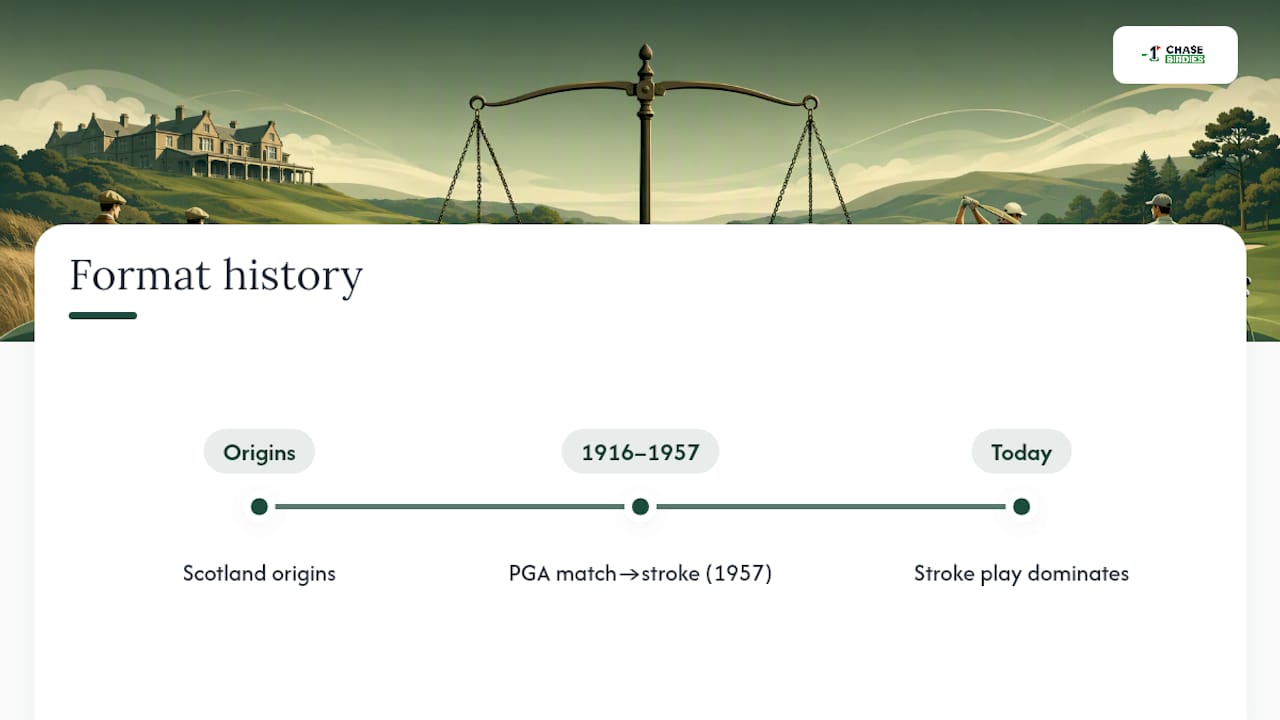
Match play is the older format by a wide margin, tracing back to golf's earliest organized competitions in Scotland, where head-to-head contests were simply easier to officiate on a single course with no formal scoring infrastructure. Stroke play developed as tournaments grew larger and organizers needed a way to rank many players against a common standard rather than running an ever-expanding bracket.
The PGA Championship is the clearest example of that shift in American golf. It ran as a pure match-play championship from 1916 until 1957, when it switched to stroke play to accommodate a larger field and make television broadcasting more manageable. No current major runs the full field through match play today, though the format survives in team competitions and select professional events. That history explains why stroke play now dominates professional golf almost entirely, while match play persists mainly in team formats like the Ryder Cup, club ladders, and knockout qualifiers where the head-to-head drama is the draw rather than a scheduling limitation.
Which Format Suits Your Skill Level
New golfers often find match play more forgiving, since one terrible hole costs a single hole instead of dragging down an entire scorecard. That containment effect lets a beginner post a blow-up nine and still have a real shot at the back nine.
Stroke play, by contrast, punishes exactly the kind of inconsistency beginners tend to show. A single double-par hole can erase three good holes' worth of progress, which is part of why stroke play tends to reward experienced players who have ironed out the big mistakes from their game.
Mid-to-low handicap players tend to enjoy both formats for different reasons. Match play rewards them for reading an opponent and adjusting risk hole by hole, while stroke play rewards the steady ball-striking they've already built. Elite and scratch players often prefer stroke play because it's the format that most cleanly separates skill from luck across a full round, which is exactly why it dominates professional tours.
The Mental Game: Pressure Feels Different in Each Format
Stroke play pressure builds slowly and never really releases. Every shot adds to a running total that follows you for the entire round, so a poor decision on the 4th hole can still weigh on you at the 16th.
Match play pressure resets constantly. Lose a hole, and it's gone. That mental reset is part of why match play produces higher variance and more frequent comebacks, since each hole functions as an independent contest rather than a fragment of a cumulative score. Players who struggle to shake off a bad shot often find match play more forgiving psychologically, simply because the format itself gives them a clean break every 15 minutes or so.
The flip side is that match play introduces its own pressure source: your opponent. Watching someone else's ball flight, reacting to their putt, and adjusting your strategy hole by hole adds a layer of psychological chess that stroke play, played against a fixed par rather than a person, simply doesn't have.
Pace of Play and How Long a Round Actually Takes
Stroke play rounds are the more predictable of the two. Every player plays every hole out, so a foursome's round tends to run close to the same length regardless of how the scores shake out, typically four to four and a half hours for a full field.
Match play rounds are far less predictable. A lopsided match can end in a "5 & 4" finish after just 14 holes, while a tight match can run the full 18 and then head into sudden-death extra holes. That variability makes match play tee sheets harder to plan around, since one early finish can leave a gap on the course while a close match backs up the group behind it.
How Ties Get Broken in Each Format
Stroke play resolves ties through either a scorecard playoff (extra holes played immediately) or a countback method, where officials compare scores on the back nine, then the last six holes, then the last three, until a winner emerges. Major championships typically use a shortened playoff format, while club events often rely on countback to avoid delaying the rest of the field.
Match play ties are simpler by design. If a match is level after 18 holes, it moves straight into sudden-death extra holes, and the first player or side to win a hole wins the match. There's no countback, no scorecard math, just the next hole played until someone comes out ahead.
Author Perspective: Where Each Format Actually Shines
Stroke play is the fairest test of who's actually playing better golf that day, and I'll take it for any event where the scoreboard needs to mean something. But for pure fun, nothing beats match play. Watching two friends battle hole by hole creates drama a stroke total never will. If your goal is fundraising or a casual outing, match play's head-to-head energy usually wins the room. If your goal is a fair competitive result, stroke play is the honest choice.
— Jon
Run Either Format Without the Scoring Headache
Whichever format you choose, the scoring workflow is where most organizers lose an afternoon. Chasebirdies handles hole-by-hole entry for both match play and stroke play from a phone, with standings updating live so nobody's crowding a clipboard on the 18th green.

The platform supports every format covered here, from head-to-head match play brackets to full-field stroke play championships, plus Stableford, scramble, and shamble scoring if your event mixes formats. There's no subscription and no per-event software fee. Costs are based on a per-player fee, making it feasible for both small club ladders and large charity outings. That flat structure makes it realistic for small clubs and nonprofit fundraisers that can't justify a recurring platform bill for one or two events a year.
If you're planning your next tournament, start by browsing the supported formats page to confirm your event's scoring rules, then set up hole-by-hole entry through the scoring app before your field tees off.
Sources
- Rules of Golf — Forms of play (USGA)
- Match play vs stroke play — strategy differences (Golf Monthly)
- Match play and the PGA Championship — where it all began
- Rules of Golf 101: Stroke Play vs. Match Play (NCGA blog)
- Match Play vs. Stroke Play: What Every Golfer Needs to Know
FAQ
What Are the Disadvantages of Match Play?
Match play can end early (like a 5 & 4 finish), making tee sheets unpredictable, and it doesn't scale well for large fields since it requires a full bracket rather than simultaneous play.
Is Stableford Match Play or Stroke Play?
Stableford is a stroke-play variant that awards points based on your score relative to par on each hole, rather than counting total strokes directly.
Is It a Two-Stroke Penalty if Your Ball Goes in the Water?
In stroke play, a ball hit into a water hazard typically costs one penalty stroke under the standard relief options, not two; in match play, that same situation usually costs you the hole if it results in a rules violation rather than a straightforward penalty drop.
Did the PGA Championship Used to Be Match Play?
Yes. The PGA Championship ran as match play from 1916 to 1957 before switching to stroke play to accommodate larger fields and simpler broadcasting.
Which Format Is Easier to Score for a Club Event?
Stroke play is generally easier to administer for large fields since every player competes simultaneously against a shared total, while match play requires bracket management. A tool like Chasebirdies can handle hole-by-hole entry for either format from a phone, which removes most of the scoring workload either way.