
Match play is golf scored hole-by-hole. The player or side that wins the most holes wins the match, not the player with the lowest total strokes. When you see a result like "3 and 2," it means the winner was three holes up with only two holes left to play, so the match ended right there. No back nine needed.
TL;DR:
- Match play ends early once a player or side leads by more holes than remain, making the score like "3 and 2" or "5 and 4" common in results.
- Strokes are allocated based on the handicap difference and hole difficulty, with net scores determining who wins each hole.
- Concessions of holes, strokes, or the entire match are permanent and can be given at any time, influencing match outcomes significantly.
- The format suits casual and competitive play, offering high engagement and strategic depth by treating each hole as an individual contest.
- Live scoring tools simplify management by tracking scores and handicaps in real time, reducing errors in large or complex match play events.
Table of Contents
- What Is Match Play Scoring? Hole Results, Dormie, and Match Outcomes
- Decoding Match Play Scorelines: 3 and 2, 2 and 1, and All Square
- How Handicaps Work in Match Play: Stroke Allocation Made Simple
- Rule Differences That Change How Match Play Is Scored
- Common Match Play Formats: Singles, Four-Ball, and Foursomes
- Match Play Strategy: Why Every Hole Is Its Own Battle
- Running a Match Play Event: Scorecards, Scoring Tools, and Ties
- Why Organizers and Players Keep Coming Back to Match Play
- Set Up Match Play Scoring Without the Spreadsheet Headache
- Sources
- FAQ
What Is Match Play Scoring? Hole Results, Dormie, and Match Outcomes
Every hole in match play is its own contest. Win the hole, and you go "1 up." Lose it, and you go "1 down." Tie the hole (a halve), and the score stays the same. You track the running score as the round goes, and the match ends the moment one side's lead is bigger than the number of holes left to play. That's why you'll never see an 18-hole final score in match play the way you would with stroke totals.
A few terms you'll hear constantly on the course:
- All square means the match is tied, with neither player up.
- Dormie means a player's lead equals the holes remaining, so the worst that leader can do is halve the match.
- Halved match means both sides finished all square after the last hole.
Most club and casual matches accept a halved result and move on. Tournaments that need a winner, especially in bracket-style knockout play, send the match to sudden-death extra holes until someone wins one outright. The USGA's Rule 3 on match play covers exactly how a match closes when a lead exceeds the holes left.
Decoding Match Play Scorelines: 3 and 2, 2 and 1, and All Square
Match play results use a two-number format, and once you know the pattern, every scoreline reads instantly.
- "3 and 2" means the winner was 3 up with 2 holes left. The match ended after 16 holes.
- "2 and 1" means 2 up with 1 hole left. The match ended after 17 holes.
- "5 and 4" means 5 up with 4 holes left. That's a blowout, ending after 14 holes.
- "1 up" describes a match that went the full distance, with the winner ahead by just one hole after 18.
A finished match that never got decided early keeps the simpler "1 up" label instead of a two-number score, since there were no holes left to play. And any time you hear a player is dormie, know it guarantees them at least a halve. Their opponent has to win every remaining hole just to tie.
How Handicaps Work in Match Play: Stroke Allocation Made Simple
Match play handicaps run on a system called "off-low-man." The player with the lowest handicap plays at scratch, and every other player in the match receives strokes equal to the difference between their handicap and that lowest player's handicap.
Those strokes don't land wherever you want them. They're allocated by stroke index, the rating printed on the scorecard that ranks each hole from hardest (SI 1) to easiest (SI 18).
- A player receiving 7 strokes gets one stroke on each hole rated stroke index 1 through 7.
- A player receiving 12 strokes gets strokes on SI 1 through 12, with two on the two toughest holes if the difference exceeds 18.
- Net score, not gross score, decides who wins the hole once strokes are applied.
Stat check: the USGA's handicapping guidance confirms this stroke-difference method as the standard for match play, and team matches compare every player's handicap to the lowest handicap on either side rather than calculating each pairing separately. Decide before the round whether your event uses net or gross scoring, especially in team formats, so nobody argues about it on the 9th green.
Rule Differences That Change How Match Play Is Scored
Match play punishes rule breaks differently than stroke play does, and that difference shapes how aggressively players compete. The SCGA's rules comparison lays out the core distinction clearly: in stroke play, most violations cost two strokes, but in match play the general penalty is loss of the hole. One bad ruling, and the hole is simply gone.
Concessions add another layer unique to match play:
- A player can concede a single stroke, an entire hole, or the whole match at any point.
- Once given, a concession cannot be declined or withdrawn, even if the conceding player has a change of heart.
- Playing out of turn is legal but risky. Your opponent can cancel your shot and make you replay it if it works against them.
Pro Tip: Concede short putts early and often when the pressure is low. It builds goodwill, speeds up play, and sets a precedent that pays off if you need a favor on a tense hole later.
Common Match Play Formats: Singles, Four-Ball, and Foursomes
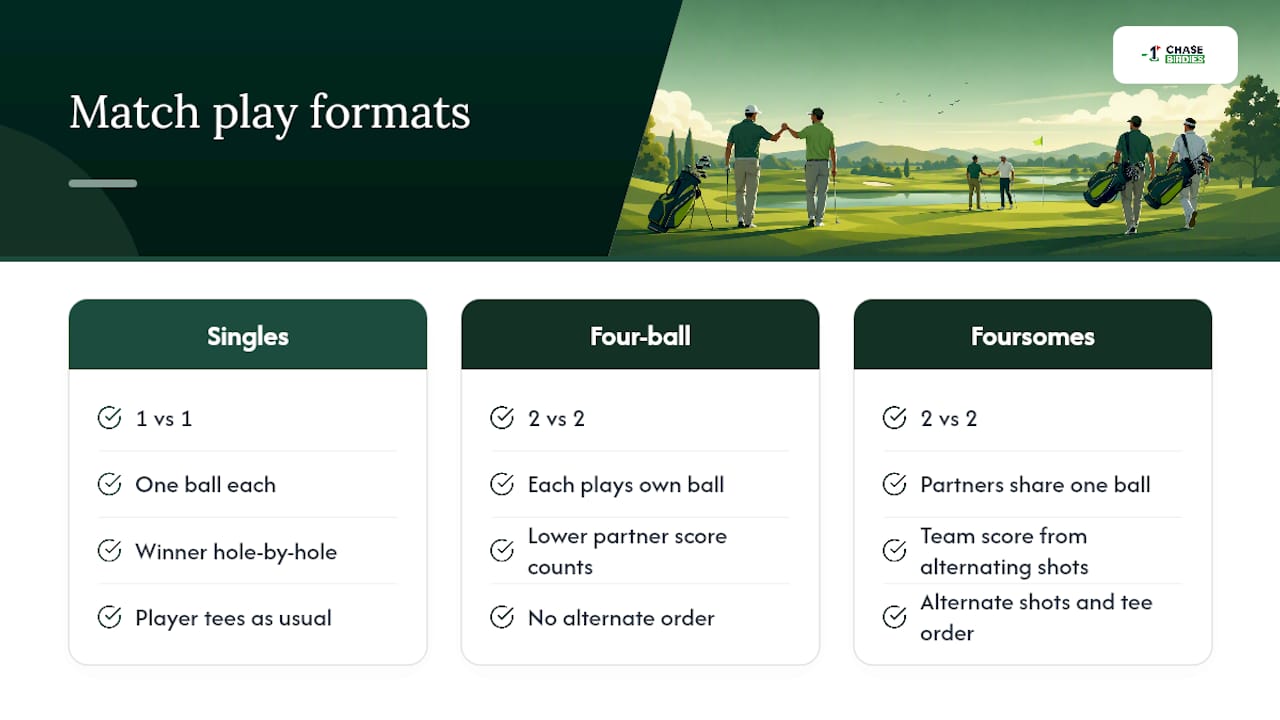
Singles is the purest version: one player against one player, hole by hole, straightforward and personal.
Four-ball, also called better ball, pairs two players against two players, but each golfer plays their own ball throughout. The lower score between partners on each hole becomes the team's score for that hole. It's forgiving because one partner's rough patch doesn't sink the team.
Foursomes, or alternate shot, is the toughest format mentally. Two partners share one ball, alternating shots, and they must alternate who tees off on each hole regardless of who made the last putt. Order matters here more than any other format, since a poor tee shot from the "wrong" partner can put the team behind before the hole even starts.
Casual groups often layer betting formats on top of straight match play. Nassau splits the round into three separate matches, covering the front nine, back nine, and full 18, and players sometimes "press" a new side bet mid-round when they're down and want a fresh start.
Match Play Strategy: Why Every Hole Is Its Own Battle
Stroke play punishes a blow-up hole for the entire round. Match play doesn't. Lose a hole with a triple bogey, and it costs you exactly one hole, nothing more. That single fact should change how you play every shot.
When your opponent is in trouble, in the trees, in a bunker, facing a lost ball, play conservatively and let them make the mistake. When your opponent is sitting safely on the green, that's when you take the aggressive line, because a hole halved from a safe position gains you nothing.

Honour, the right to tee off first, is a small tactical tool. Winning a hole earns you the honour on the next tee, letting you set the tone. Some players who are struggling actually prefer to hit first and take the pressure off their opponent's read on the shot. Golf Monthly's breakdown of match play psychology notes that shot order becomes a real strategic lever once a match tightens up.
Pro Tip: Never concede a hole out of frustration when you're only 1 or 2 down. Matches turn fast in golf, and a conceded hole is gone for good, unlike a bad stroke-play score you can still recover from later in the round.
Running a Match Play Event: Scorecards, Scoring Tools, and Ties
Match play scorekeeping is lighter than stroke play. You need each hole's winner, the running score, and the final margin. Full attested scorecards aren't always required the way they are in stroke play, though some tournaments still ask players to return signed cards for the record, according to the USGA's match play hub.
Before anyone tees off, settle two things:
- Will tied matches after 18 holes go to sudden-death extra holes, or stand as a halve?
- Will you score net (with handicaps applied) or gross?
A live scoring setup like the one built into Chase Birdies' match play format guide removes the mental math entirely. Enter each hole's result as it happens, and the app tracks the margin, flags dormie automatically, and updates the leaderboard for spectators without anyone doing arithmetic on a golf cart dashboard.
Why Organizers and Players Keep Coming Back to Match Play
Match play creates drama stroke play can't match. Every hole feels like its own mini-event, and a player 4 down after 9 can still walk off a winner. That's the pull.
Choose match play when you want engagement over pure scoring precision, club championships, member guest events, and Ryder Cup style team days all lean on it for a reason. Chase Birdies exists because organizers running these formats still want scoring that's simple to set up and easy for players to follow hole by hole.
— Jon
Set Up Match Play Scoring Without the Spreadsheet Headache
Running a match play bracket usually means someone's phone becomes the unofficial scoreboard, and mistakes creep in fast when handicap strokes need tracking across a dozen matches at once. A tool fixes that by giving every match its own live, hole-by-hole leaderboard that updates the second a score gets entered, with handicap allocation built in so nobody has to do stroke-index math on the back nine.

Setup takes minutes, works on any phone without an app download, and there's no subscription tying you down. Chase Birdies charges a flat $1 per player, according to its pricing page, so a 24 player match play bracket costs $24 total, no hidden fees, no long term contract. Explore the hole-by-hole scoring features built for exactly this kind of event, and get your bracket live before your first tee time.
Sources
FAQ
What does 3 and 2 mean in match play?
It means the winning player or side was 3 holes up with only 2 holes left to play, so the match ended after 16 holes instead of going the full 18. The USGA's match play rule confirms a match closes once a lead exceeds the holes remaining.
What does 5 and 4 mean in match play?
A "5 and 4" result means the winner was 5 holes up with 4 holes remaining, ending the match after just 14 holes. It's one of the more lopsided finishes you'll see recorded on a scoreboard.
What does 7 and 6 mean in match play?
"7 and 6" means the winner was 7 up with holes left, so the match ended early. That's about as dominant as a match play result gets beyond the examples like "5 and 4" given here.
What does 2 and 1 mean in golf match play?
"2 and 1" means the winner was 2 holes up with 1 hole remaining, closing the match after 17 holes. It's one of the most common finishing margins in club-level match play.
Can a hole or match be conceded in match play?
Yes. A player can concede a stroke, a hole, or the entire match at any point, and once given, that concession cannot be withdrawn or declined, per the SCGA's rule comparison. This is different from stroke play, where every stroke must be completed and holed out.
How do handicaps work in match play scoring?
The lower-handicap player plays at scratch, and the higher-handicap player receives strokes equal to the handicap difference, applied to the holes rated hardest by stroke index. Net score, not gross score, decides each hole once those strokes are applied.