
Calculate your total purse before you decide anything else, then choose either a ratio-based or fixed-percentage schedule to spread it across places. Apply your tie and rounding rules while you build the sheet, not after players start asking questions. Run the numbers with the formulas below or an online payout calculator before you commit to anything on paper.
TL;DR:
- Payouts should scale with field size using ratio-based methods for dynamic fields or fixed percentages for consistent tournament formats.
- Build the purse from paid entries, subtract non-prize deductions, and add sponsor contributions, ensuring accurate early calculations.
- Handle ties with the add-and-divide method and round payouts carefully to avoid disputes or errors, validating against payout calculators beforehand.
- Separate side pots, skins, and contest prizes from the main purse to keep payouts clear and avoid confusion among players.
- Prioritize non-cash prizes under roughly $1,000 for amateur golfers and clearly define payout and tie rules before the event to prevent disputes.
Table of Contents
- How Do You Decide How Deep to Pay Golf Tournament Payouts?
- Build the Purse: Entries, Deductions, and Sponsor Add-Ons
- Calculate Payouts: Formulas, Ties, and Two Worked Examples
- Side Pots, Contests, and Flights: Keeping Prizes Fair
- Amateur Status and Quick Compliance Reminders
- Quick Formulas and a Calculator Checklist
- Why Payout Clarity Matters More Than Payout Size
- Sources
- FAQ
How Do You Decide How Deep to Pay Golf Tournament Payouts?
The number of places you pay should scale with your field size, not sit at a fixed number you picked because it "felt right" last year. Two methods handle this well, and each fits a different kind of event.
Ratio-based payouts work off a simple rule: pay 1 in every 4 players (or 1 in 5, or 1 in 3, depending on your budget). A 40-player field paying 1-in-4 covers 10 places. Bump that field to 80 players, and you're paying 20 places automatically, without redesigning your schedule from scratch. This is why ratio-based payouts are the standard for club leagues and amateur events with fields that shrink or grow year to year.
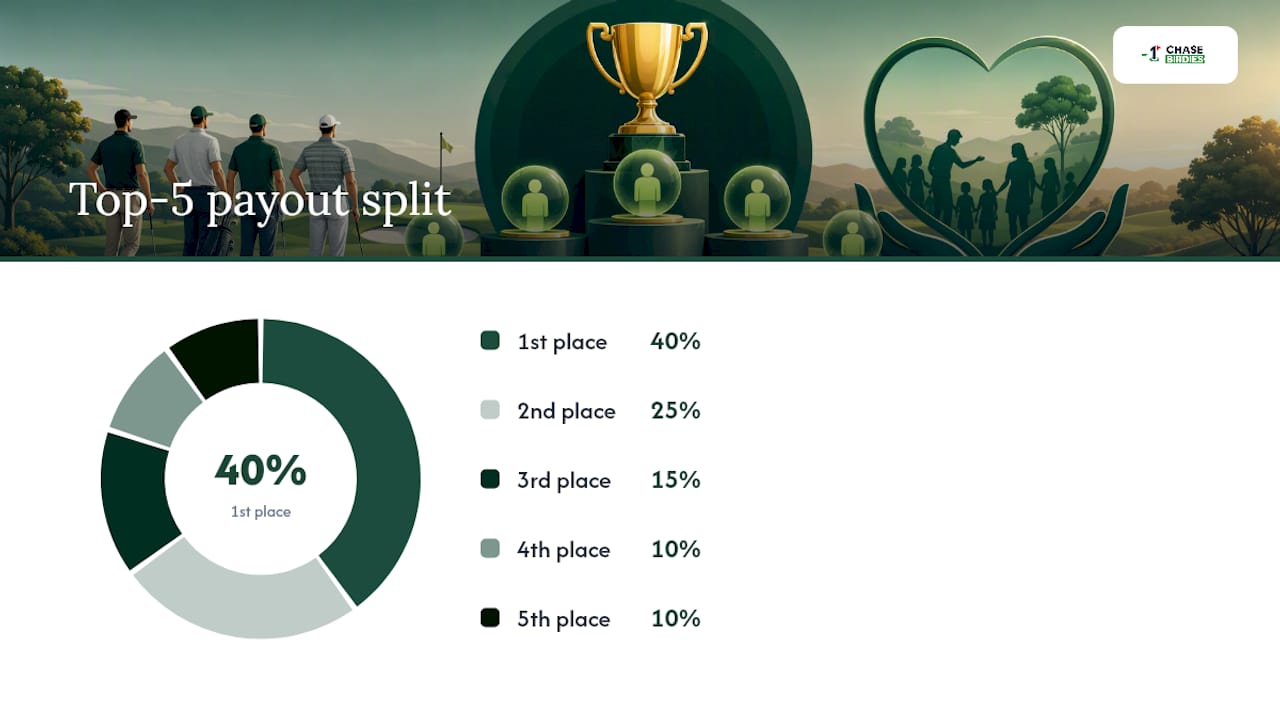
Fixed-percentage schedules assign a set percentage to each place, like 40/25/15/10/10 for a top-5 payout. These work best when your field size barely changes tournament to tournament, since the schedule doesn't adjust to a shrinking or ballooning turnout. If you run the same 32-player member event every quarter, a fixed schedule is simpler to reuse.
A few situations call for extra structure:
- Flighted events, where players are grouped by handicap, need either a duplicate purse per flight or a fixed slice of the main purse per flight.
- Team events (scrambles, shambles, best ball) pay the team, then split the winnings evenly among teammates unless you've stated otherwise in advance.
Pro Tip: If you're aiming for 1-in-4 coverage but don't have enough cash prizes to hit that depth, count door prizes and small merchandise toward your total. A $25 pro-shop gift card still counts as a paid place.
Build the Purse: Entries, Deductions, and Sponsor Add-Ons
The purse formula is straightforward: (paid entries × entry fee) − deductions + sponsor add-ons.
Not every dollar collected at registration belongs in the prize purse, and mixing that up is where a lot of first-time organizers get into trouble.
- Start with paid entries times entry fee. A 40-player field at $75 gives you $3,000 before anything else happens.
- Subtract deductions that don't fund prizes, like green fees paid to the course, admin costs, catering, and any cart or range fees bundled into registration.
- Add sponsor contributions earmarked specifically for prizes, separate from hole sponsorships or auction proceeds that fund the charity itself.
For a charity event, event planning guides recommend budgeting roughly 10 to 15% of gross revenue for prizes, leaning on donated merchandise and sponsor-supplied items to stretch that number further without touching more cash. A $10,000 gross event might allocate $1,200 to $1,500 in prizes and cover the rest through donated rounds, gift baskets, and pro-shop credit.
Quick example: 40 entries at $75 = $3,000. Subtract $800 for green fees and $200 for admin, leaving $2,000. Add $500 in sponsor cash earmarked for prizes, and your purse lands at $2,500.
Calculate Payouts: Formulas, Ties, and Two Worked Examples
The core formula never changes: Payout(place) = Purse × Schedule(place). Set your schedule as percentages that add up to 100%, then multiply each one against the total purse.
Ties get handled with the add-and-divide method: add the prize amounts for every tied place, then divide equally among the tied players. If second and third place both pay $300 and $200 and two players tie, that's $500 split into $250 each.
Rounding matters more than most organizers expect. When a split leaves an odd cent or two, three options work:
- Push the extra cents to whichever tied player finished the round with the better back-nine score.
- Round every payout down to the nearest dollar and donate the leftover to the charity or club fund.
- Round evenly and eat the small variance out of the operating budget.
Payout schedules and add-and-divide tie handling are standard practice across payout calculator tools built specifically for amateur events, which confirms this isn't a workaround, it's the accepted method.
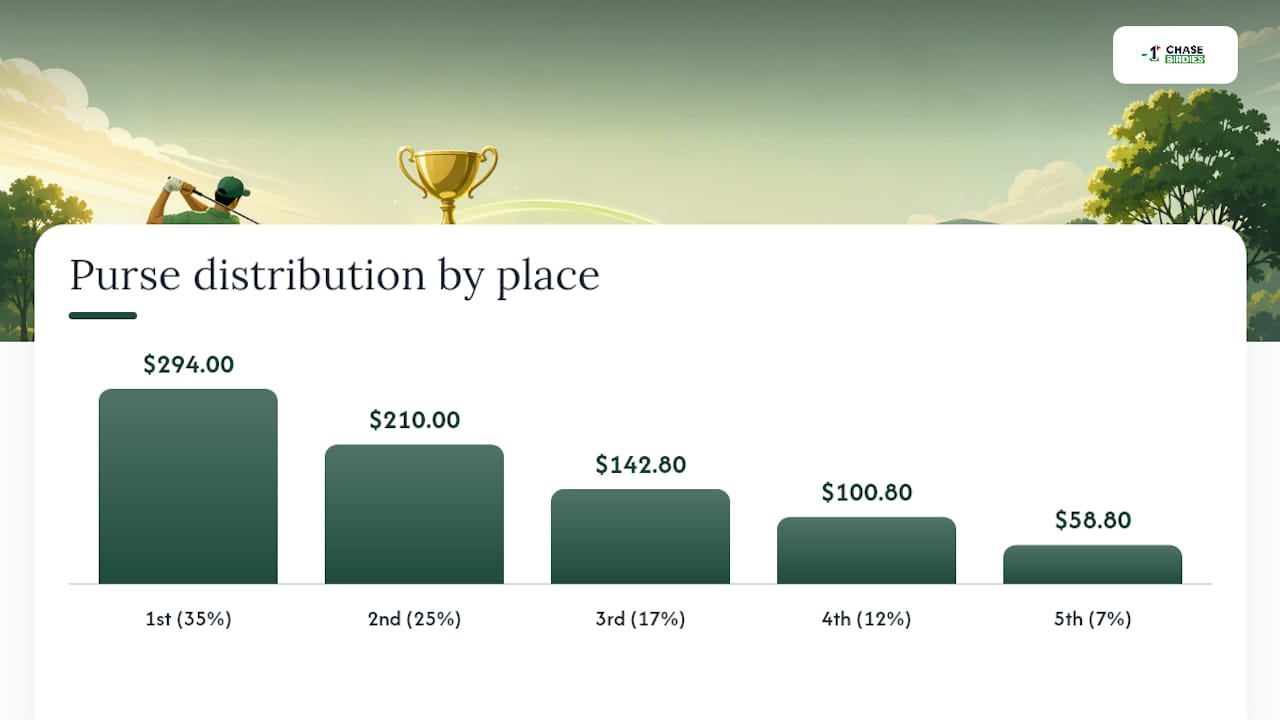
Worked Example A: 24 players, $40 entry fee, $5 admin deduction per player. Purse = (24 × $40) − (24 × $5) = $960 − $120 = $840. Paying 1-in-4 covers 6 places. Using a schedule of 35/25/17/12/7/4, first place earns $294, second $210, third $142.80, fourth $100.80, fifth $58.80, and sixth $33.60.
Worked Example B: 16-team scramble at $200 per team, plus a $20-per-team skins pot. Main purse = 16 × $200 = $3,200 (before any deductions). The skins pot runs separately at 16 × $20 = $320, distributed only among skins winners, never touching the main purse.
Side Pots, Contests, and Flights: Keeping Prizes Fair
Skins, closest-to-pin, and long-drive pots should never touch your main purse math. Mixing them in muddies your payout sheet and makes it harder to explain to players later.
- Calculate the skins pot separately: skins buy-in × number of entrants gives you the total pot. If 5 skins get won during the round, divide the pot by 5 for the per-skin payout. A $10 buy-in across 32 entrants creates a $320 pot; split five ways, that's $64 per skin.
- Handle flights by duplicating the purse or splitting a percentage. Either give each flight its own full purse (works when flights have similar entry counts) or reserve a fixed slice of the main purse per flight based on how many players are in it.
- Split team winnings evenly among teammates unless your entry form states a different arrangement in writing before the round starts.
- Favor merchandise or pro-shop credit over cash in handicap events. It keeps bookkeeping simpler and sidesteps amateur-status questions entirely.
Amateur Status and Quick Compliance Reminders
Cash prizes carry real risk for amateur golfers, and organizers who skip this step can put players in an awkward spot without meaning to. Golf tournament prize guides recommend keeping individual non-cash prizes under roughly $1,000 in typical handicap events, since cash and cash-equivalent prizes are treated differently under amateur-status rules.
The one common exception is the hole-in-one prize. Big-ticket items like a car or a large cash award tied to a hole-in-one are standard practice at charity events, and they're almost always covered by a specific insurance policy rather than paid out of pocket.
For everything else, default to merchandise, pro-shop credit, or experience-based prizes (a round at a nearby course, a golf lesson package) instead of cash. It's simpler, it's safer for your players, and it stretches your prize budget further when local shops donate product.
Quick Formulas and a Calculator Checklist
Keep these four formulas on hand while you build your payout sheet:
- Purse: (paid entries × entry fee) − deductions + sponsor add-ons
- Place payout: Purse × Schedule(place)
- Tie split: sum of tied place amounts ÷ number of tied players
- Skins pot: skins buy-in × entrants ÷ number of skins won
Run through this six-step checklist before you print a single check: confirm final entry count, subtract confirmed deductions, add confirmed sponsor cash, pick your schedule or ratio depth, apply the formulas above to every place, and double-check ties and rounding against your stated policy. Cross-check the total against a golf payout calculator before anything goes to print. A five-minute verification pass catches a lot more math errors than a tired volunteer catches at 9 p.m. the night before.
Why Payout Clarity Matters More Than Payout Size
Most disputes at club and charity events trace back to one thing: nobody wrote down the tie and rounding rules before the round started. Players don't argue about formulas; they argue about surprises. Stating your method on the scorecard or entry form up front, even in one sentence, heads off nearly every complaint before it happens. A live scoring tool like Chase Birdies helps here too, since a visible leaderboard makes the final standings obvious to everyone before payouts get announced, which cuts down on the "wait, how did they win?" conversations.
— Jon
Sources
Cross-check your payout sheet against a couple of outside resources before finalizing anything. CalculatorCorp's golf payout calculator handles purse math, ties, and side pots in one pass. Calculator Academy's golf payout tool walks through sample formulas step by step, and the charity golf tournament planning guide covers budgeting percentages for fundraiser-style events. Running your numbers through even one of these before printing checks catches most errors early.
- Golf Payout Calculator
- Golf payout calculator (CalculatorsHub)
- Charity golf tournament planning guide
- Golf tournament prizes and awards: the complete organizer's guide
FAQ
How Many Places Should a Golf Tournament Pay?
A common rule of thumb is paying 1 place for every 4 players entered, which scales naturally as your field grows or shrinks. Fixed-percentage schedules work fine too, but only when your field size stays consistent tournament to tournament.
How Do You Split a Tie in Golf Tournament Payouts?
Add together the prize amounts for every tied place, then divide that total equally among the tied players. This is called the add-and-divide method, and it's the standard approach used across payout calculators built for amateur events.
Can Amateur Golfers Accept Cash Prizes?
Cash prizes carry risk to amateur status in most handicap events, so organizer guides recommend non-cash prizes like merchandise or pro-shop credit instead, generally keeping individual prize values under roughly $1,000. Hole-in-one prizes are a common exception when covered by insurance.
How Do You Calculate a Skins Pot Separately From the Main Purse?
Multiply the skins buy-in by the number of entrants to get the total pot, then divide by the number of skins actually won during the round. A skins pot should never be mixed into your main tournament purse or its payout schedule.
What Percentage of Gross Revenue Should Go to Prizes at a Charity Golf Event?
Event planning guides commonly recommend budgeting 10 to 15% of gross revenue for prizes at charity tournaments, using donated merchandise and sponsor items to stretch that further. The rest of gross revenue typically goes to course costs, operations, and the charitable cause itself.