
Most small charity tournaments typically cost several thousand dollars in total, while mid-size events with more players and add-ons can cost significantly more. The course package is almost always your biggest line item, with food and beverage and prizes close behind. Your next move: grab a sample budget template, plug in your expected headcount, and let the numbers tell you what to charge for registration.
TL;DR:
- Securing early booking and negotiating course fees six months in advance can significantly reduce costs and increase your bargaining power.
- Sponsorship revenue can offset at least half of the total expenses, with tiered sponsorship options covering everything from signage to exclusive contests.
- Contingency funds of 5 to 15 percent are essential for unexpected costs, weather issues, or last-minute adjustments.
- A detailed, itemized budget template helps prevent hidden costs from inflating your final invoice and guides accurate registration pricing.
- On-course revenue from sales and contests can generate several thousand dollars, reducing pressure on participant registration fees.
Table of Contents
- What Goes Into a Golf Tournament Budget?
- Sample Golf Tournament Budgets You Can Copy
- How Do You Fund a Golf Tournament?
- How to Cut Golf Tournament Costs Without Cutting the Experience
- When to Book and How Much to Set Aside for Surprises
- Your Golf Tournament Budget Checklist
- Where Your Staffing Budget Actually Goes
- Why Most Tournament Budgets Fail Before They're Even Set
- Sources
What Goes Into a Golf Tournament Budget?
A golf tournament budget breaks down into a handful of categories that repeat at nearly every event, whether you're running a 36-player club scramble or a 150-player corporate outing. Knowing them upfront keeps you from getting blindsided by a line item you forgot to price.
Course package and green fees. This usually includes greens fees, carts, and range access bundled together. Watch for F&B minimums buried in the contract, service charges (often 18 to 22%), sales tax, and separate cart plate or signage fees that some courses tack on outside the base rate.
Food and beverage. Boxed lunches run cheaper than a plated dinner or buffet. Beverage carts, drink tickets, and an open bar at the 19th hole all add up fast, and F&B minimums are one of the most common places organizers get surprised by a final invoice.
Prizes, contests, and insurance. Budget for tournament prizes, closest-to-the-pin and longest-drive contests, and hole-in-one insurance if you're offering a big prize (like a car) for that shot.
Player experience items. Welcome bags, printed scorecards, signage, registration materials, and a photographer or videographer if you want content for next year's marketing.
Staffing and operations. Marshals, scoring staff or scoring software, volunteer meals and shirts, and security for larger events with alcohol service.
The small stuff that adds up. Insurance riders, permits, credit card processing fees on registration and donations, and miscellaneous printing costs.
Before you sign anything, ask every vendor these questions:
- What's included in the base price, and what costs extra?
- Is there an F&B minimum, and what happens if we don't hit it?
- What's the deposit amount and cancellation policy?
- Are gratuity and service charges added on top, or already included?
- Are there surcharges for a shotgun start or non-standard tee time?
Sample Golf Tournament Budgets You Can Copy
Numbers help more than advice. Here's how two real-size events shake out.
A 72-player charity tournament commonly totals around $11,000 once you add course fees, carts, F&B, welcome bags, signage, prizes, and insurance. That works out to roughly $153 per player before sponsorship revenue offsets anything.
The mid-size event benefits more from sponsorship, since a $6,000 sponsor haul against $18,500 in costs drops your break-even registration price substantially compared to the small event running mostly on player fees alone.
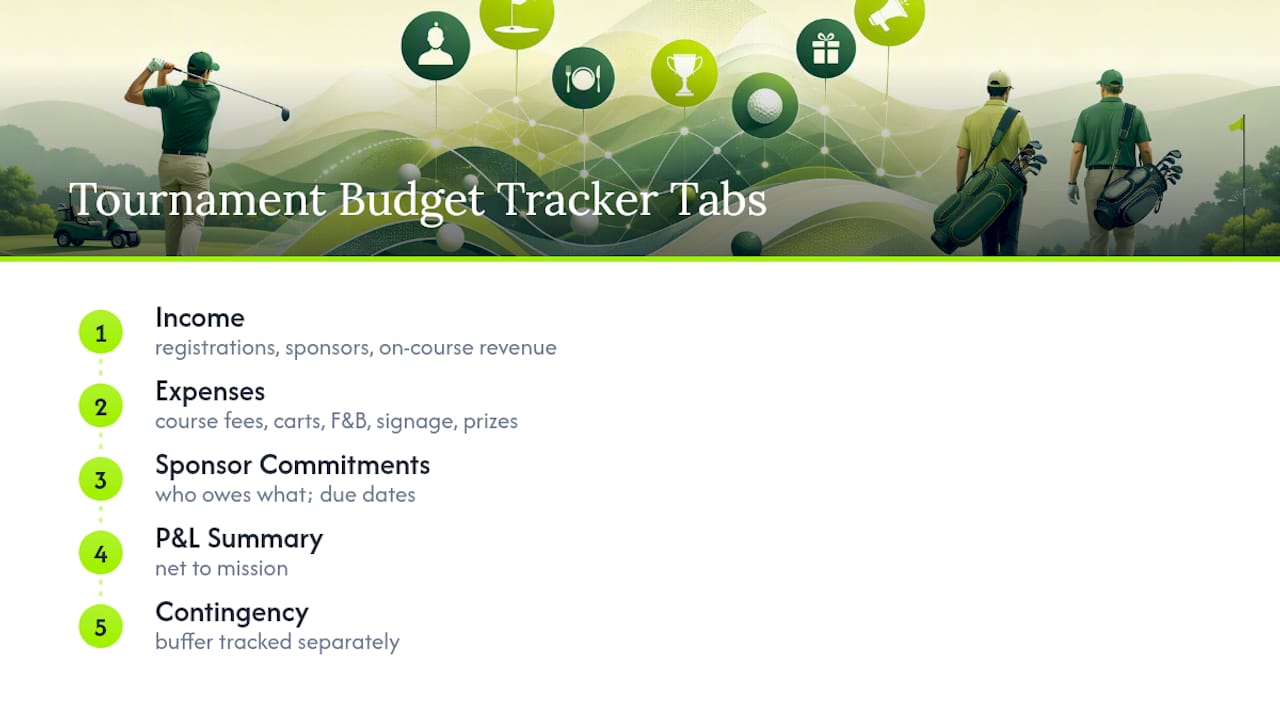
Build your own tracker with five tabs: Income (registrations, sponsors, on-course revenue), Expenses (every category above), Sponsor Commitments (who owes what, and when it's due), P&L Summary (net to mission), and Contingency (your buffer, tracked separately so it doesn't quietly get spent on regular line items).
To set your registration price, add total expenses plus your contingency, subtract expected sponsorship, then divide by your expected player count. That's your break-even number before you add any profit margin for the cause.
How Do You Fund a Golf Tournament?
Player fees alone rarely cover a charity event's costs. Combining strong sponsorship with reasonable registration pricing tends to produce a better net-to-mission result than leaning on players to cover everything.
Structure sponsor tiers to match your expense categories:
- Title sponsor ($3,000 to $10,000+): logo on all materials, tee-off remarks, top signage placement.
- Platinum/Gold ($1,000 to $2,500): banner placement, mention in program, foursome included.
- Hole sponsor ($150 to $500): a sign at one tee box, common at almost every event.
- Contest sponsor ($250 to $750): branding on closest-to-the-pin or longest-drive holes.
On-course revenue fills the gaps: mulligan sales, putting contests, raffle tickets, and a silent auction can realistically add several thousand dollars without raising registration prices. Track every sponsor commitment and invoice date in your spreadsheet's Sponsor Commitments tab so nothing slips through before the event.
How to Cut Golf Tournament Costs Without Cutting the Experience
Cost control starts before you ever sign a contract, not after you're already over budget.
- Book weekdays or shoulder-season dates. Course rates drop noticeably outside peak weekend windows.
- Negotiate the F&B minimum down and ask for comps like free range time, cart signage, or waived staff fees.
- Chase in-kind donations for prizes and welcome bag items instead of buying everything outright.
- Skip the expensive banquet and run a mulligan sale or raffle instead. It often nets more per hour of effort.
- Consolidate vendors where you can, and get every tax and service charge confirmed in writing before you sign.
Pro Tip: Ask your host course for a written, itemized quote rather than a bundled price. Bundled quotes hide the F&B minimums and service charges that turn a $9,000 estimate into an $11,500 invoice.
When to Book and How Much to Set Aside for Surprises
Book your venue at least six months out. Early booking gives you real negotiating leverage and often unlocks comps that vanish once a course's calendar fills up.
- Expect a deposit, often around 25% of estimated costs, due at signing.
- Confirm your final player guarantee deadline, usually one to two weeks before the event.
- Ask about shotgun start pricing, since non-standard start times often carry a surcharge and courses may require a minimum player count to approve one.
- Set aside a contingency fund of roughly 5 to 15% of your total budget for last-minute add-ons, weather changes, or print corrections.
Your Golf Tournament Budget Checklist
- Confirm exactly what's included in your course package, in writing.
- Lock your final sponsor list and invoice schedule.
- Set your registration price using the break-even formula and open registration.
- Assign volunteer leads for registration, scoring, and day-of logistics.
- Add your contingency line and don't touch it unless something actually goes wrong.
Pro Tip: Small items like extra scorecards, tee gift shipping, and last-minute signage reprints rarely get their own budget line, but they routinely add several hundred dollars by event day.
For a full week-by-week task list, the 8-week planning checklist walks through what to do and when.
Where Your Staffing Budget Actually Goes
Manual scorekeeping eats staff hours you're probably budgeting for without realizing it. Hole-by-hole live scoring cuts the need for extra scoring volunteers and speeds up results. Chase Birdies charges $1 per player, no subscription, works on mobile, and plugs straight into your expense sheet as a fixed, predictable line item instead of a staffing guess.
Why Most Tournament Budgets Fail Before They're Even Set
Most budget advice treats every line item as equally negotiable, and that's backwards. The course package is where the real money hides, not the welcome bags. Organizers spend hours agonizing over prize sourcing and skip the harder conversation with the venue's F&B manager about minimums and service charges buried three pages into the contract.
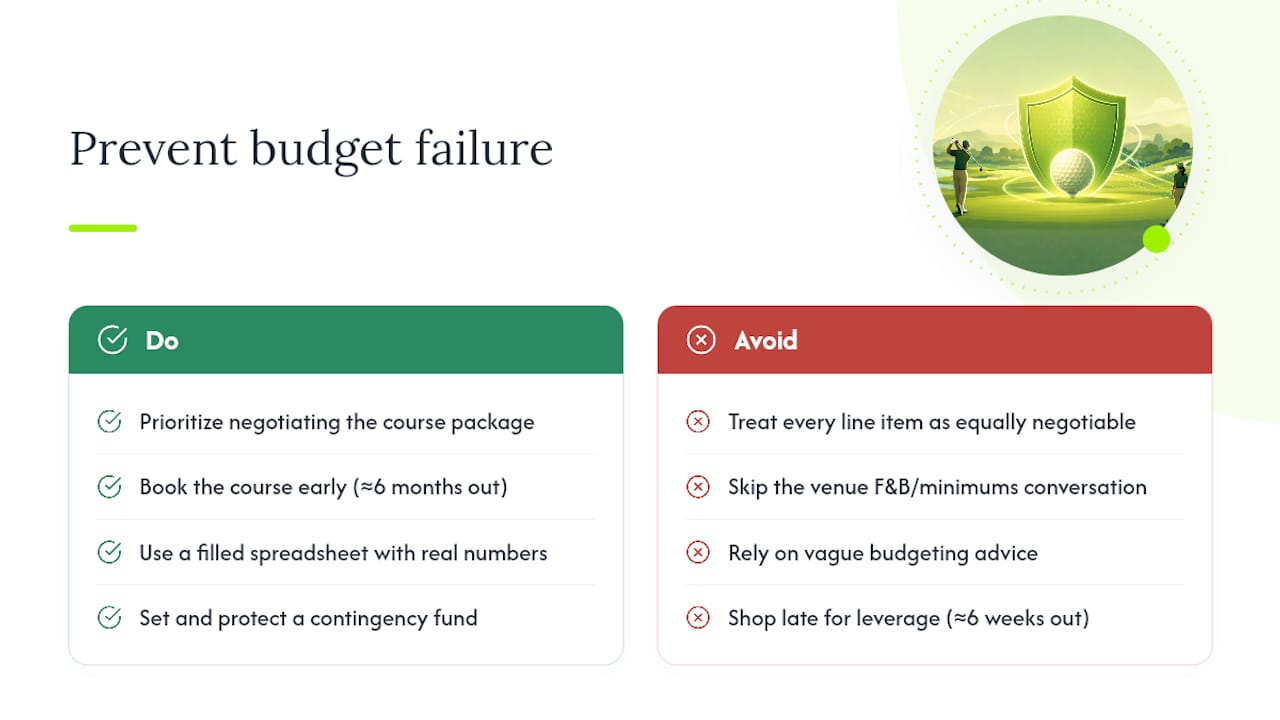
The conventional wisdom says "get three quotes and compare." That's fine advice, but it misses the bigger lever: negotiating leverage comes from booking early, not shopping around late. A course six months out has room to comp your range time or waive a signage fee. A course six weeks out has neither incentive nor availability to give you anything.
If you take one thing from this guide, prioritize the template over the tips. Vague budgeting advice doesn't stop a $9,000 estimate from becoming an $11,500 invoice. A filled-in spreadsheet with real numbers, checked against every vendor's written quote, does. Set your contingency fund, protect it, and build your registration price backward from what the event actually costs, not what you hope it costs.
— Jon
Sources
- How Much Does It Cost to Run a Charity Golf Tournament? A Complete Budget Breakdown - Tee To Toe
- Shotgun Pricing
- Teeing Up for a Cause — Host a Charity Golf Tournament | Watersound Club