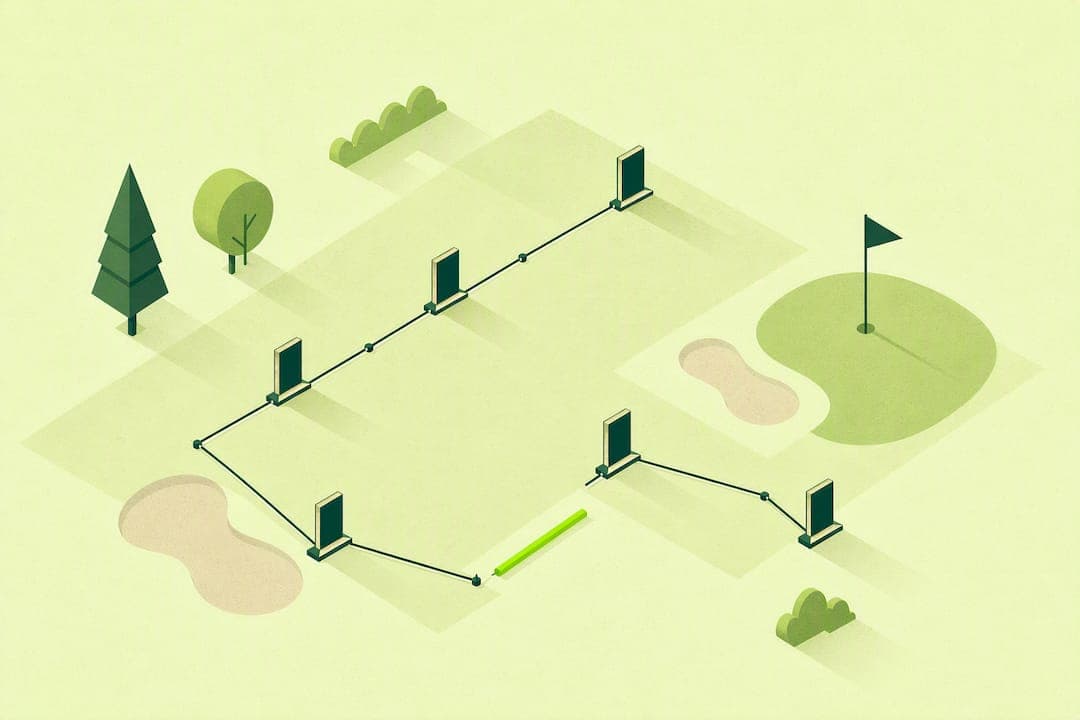
The golf string game replaces your handicap strokes with a length of string. Every time you move your ball to a better spot, you measure that distance, cut off an equal length of string, and toss the used piece. The stroke still counts on your card. String only repositions the ball, and once you've used it up, you're playing it straight for the rest of the round.
TL;DR:
- String length typically correlates with handicap, with common conversions being one foot or one yard per stroke, adapting to skill level.
- House rules vary on green use, hazards, and team formats, making early agreement crucial to prevent disputes during the round.
- String use does not affect stroke count but allows repositioning of the ball with significant moves costing a large portion of allotted string.
- Spending string should be strategic, reserving it for difficult shots or trouble spots, as overuse on easy putts or approaches wastes valuable resource.
- Proper pre-round setup, clear rules, and real-time tracking simplify implementation at outings, keeping the game fast and engaging for all skill levels.
Table of Contents
- What Is the Golf String Game and How Does It Work?
- How Do You Set Up String Length and Supplies?
- What Rule Variations Should Your Group Agree On?
- How Does String Affect Your Score?
- When Should You Actually Spend String?
- How Do You Run a String Game at an Outing?
- What's the Typical Flow of a Round Using String?
- Common Etiquette for String Games
- Why the String Format Works So Well for Mixed Groups
- Run Your String Game Without the Scoring Headache
- Where to Learn More About String Rules
- Sources
What Is the Golf String Game and How Does It Work?
The mechanics stay the same from tee to green, but you need to know the sequence before your group starts arguing on the third hole. Here's the flow that keeps things fair.
- Get your string before you tee off. Each player receives a length tied to their handicap, and someone should jot the starting length on the scorecard next to your name.
- Declare before you swing. If you want to move your ball, say so before you hit, whether that's a full shot or a three-foot putt. Waiting until after a bad result to "remember" your string is the fastest way to start a dispute.
- Measure first, then cut. Stretch the string along the actual distance you're moving the ball, cut that segment, and hand the leftover back to your pocket. Golf Monthly explains that this cut piece gets discarded immediately. It's gone for good.
- Move the ball any direction. Forward, sideways, out of a divot, away from a sprinkler head. Distance is distance.
- Know the standard no-go zones. Most groups won't let you use string off the tee, since there's no lie to fix yet, and many house rules ban it in water hazards entirely.
That last point trips up more groups than anything else. Decide your hazard and tee-box rules before round one, not while someone's ankle-deep in a pond arguing for a mulligan.
How Do You Set Up String Length and Supplies?
Length usually maps directly to handicap, and the two most common conversions are one foot per stroke or one yard per stroke. A foot-per-stroke system gives a 12-handicap player a length of string proportional to their handicap for the round, while a 5-handicap gets a shorter equivalent; some groups use feet, others yards. That is enough to bail out of real trouble a couple of times.
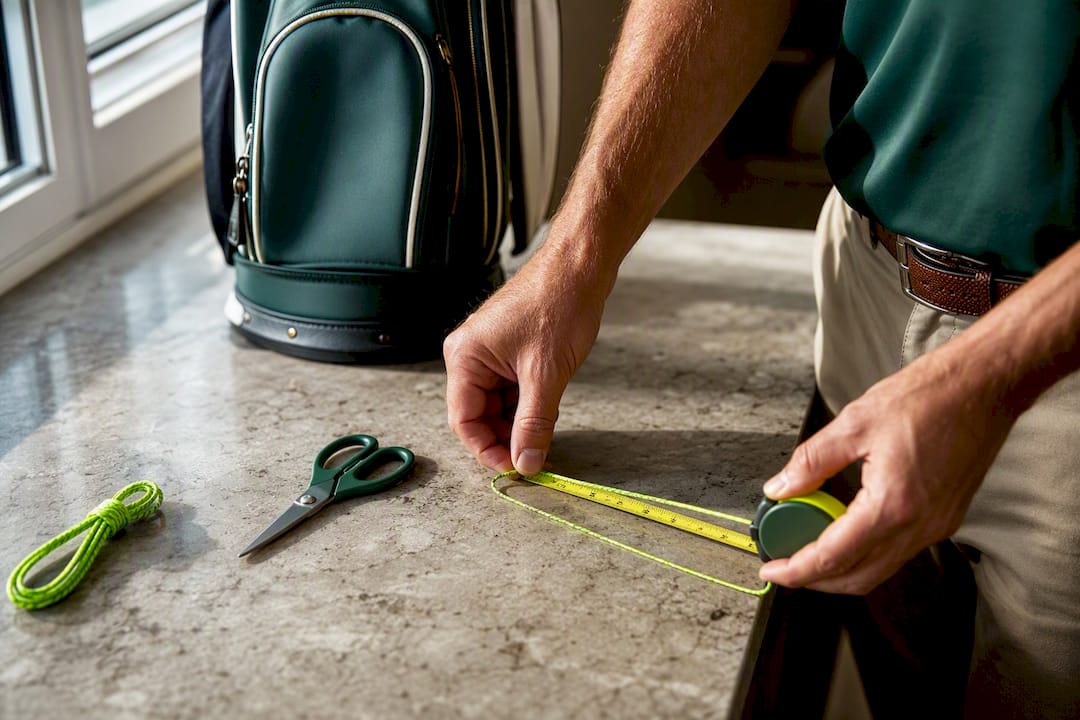
Some groups reduce the amount of string allotted in proportion to the handicap to balance advantages across skill levels
Before your outing, gather:
- Scissors for every player (small travel scissors work fine)
- A short ruler or a soft measuring tape for accurate cuts
- Pre-cut, pre-labeled string packets by handicap tier
- A scorecard column specifically for tracking remaining string
Pro Tip: Cut the packets the night before and label them by handicap range instead of by name. It's faster to hand out "10 to 14 handicap" bundles at check-in than to search for individual names while a line forms at the first tee.
Selling extra string is a simple add-on for charity events, and if you want inspiration for organizing such events, check out Padel tournaments in Lithuania for ideas on running small tournament formats and event logistics. A few extra feet at $2 or $3 apiece adds up fast across a full field.
What Rule Variations Should Your Group Agree On?
The golf string game changes character depending on a handful of house-rule decisions your group makes before the round starts. Get these settled early and you'll avoid the debate that always seems to erupt around the 14th hole.
Green rules. Allowing string on the putting surface turns the format into a real risk calculation. Golf Monthly notes that green-eligible string transforms short putts into a spending decision rather than an automatic gimme, since players have to weigh a guaranteed make against saving that string for a tougher spot later. Ban string on the green, and the format leans more toward rescuing bad approach shots than fixing missed putts.
Hazard rules. Water hazards are commonly off-limits, but bunkers and deep rough are usually fair game. ShunGolf's rundown lists extraction from bunkers and rough among the most common string uses in casual play.
Team and shared-string formats. Some groups pool string across a foursome instead of assigning it per player, which works well for scramble-style team events. Whoever cuts a piece still discards it. The team total just drops together.
Tie-breaking. A few house rules use leftover string length as a sudden-death tiebreaker, awarding the win to whoever has more string left unused.
Whatever you settle on, write it down and put it on the scorecard. Verbal rules become disputed rules by hole number six.
How Does String Affect Your Score?
The stroke count never changes. If you three-putt and use string to save the third one, you still wrote down a three-putt hole. What changes is where the ball sits, not what you write on the card.
Here's how the math actually plays out:
- A 5-foot putt saved: You knock in a birdie putt from six feet, watch it slide four feet past, and use 4 feet of string to place it in the cup instead of facing a comeback putt. You still count the stroke that missed. You just skip the second putt.
- A 20-foot extraction: Your approach lands in a fairway bunker, and rather than blading it across the green, you use 20 feet of string to set it on the fringe. That's a big chunk of a 5-handicap's total allotment for one shot.
- Foot-per-stroke math: A 5-handicap with 5 feet total can't afford many big moves. A 12-handicap with 12 feet has more room to fix multiple small mistakes across the round.
The three-quarters conversion exists specifically so a 20-handicap doesn't walk away with an unfair mountain of string compared to a 5-handicap who's already playing tighter golf.
When Should You Actually Spend String?
Value-per-inch thinking beats spending string reflexively. A three-foot putt save costs almost nothing and removes real risk. A 20-yard rescue from deep rough costs a huge chunk of your total for one shot, so save those for situations where the alternative is a near-certain double bogey or a penalty stroke.
Hold string in reserve for the holes you already know are trouble, whether that's the par-3 with the pond fronting the green or the dogleg where your slice always finds trouble. Spend freely once you're deep into the back nine with string left over and no more "save it for later" holes coming up.
Pro Tip: Round every measurement down, not up. A generous eyeball estimate on a cut always looks worse in hindsight than a slightly conservative one, and it keeps your playing partners from questioning every future cut you make.
How Do You Run a String Game at an Outing?
Adding the string format to a club outing or charity event takes minimal extra setup if you prep ahead. Build a short checklist:
- Printed house rules for every group (green rule, hazard rule, tee-box rule, all spelled out)
- Pre-cut string packets sorted by handicap tier
- Scissors and a measuring tool in every cart or golf bag
- A quick briefing for scorers on how to log string usage hole by hole
Record string usage right alongside strokes on each hole rather than trying to reconstruct it at the turn. A live scoreboard that displays remaining string next to each player's name adds a fun leaderboard angle beyond just the raw score, and tools built for hole-by-hole scoring make that tracking painless for volunteer scorers who are already juggling enough.
Selling extra string packets at check-in is an easy fundraising add for charity rounds, and shared-string team formats keep foursomes engaged even when one player's swing goes sideways early. As a bonus, string tends to speed up play. Fewer re-hits from bad lies means fewer groups bunching up behind you.
What's the Typical Flow of a Round Using String?
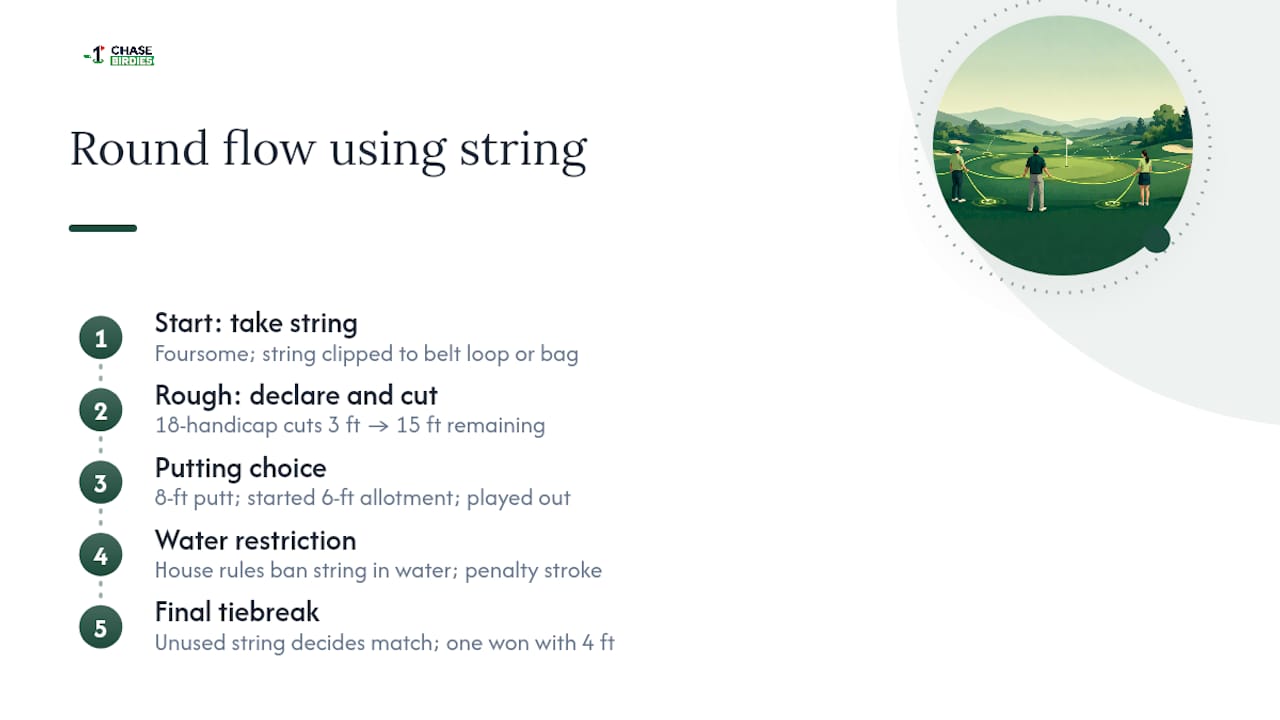
Picture a foursome of mixed handicaps teeing off with their string clipped to a belt loop or tucked in a golf bag pocket. On the first hole, the 18-handicap player drives into the right rough with an ugly lie. He declares before his next swing, measures three feet to a clean patch of fairway, cuts three feet off his string, and drops the ball there. His scorecard still shows the stroke; the string column now reads 15 feet remaining.
By the fifth hole, a low-handicap player faces a slick eight-foot putt for par. She's got green use allowed under the group's house rules, so she rolls it two feet past, then debates: spend eight feet of a starting 6-foot allotment (impossible) or take the second putt. With barely any string to spare, she plays it out.
Later, on a par-5 guarded by water, another player's approach lands in the drink. Their house rules ban string in water hazards, so no rescue is available. That's a penalty stroke regardless of remaining string.
On the final hole, two players are tied. Their group's tiebreaker rule kicks in: whoever has more string left unused wins the side match. One player held back all round specifically for this moment, and it pays off with four unused feet to spare.
That's the format working exactly as intended: strategic through 18 holes, not just at the finish.
Common Etiquette for String Games
String adds a layer of trust to a format that already runs on the honor system, so a few etiquette habits keep rounds friendly instead of tense.
Always declare your intent to use string before you hit, never after seeing a bad result. Announcing "I might use string here" as you're already swinging looks like you're covering for a mistake rather than making a strategic choice, and it puts your partners in an awkward spot if they have to call you on it.
Measure honestly and let a playing partner glance at the cut if there's any doubt. Nobody wants to police every inch, but a quick second look on a big cut avoids hard feelings later. Don't pressure playing partners to reveal their remaining string total mid-round unless your house rules use it as a public tiebreaker; some players like to keep that number private for strategic reasons, and that's fair.
Keep pace of play in mind. String is meant to speed rounds up by removing repeated bad-lie strokes, not slow them down while someone digs through a bag for scissors. Cut a handful of extra pieces and precut common lengths (3 feet, 5 feet, 10 feet) so measuring goes faster.
Finally, respect the one-time-use rule without exception. Trying to piece together two used segments to make a longer cut isn't just against the rules; it undercuts the entire premise of the format. Once it's cut, it's done.
Why the String Format Works So Well for Mixed Groups
The biggest thing people underestimate about this format is how much it changes the feel of a round for higher-handicap players, not just the numbers. A bad lie stops being a round-wrecking moment and becomes a decision point instead. That shift matters more for keeping casual groups engaged than any scoring adjustment on paper.
Publish your house rules before the first tee shot, track remaining string on the scorecard, and consider pairing the format with a scramble or shamble for a charity event that keeps every skill level involved from hole one to eighteen.
— Jon
Run Your String Game Without the Scoring Headache
String adds a fun wrinkle to a round, but tracking cut lengths on top of strokes, handicaps, and a leaderboard by hand gets messy fast, especially at a charity outing with forty or fifty players spread across a course. Chasebirdies handles the scoring side so you can focus on running the format, not chasing down scorecards.

With hole-by-hole entry, players or scorers log strokes in real time, and your live leaderboard updates instantly so everyone can see standings without waiting at the clubhouse. Setup takes minutes, not days, and there's no subscription to manage. Just a flat $1 per player, detailed on the pricing page, whether you're running a club outing, a scramble, or a string-format charity round. If you're planning your next event, browse the available tournament formats and set up your leaderboard before your next tee time.
Where to Learn More About String Rules
- Golf Monthly covers the core definition and green/hazard variations.
- LiveAbout breaks down length conversions and handicap mapping.
- ShunGolf lists common practical uses during a round.
- GolfBlogger explains charity fundraising and team variants.
Confirm your group's specific house rules before you tee off. Variations are common enough that assuming one version is universal is the fastest route to a disagreement on the back nine.
Sources
- What is the golf string game? | Golf Monthly
- The String It Out Golf Game | LiveAbout
- Golf string basics: What you need to know | ShunGolf
- Golf Games: Stringball - GolfBlogger