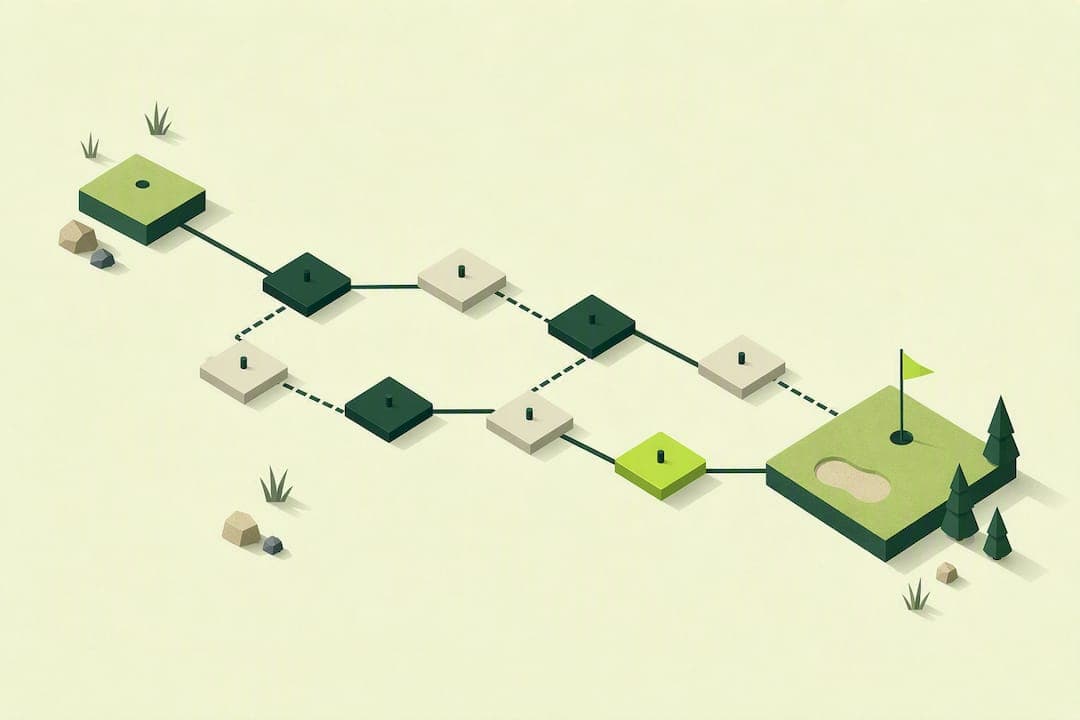
Alternate shot, or foursomes, is a two-player format where partners share one ball and take turns hitting it. One player tees off on odd holes, the other on even holes, and after that first shot, you alternate every stroke until the ball is holed. Penalty strokes never change whose turn it is next.
TL;DR:
- Teams must decide their odd or even tee-off order before the round and cannot change it afterward, as rotation resets each hole, not after each total.
- Penalties or out-of-turn shots do not alter the established turn order, and players must correct any mistakes before starting the next hole to avoid disqualification.
- In stroke play, a 50% allowance of the total team handicaps is standard, with the signatory process simplified to only one partner signing the scorecard.
- Using visual cues, like flipping a tee or coin, helps prevent confusion about turn order and speeds up the pace of play.
- Clear rules and preparation reduce disputes and make organizing or running a foursomes event more efficient, especially with live scoring tools.
Table of Contents
- What Does Alternate Shot Rules Actually Cover?
- How Do the Core Rules of Alternate Shot Work?
- What Mistakes Do Alternate Shot Teams Make Most?
- How Does Scoring and Handicapping Work in Foursomes?
- What Strategy Actually Helps in Alternate Shot?
- Why Clear Rules Make Foursomes More Fun
- Running an Alternate-Shot Event Without the Headache
- Sources
- FAQ
What Does Alternate Shot Rules Actually Cover?
Alternate shot shows up most often in match play, though plenty of stroke-play events use it too, including some of the most-watched team golf on the planet. The Ryder Cup has run foursomes sessions for decades, which is likely where most casual players first saw the format in action.
It's easy to confuse alternate shot with its cousins, so here's the quick breakdown:
- Alternate shot (foursomes): two partners, one ball, alternating strokes.
- Fourball: two partners, each playing their own ball, with the better score counting for the team.
- Greensomes: both partners tee off, pick the better drive, then alternate shots from there.
- Chapman (or "pinehurst"): both drive, then hit each other's second shot, then pick one ball and alternate.
Your side chooses its own tee order before the round starts, unless the tournament committee sets specific terms for the competition. Always check the notice board or the pairings sheet before you assume you get to decide.
How Do the Core Rules of Alternate Shot Work?
Rule 22 is short as golf rules go, but it packs in a lot. Here's the actionable version, straight from the USGA's Rule 22 text.
Before you tee off: decide which partner plays the odd-numbered holes and which plays the even-numbered holes. That choice locks in for the entire round. You can't swap it on the back nine because your partner is playing better.
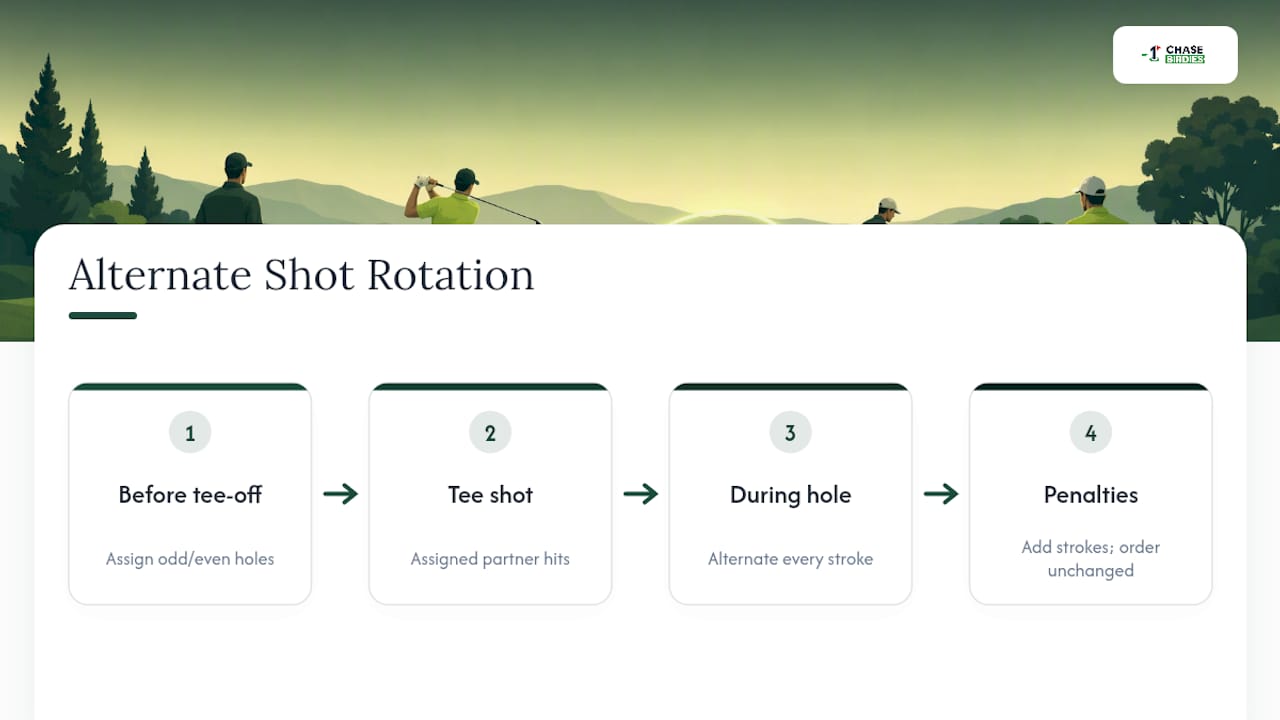
During the hole: partners alternate every stroke, including putts, until the ball is in the hole. Whoever plays the tee shot on hole one doesn't touch the ball again until it's their partner's turn.
Penalties don't shuffle the order. This trips up more teams than anything else in the format. If your partner's drive draws a stroke-and-distance penalty, you still play the next shot, exactly as the fixed rotation dictates. The penalty adds strokes to the score; it does not hand the turn back to whoever just played.
Quick reference: Breach of the alternating-order rule carries the general penalty. In match play that's loss of hole. In stroke play, it's two penalty strokes, according to the USGA's official ruling.
If your side plays out of order in stroke play, here's the fix: any stroke made out of turn doesn't count. The correct partner has to replay from the spot where the wrong-order stroke was first made, and any penalty strokes from that earlier error still apply. You must correct the mistake before teeing off on the next hole. Miss that window, or sign an incorrect scorecard, and disqualification follows.
Either partner may act for the side at any point. One of you can mark the ball, lift it, replace it, take a drop, or sign the scorecard, according to R&A's Rule 22 guidance. If a provisional ball needs playing, the same partner who's next in the rotation plays it. You don't get to swap turns just because a provisional is involved.
What Mistakes Do Alternate Shot Teams Make Most?
The single biggest mix-up: players think alternation carries over between holes. It doesn't. Whoever holes the winning putt on hole three doesn't automatically tee off on hole four. Rotation restarts at the tee based on your pre-set odd/even assignment, a point Golf Monthly's explainer flags as a common source of confusion for newcomers to the format.
If you discover mid-hole that someone played out of turn, stop immediately. Work out the correct replay point, note any penalty, and keep moving. Don't argue it out on the fairway while the group behind you waits.
- Announce your tee order out loud on the first tee, so there's no ambiguity later.
- Assign a scorecard signer before you start, even though either partner can technically do it.
- Write your odd/even split on your scorecard as a reminder for the back nine.
Pro Tip: Use a simple visual cue, like flipping a tee or a coin, or a shared bag tag, to mark whose turn it is at each tee box. It sounds basic, but it eliminates the "wait, whose hole is this?" conversation that slows down more foursomes rounds than any rules dispute.
How Does Scoring and Handicapping Work in Foursomes?
In stroke play, your team records one score per hole, the total strokes it took to hole that single ball. There's no "better ball" counting here. Every stroke, including penalty strokes, goes on the card.
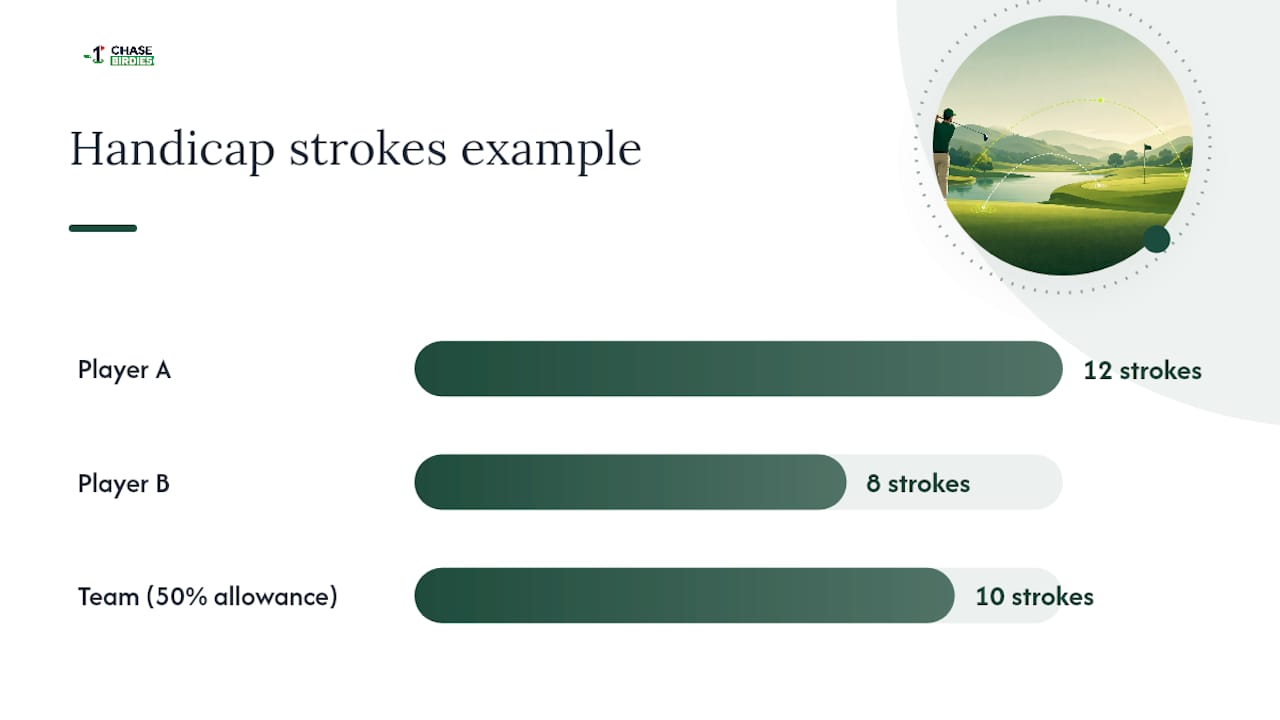
Handicaps get a little more interesting. The most common method for match-play foursomes applies a 50% allowance of the combined course handicaps, a practice GolferHive's foursomes breakdown lays out clearly.
Here's a worked example:
- Player A has a course handicap of 12. Player B has a course handicap of 8.
- Combine them: 12 plus 8 equals 20.
- Apply the 50% allowance: 20 times 0.5 equals a team handicap of 10 strokes for the round.
Scorecard signing is simpler than you'd think. Only one partner needs to sign in stroke play, though either one is allowed to do it under the same rule that lets either partner act for the side. Sign it wrong, or leave a hole score off entirely, and you're looking at disqualification, so double-check before you hand it in. If your event runs on stroke-play scoring, confirm with your organizer how they want the card submitted.
What Strategy Actually Helps in Alternate Shot?
Picking odd or even holes isn't just a coin flip if you think it through. Look at the course routing. If your stronger driver struggles with a tricky opening tee shot, put your steadier player on the odd holes and adjust from there. Weather matters too. A player who handles wind well should probably take the exposed holes.
- Split your combined bag carefully. The rule allows 14 clubs total between both players, not 14 each, according to USGA's Rule 22.
- Decide who reads putts on the greens, since only the player about to hit can get help lining up.
- Stay off your partner's line and out of their sightline while they're playing a shot.
- In match play, agree in advance on how aggressively you'll concede short putts to keep pace moving.
Pro Tip: If one of you carries a strong short game and the other bombs drives, build your club split around that. Give the short-game player extra wedges and putters worth of flexibility, and let the long hitter carry fewer clubs. Fourteen combined clubs go further when you're not duplicating gear.
Why Clear Rules Make Foursomes More Fun
Foursomes rewards preparation more than any other format. A team that locks in tee order, agrees on a scorecard signer, and knows the correction procedure for a wrong-order stroke plays faster and argues less. Most disputes I've seen traced back to a rule nobody read beforehand, not a genuinely ambiguous ruling.
If you're running an event, hand out written tee-order and scoring instructions before the round starts. When a real dispute comes up, point players to the official rule text instead of settling it by memory on the fairway.
— Jon
Running an Alternate-Shot Event Without the Headache
Rule 22 gives you the playing rules. Chasebirdies handles the part that actually eats up an organizer's afternoon: tracking who shot what and keeping the field updated hole by hole. Instead of chasing paper scorecards around the clubhouse, you get live scoring and leaderboards that update the moment a score gets entered, on any phone, with no app download required.

Chasebirdies supports foursomes alongside scramble, shamble, and match play formats, so if your event mixes formats across flights, one setup covers all of it. Pricing runs $1 per player, one time, with no subscription and no hidden add-ons, which matters if you're running a club outing or a fundraiser on a tight budget. Check the pricing page and set up your next alternate-shot event in minutes.
Sources
- Rule 22 - Foursomes (Also Known as Alternate Shot) — USGA
- Foursomes (Also Known as Alternate Shot) — R&A
- Alternate shot golf format explained — Golf Monthly
- Foursomes golf: rules, handicaps & how to play explained — GolferHive
FAQ
What Is an Ostrich in Golf?
An ostrich is scoring five strokes under par on a single hole, a term that pops up occasionally in golf trivia but has nothing to do with the alternate-shot format itself. It's essentially a step beyond an albatross and is exceedingly rare, since it would require something like a hole-in-one on a par six.
What Does 69 Mean in Golf?
A score well under par simply means a player finished a round several strokes below the course par. It carries no special rules meaning in alternate shot; it's just a strong individual or team total for the round.
How Does Alternate Shot Work in the Ryder Cup?
Ryder Cup foursomes sessions follow standard Rule 22: each two-player team hits one ball, alternates strokes, and sticks to a fixed tee-off order for the match. The format has been part of the Ryder Cup for generations, which is why casual fans often recognize it even without knowing the formal rule number.
How Do You Handicap a Two-Player Alternate Shot Team?
The common approach combines both players' course handicaps and applies a 50% allowance, so a team with handicaps of 12 and 8 gets a combined allowance of 10 strokes, following the method GolferHive outlines. Some stroke-play events use a slightly different combined or averaged calculation, so always confirm the method your organizer or club is using before the round.
Does Chasebirdies Support Alternate Shot Scoring for Tournaments?
Yes, Chasebirdies supports foursomes scoring alongside other common formats, with hole-by-hole entry and live leaderboard updates. Pricing is $1 per player, a flat one-time charge with no subscription required.